
-
News
- 3 Oct 2026
Why Bayern didn't receive a penalty for Joao Neves' handball: 'The rule has been changed four times'
3 min read
News

There was major controversy in the Champions League semi-final second leg between Bayern Munich and Paris Saint-Germain on Wednesday.
The first leg was an entertainment spectacular that finished 5-4 to the Parisians a week ago but the second leg was a more measured affair, dramatic for other reasons than effervescent attacking football.
PSG progressed 6-5 on aggregate after a strike from Ousmane Dembele just a few minutes into play, with Harry Kane netting late on. Though Luis Enrique's men looked dangerous on the counter from there, they also defended superbly and largely kept the likes of Harry Kane, Michael Olise and Luis Diaz at bay.
A couple of handball incidents caused uproar in the stands as the Allianz Arena faithful left the match furious at the decisions by the referee and VAR.
First, Nuno Mendes escaped a second yellow card after the bull struck his hand from close range in the middle of the pitch. The referee deemed that Konrad Laimer had handballed it seconds before and awarded PSG the free-kick even though replays showed it hit Laimer's chest.
For Bayern, the most puzzling decision was still to come.
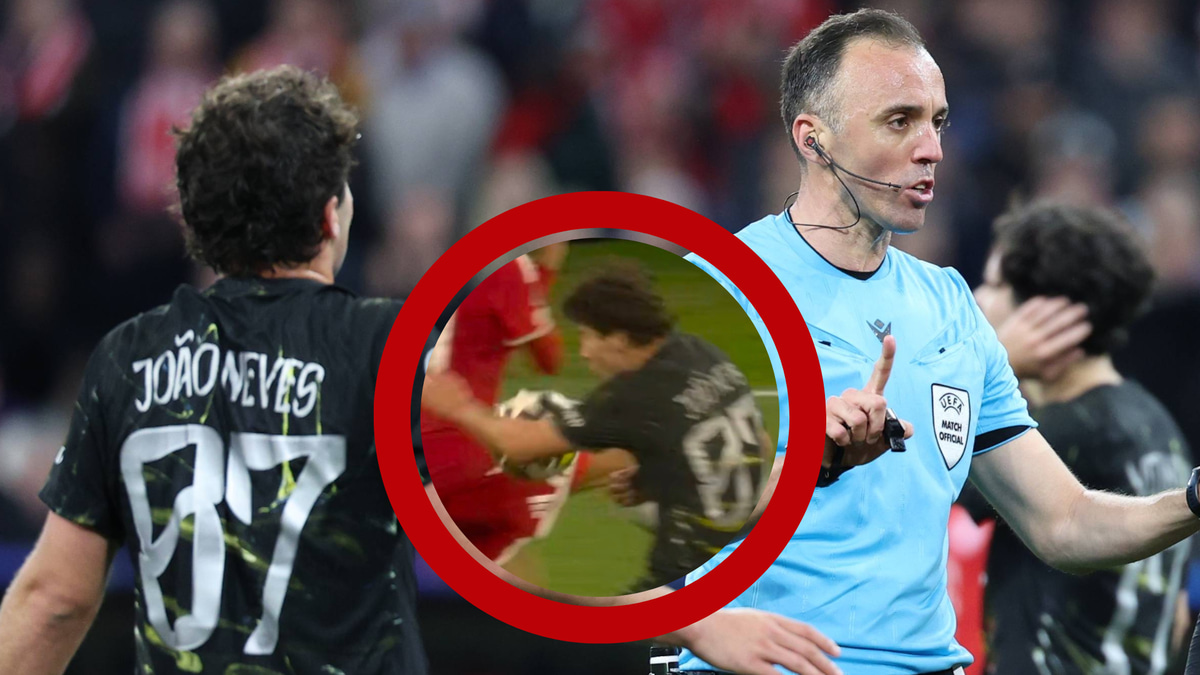
Vitinha, in an attempted clearance, cannoned the ball off the arm of his team-mate, Joao Neves, inside the PSG penalty area. The Bayern players quickly surrounded the referee but nothing came of the incident as head coach Vincent Kompany was left dumfounded.
However, there are very specific rules in place for this type of handball incident.
The BBC posted the following on social media after the handball:
"The laws of football say it's not a handball if 'hit on the hand/arm by the ball which has been played by a team-mate (unless the ball goes directly into the opponents' goal or the player scores immediately afterwards, in which case a direct free kick is awarded to the other team)'".
The situation was further explained by soccer laws analyst and former referee Christina Unkel on CBS Sports: "Anytime you have a clearance by a defender kicking and clearing the ball out from and is going towards upfield and it hits another defender of theirs.
"That is not considered a deliberate handball offence. This is one of those exceptions. It's not deliberate because you go back to the purpose of the handball - are you gaining an unfair advantage?
"Are you gaining a competitive advantage? And here, a defender clearing the ball outside of their defensive third moving up the field into a close range of a fellow defender into their direct hand, what competitive advantage are they gaining?
"And this is why it's an exception to the rule. It is not a handling offence. It doesn't matter necessarily where his arm is, he's not taking an advantage away from anybody in that sense and that's why it says it's an exception."
Unkel went on to explain the confusion that has developed over the last few years due to the constant amendments to the handball rule.
"The law on handling has changed over the past 15 years, probably about four times," she continued.
"And there's been many arguments here - just keep it simple. If it hits a hand, it's a handball offence. Okay, no problem.
"That was applied. Then everyone said that's too draconian, right? Now we're going to add distance to it, we're going to add who hits it. Then that actually was taken back and they went back to a little bit more draconian if it hits your hand. Then everyone's like, 'we don't like this again'.
"Those are typically games that happen in World Cups and to be quite honest in Champions League games where they think its too harsh of a rule and the punishment doesn't fit the crime. So now we're back once again to saying - and it was even like two-three years ago - distance wasn't a consideration.
"So even if it was a close shot by an attacker and it hits a defender's hand and they don't have time to move their hand out of the way, we were still giving it as penalties. That was as late as three years ago. Now we've added distance and time to react back into the analysis."