
-
Analysis
- 6 hours ago
Inside the club-led reform movement shaking up German football
5 min read
Analysis

German lower-league clubs are in open revolt against the established order, and they have been for some time.
Far away from the glitz and glamour of the Bundesliga, a reform movement is calling for change to the footballing pyramid in Germany. The frustration stems from the fact that the current promotion system is broken - or "sick," as supporters of Lokomotive Leipzig described it.
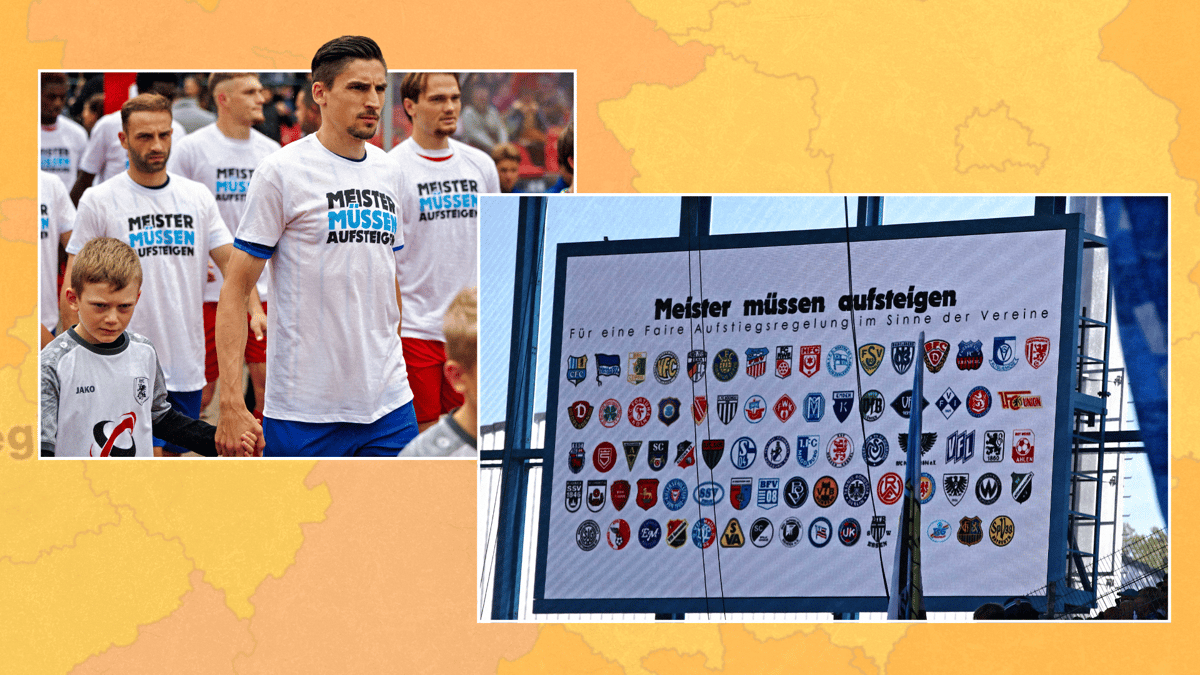
The reform movement wants German football to adhere to the idea that Meister müssen aufsteigen - champions must get promoted. Currently, this is not the case, at least not everywhere.
If you win one of the regional, semi-professional fourth divisions in Germany, the Regionalligas, you are not guaranteed promotion to the third tier, the 3. Liga. That is, unless you play in one of the western divisions.
The Regionalliga Südwest (Southwest) and West each have one automatic promotion spot. The other three Regionalligas do not. Only four teams get promoted to the 3. Liga, yet there are five divisions. It is easy to see why this could lead to conflict.
How does promotion to the 3. Liga work?
Currently, the system is such that the winners of the West and Southwest divisions are guaranteed promotion, while an additional automatic promotion spot rotates between the other three leagues, Bayern (Bavaria), Nord (North) and Nordost (Northeast).
That leaves two regional champions who have to play in a two-legged playoff after the regular season to determine the fourth promoted side. One league winner, therefore, does not get to reach the promised land of fully professional football.
Lok Leipzig's social media post after losing the promotion playoff for the second season running
Lokomotive Leipzig are back-to-back champions in the Regionalliga Nordost, comprising the territory of the former German Democratic Republic, yet they are still stuck in the fourth division because they have lost twice in the promotion playoff in the last two seasons.
The reasoning behind privileging the western divisions over the rest of the country was exceedingly simple. Because the areas have a higher population and concentration of clubs, they should get automatic promotion spots.
While that may be true, this argument no longer holds up to any kind of scrutiny. For example, the Northeastern league, which is basically the old GDR-Oberliga with teams from West Berlin, has become the most attractive and best-attended division because of its sheer number of huge clubs.
That, of course, is a double-edged sword. On the one hand, it has reinvigorated the football scene in eastern Germany, with big derby games drawing tens of thousands of spectators.
On the other hand, it means that some of the most notable East German clubs are stuck in fourth-division no-man's-land and, more often than not, have their fate decided in a playoff - despite winning the league.
Right now, the only eastern German clubs in the top-three leagues are RB Leipzig and Union Berlin in the Bundesliga, Dynamo Dresden and 1. FC Magdeburg in the 2. Bundesliga and Hansa Rostock in the 3. Liga.
Half of the 18 teams in the Regionalliga Nordost are former big hitters from the GDR-Oberliga. They're historic clubs with huge fanbases, and many of them used to play European football. By contrast, six of Regionalliga West's 18 clubs are Bundesliga or 2. Bundesliga reserve sides.
Promotion reform
While the problem of champions not getting promoted also concerns the North and Bavaria divisions, it is unsurprising that the campaign for a promotion reform started in the Northeast last year.
It is not a new phenomenon, though. For more than a decade, the DFB has been deliberating on changing the structure of the Regionalligas so as to have a fairer promotion system.
However, previous proposals for change were not deemed workable solutions. That's why clubs have now taken matters into their own hands and started pressuring the DFB to get its act together.
The biggest roadblock is the DFB's federated structure. Because all of the Regionalligas have their own governing body, finding common ground isn't easy. Moreover, any change to the promotion system also requires the consent of 3. Liga clubs.
The easiest solution would be to promote all five champions, either by adding an additional relegation spot to the 3. Liga or by expanding the number of clubs in the division. However, this has been vehemently opposed by 3. Liga clubs and the DFB.
Eight years ago, the DFB added a fourth relegation spot and, in return, promised to reduce the number of Regionalligas from five to four. It hasn't made good on that promise, so adding another relegation spot to the 3. Liga is deemed "illegitimate."
The only solution is to get rid of one Regionalliga. The most obvious candidates would be the North and Bavaria divisions - or even the Regionalliga West - as all of them have significant structural problems.
Despite having access to more and wealthier sponsors than the economically disadvantaged Northeast, many clubs in those leagues are struggling to stay afloat because of low attendances and a general lack of public interest.
Arguing on those grounds is not straightforward, though, especially as clubs in the Northeast league haven't exactly covered themselves in glory by constantly losing the promotion playoff.
Chemie Leipzig won two national titles in the GDR
You can't really say that you are the most robust or most attractive league when you repeatedly fail to beat teams from ostensibly weaker divisions over two legs. On sporting merit, it is the Northeast that should be removed.
That would be catastrophic for football in an already struggling area. Nevertheless, the Northeast division has had to make concessions in order to garner support for its so-called "compass model," which is now the favoured reform proposal nationally.
The idea is that clubs would be allocated into four divisions based on fluid geographic borders, loosely aligned with the cardinal directions. These borders would be determined with the help of artificial intelligence while taking into account travel distance and local derbies.
The Regionalliga Northeast would then become a Regionalliga East and, instead of solely comprising the state borders of the former GDR, it could also include teams from northern Bavaria.
The trade-off is that it would likely lose its northern clubs like Greifswald - or Hansa Rostock if they were to suffer relegation from the 3. Liga. An eastern league without Hansa would be almost unthinkable, but that is the sacrifice that may have to be made for the good of German football.
This proposal has received strong support from northern Bavarian clubs like Bayreuth, which just goes to show how appealing the Northeastern division is. They believe that playing against huge clubs like Chemnitz, Erfurt and the Leipzig teams rather than sides from Bavarian small towns and villages could transform their revenues.
The same would be true for the other side of the country, too. A fusion of the western divisions would make the new West league much more appealing, as it would corral big teams like Rot-Weiß Oberhausen, FSV Frankfurt and the Stuttgarter Kickers all into one competition.
More than 80 clubs from across the German pyramid, including Bundesliga teams, have come out in support of the compass model. However, the backing hasn't been unanimous.
In June, clubs were supposed to vote on the reform, but last-minute amendments caused chaos and ultimately doomed the reform. The Southwest division voted against the compass model and instead wanted the Northeastern division to be dissolved.
Bavaria, meanwhile, claimed that the vote was premature and wanted the topic to be discussed further. The league has been one of the toughest nuts to crack for the reform movement, despite support from Bavarian clubs. Bavarian exceptionalism is a hell of a drug.
Widespread fan protests have erupted across Germany in the wake of this farce, while players in the Northeast are walking out for their games in shirts that read "champions must be promoted" and then stand still for the first minute before kicking off.
In order to finally resolve the issue, the DFB will hold an extraordinary general meeting on 18 December. The reform campaign has two months to break the resistance of those who still oppose the compass model. Will it succeed?
Read more about:
Bundesliga