
-
News
- 18 hours ago
The first kick - how the 1930 World Cup changed football forever
4 Jun 2026 11:01 CDT |
4 min read
Analysis

The first World Cup took place in 1930, hosted in Uruguay, and it has since become the world’s greatest sporting event.
The trophy would be named after FIFA president Jules Rimet, its most famous founding father, and the need for a true world championship stemmed from a succession of successful Olympic tournaments in the 1920s and the irreversible onset of professionalism. It was an age of comparative innocence, and when France beat Mexico on that mid-summer Sunday in the now demolished Estadio Pocitos in the Uruguayan capital – with Frenchman Lucien Laurent scoring the World Cup’s inaugural goal – history was in the making.
Hosts Uruguay seemed to have everything going their way. They had dominated the 1924 and 1928 Olympic tournaments, and had offered to pay all expenses of World Cup entrants. Sadly, the Europeans who had given birth to the idea of a World Cup were far from enthusiastic about taking part on the far side of the Atlantic.
The home countries had deserted FIFA in 1920 and consequently the first three tournaments would be conspicuous by their absence. That split reflected a lack of communication in the world game, and thoughts of two weeks by boat either way and ten weeks away from home restricted European participation to four nations for the historic inaugural tournament.
France were bludgeoned into going by Rimet, Belgium by their persuasive FA president Rodolphe Seeldrayers. Romania competed, only thanks to the personal intervention of King Carol, who promised to make up to the players’ employers (mainly British) any losses incurred while the team were away. Yugoslavia completed the quartet.
Rimet’s great dream was finally fulfilled...the tournament was to provide a mixture of quality
- Nonetheless, Rimet’s great dream was finally fulfilled and as 13 nations – split into three groups of three and one of four – set out on the road to history, the tournament was to provide a mixture of quality football, eccentric refereeing and a fine conclusion.
The South American giants, Argentina – and particularly double Olympic champions Uruguay – were favourites and after Hector Castro’s goal for the latter beat Peru, four goals against Romania clinched Group 3. But the best was yet to come.
And when Luis Monti’s 81st-minute goal for Argentina clinched victory over France, they too were on their way. Guillermo Stabile scored a hat-trick in the 6-3 win over Mexico and his brace in the victory against Chile secured Argentina’s semi-final place.
Group 1 also had its idiosyncrasies. The referee in the Argentina v France match blew for time six minutes early, and against Mexico the side from across the River Plate got the better of five, somewhat dubious, penalty decisions awarded by Bolivian referee Ulises Saucedo.
In Group 4, European dissatisfaction continued when Belgium lost to the United States and Paraguay. Surprisingly, the latter proved no match for a North American side reinforced by six ex-British émigré professionals, who comfortably won 3-0 to win the group.
Yugoslavia, who had been so disappointing in Olympiads throughout the 1920s, gave Europe its only glimmer of respectability. Goals from forwards Aleksandar Tirnanic and Yvan Beck gave them a 2-1 victory over the fancied Brazilians, and Beck notched another two in a more comfortable four-goal hammering of Bolivia, which ensured a semi-final place.
In the semi-final against Uruguay, Djordje Vujadinovic scored a brilliant goal to give Yugoslavia an early lead. But the bubble soon burst against a side passing into legend. Goals by Spanish-born forward Pedro Cea and Peregrino Anselmo changed the course of the match, and the former went on to complete his hat-trick in the second half as Uruguay, ultimately convincing, won 6-1.
Two goals apiece from Stabile and Carlos Peucelle helped Argentina to an identical scoreline against a plucky but totally outclassed USA in the other semi-final to guarantee a final between the traditionally bitter River Plate rivals who had contested the 1928 Olympic final, when Uruguay triumphed 2-1.
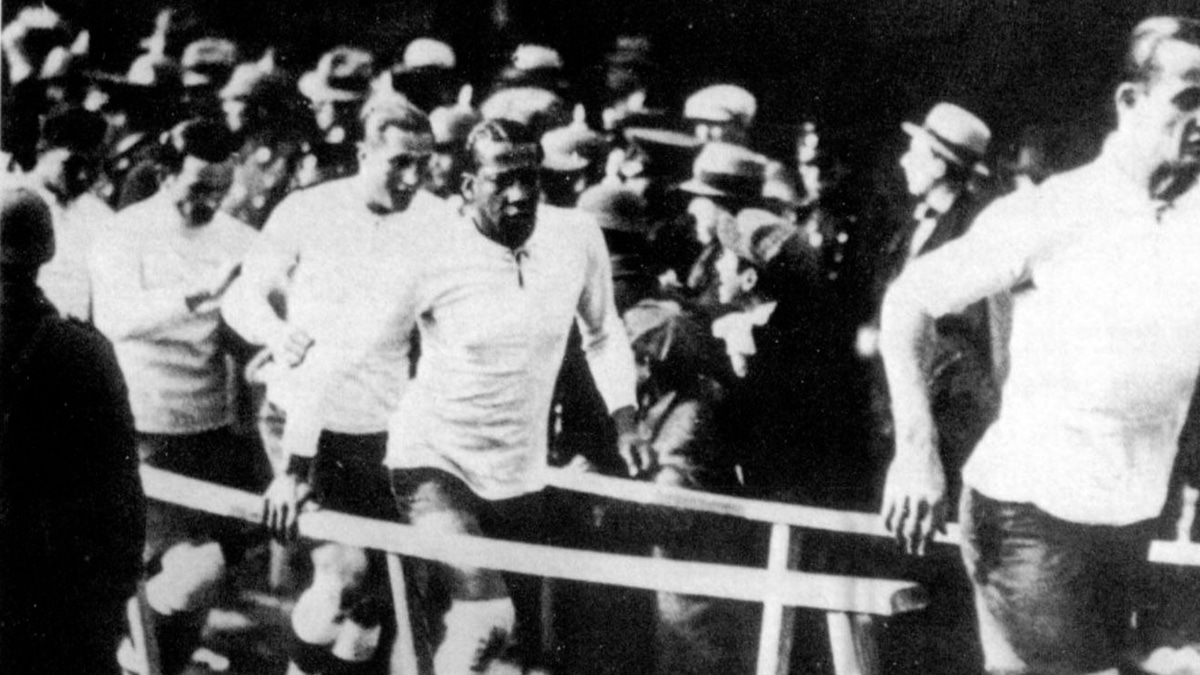
Surprisingly, the game was played in a reasonable spirit. Back in Buenos Aires a crowd of 30,000 gathered to listen to a commentary relayed over loudspeakers. At the Estadio Centenario, Uruguay – without injured forward Anselmo – scored after 12 minutes through Pablo Dorado but, after Peucelle first equalised following a miscued clearance by Uruguayan captain Jose Nasazzi, Argentina went ahead through a controversial Stabile goal. In the second half it required all of Uruguay’s technical superiority and brilliance to turn the game, and goals from Cea, Santos Iriarte and one-armed centre-forward Castro gave them a historic triumph.
Great names like Nasazzi, Ernesto Mascheroni and Jose Andrade passed into footballing folklore and though the tournament had not been an unqualified success, Rimet’s vision had laid the foundation stone for a tournament which, ultimately, developed into the most coveted crown in world sport.
By Iain Macleod & Keir Radnedge
Read more about:
World Cup U20