
-
News
- 18 hours ago
Messi claims GOAT status as he finally takes Argentina to glory - a look back at the 2022 World Cup
11 Jun 2026 19:10 CDT |
8 min read
Analysis

What a World Cup. FIFA president Gianni Infantino called it the “best ever”. For quality alone, probably not. But for drama, quite possibly so. Football punditry is often guilty of hyperbole, but the final was, without question, one of the most memorable, breathtaking and dramatic of all time.
After all of the talk and controversy off the pitch, this World Cup needed to deliver on it. And that it certainly did.
Saudi Arabia’s shock victory over Argentina kick-started the tournament and will live long in the memory, going down in football folklore as the biggest upset in World Cup history alongside the United States shocking England in 1950, Cameroon upsetting Argentina in 1990 and Senegal beating France in 2002.
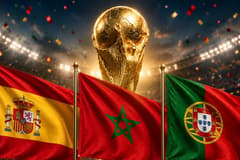
It helped set a trend – “World Cup of the underdog” as it was labelled – with lots of shocks, including Tunisia beating France, Australia sinking Denmark, and Japan edging out heavyweights Spain and Germany. But Morocco, who saw off Belgium, Canada, Spain and Portugal on their way to becoming the first-ever African nation to make it to the semifinals, deserve most of the plaudits.
Despite the many upsets, there were also outcomes that many had predicted: England once again suffering penalty pain (albeit not via the conventional route of a shootout); Brazil, for the fifth consecutive finals, going out as soon as they came up against a European side in the knockout rounds; and Belgium’s “golden generation” finding this World Cup a step too far. And, when it came to the crunch, the cream predictably rose to the top, culminating in a final between Argentina and France; a showdown between Lionel Messi and the heir to his throne, Kylian Mbappe.
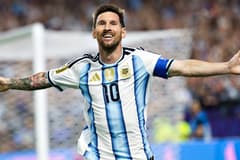
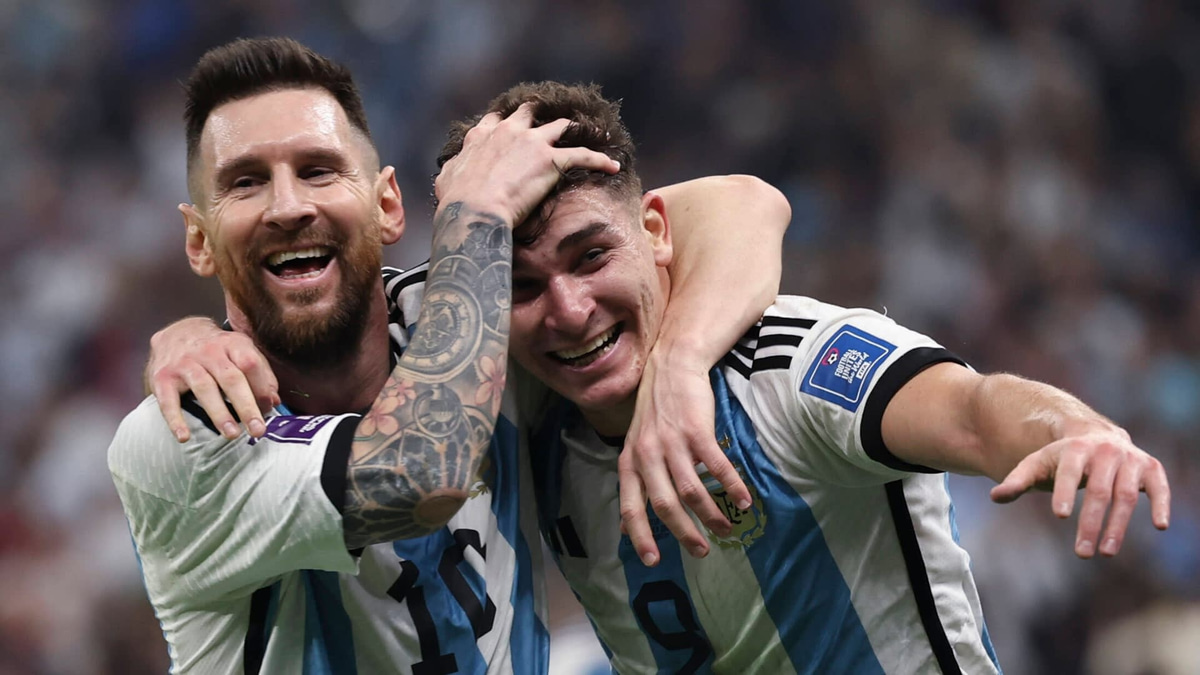
Argentina’s win appeared like destiny for Messi, and for many his Golden Ball performance cements his legacy as the greatest of all time. Indeed, Mbappe becoming only the second player to score a World Cup final hat-trick and winning the Golden Boot in the process – but Messi lifting the trophy – seemed like the perfect conclusion. A symbolic passing of the torch, and a poetic ending to an enthralling and captivating finals.
Stephen Fishlock
MESSI: MISSION ACCOMPLISHED
Argentina’s talisman is crowned world champion and football’s greatest of all time...
The most extraordinary final in World Cup history between the two best teams in the competition and the game’s two finest players in Lionel Messi and Kylian Mbappe was the perfect climax to the 2022 World Cup.
Mbappe, a hat-trick securing the Golden Boot as the finals’ eight-goal top scorer, finished on the losing side as France lost the crown secured four years ago in Moscow. But the enduring story of Qatar’s controversial World Cup will focus on Messi.
The 35-year-old did not need World Cup glory to confirm him as one of the greatest of all time, but most football fans wanted it for him. Messi duly opened the scoring and helped create a second for Angel Di Maria. The match was not even a contest until Mbappe’s dramatic, late equalising double, the extra-time seesaw and eventually the shootout – in which Messi set the standard with Argentina’s first kick.
Messi’s breadth of achievement in Qatar was not only the final. Albiceleste owed their very presence in Lusail to his magic. On his 1,000th career appearance he had provided the opening goal in the 2-1 second-round victory over Australia. Then La Pulga was the early inspiration in the shootout defeat of the Netherlands that defied a late Dutch revival.
Better still, Messi produced the most captivating individual display of the tournament yet in dicing and slicing Croatia in the semi-finals. He opened with a penalty and provided both assists for Julian Alvarez, the second after turning luckless Josip Gvardiol inside-out.
The French, beset by injuries and illness, had a day less than Argentina to recover from a physically punishing semi-final victory over Morocco. That probably proved significant because they started as if in a trance and were then always chasing the game.
The extravaganza cost Qatar £200 billion while FIFA reaped £7bn; history will judge who emerged with the better deal. In the short term, the glory was snatched by three-time champions Argentina after a tournament which produced generally good, entertaining football. Momentum was maintained by a steady string of surprises along with the adventure of Morocco, an Arab-African home team substitute.
The enduring story of Qatar’s World Cup will focus on Messi
- Pushed into the background was the negativity arising out of the award, construction workers’ deaths and human rights issues. But this was not the end of it. On the eve of the finals, Qatar barred the sale of alcohol at the stadia when it was too late for FIFA to object. Humiliating for FIFA and for president Gianni Infantino – even though he finished up parroting the old Sepp Blatter line about it being “the best World Cup ever.”
Further complications arose over seven countries’ plan for their captains to wear a OneLove armband. That was quashed by FIFA with threats of yellow or red cards. Hence Germany’s players put their hands over their mouths in an eloquent anti-censorship gesture in the photo-call before playing Japan.
There were suggestions that these political distractions were to blame for the early exits for the likes of Germany and Denmark. But England, Australia and the United States were all vocal about human rights and reached the knockout stages. Iran were also first-round fallers but entangled in political issues all of their own. Equally, Morocco’s remarkable progress was in no way hindered by their waving of the Palestinian flag.
The major surprises of the group stage were those eliminations of the Danes, the Germans and Belgium, plus the fact that Qatar were so poor. The hosts had been gifted 12 years to prepare and were Asian champions, yet became only the second hosts (after South Africa in 2010) to fall so fast.
Fortunately for Arab honour, the baton was picked up in glorious style by Saudi Arabia in a thrilling comeback victory over Argentina, by Tunisia in a homeward-bound defeat of France and, most notably, by Morocco in both the group and knockout phases.
Argentina and Messi recovered, emboldened from their Saudi upset in Group C, while France immediately stamped their class on Group D. No problems either in Group B for England. They achieved their best-ever start to a World Cup by defeating Iran 6-2, but Wales, back after 64 years, could only draw 1-1 with the USA. A late penalty from captain Gareth Bale provided their only goal and only point.
Japan contributed even more to the dramatics than Saudi Arabia. Samurai Blue launched Group E with a shock 2-1 comeback win over Germany and ended it by defeating Spain in identical fashion. At one point, as the goals flowed in the last Group E matches, both Germany and Spain were going out. In the end it was Germany who failed on goal difference despite beating Costa Rica 4-2. The tie was also notable for Stephanie Frappart becoming the first woman to referee at a men’s World Cup finals.
Morocco’s draw with Croatia and defeats of Belgium and Canada made them the first African nation to top a group since 1998. Luka Modric and Croatia, runners-up in Russia in 2018, slipped through in a workmanlike second place and ultimately won the third-place play-off; the veterans of Belgium flew home unlamented.
Brazil danced through Group G despite an early ankle injury to Neymar and a first World Cup loss to an African nation at the hands of Cameroon. Group H witnessed what turned out to be a deceptively happier start for another superstar as Cristiano Ronaldo set Portugal on their way by converting a soft penalty in a 3-2 win over Ghana. Portugal’s captain thus became the first player to score in five men’s World Cups.
The last 16 produced two penalty shootouts and one further surprise. Spain, weighed down by Luis Enrique’s old-fashioned tiki-taka, were stunned by a Morocco team who sparked memories of the turbocharged energy of South Korea in the last Asian finals, in 2002.
The rest went with form for Croatia, Netherlands, Argentina, England, Brazil, France and Portugal, for whom young striker Goncalo Ramos hit a hat-trick against Switzerland after Ronaldo was controversially left on the bench.
Fallers in the quarter-finals included England – in agonising fashion to France after captain Harry Kane had scored and then missed a penalty – and Brazil, to shootout specialists Croatia. The pity for Brazil was that Neymar had been outstanding against Croatia. He played with commitment and focus, eschewed his self-indulgent tendencies and scored one of the finest goals of the finals after a rapid-fire double exchange of passes. Yet he had long left the stage when his Paris Saint-Germain team-mates Messi and Mbappe stepped up for the final act.
If Argentina were the headline winners it has to be stated, for the record, that these finals were a staging triumph for FIFA and Qatar, if not a political one.
For the first time, teams from all five major continents reached the last 16. Also, for the first time, three teams from the AFC (Australia, Japan and South Korea) reached the knockout stages, and, for only the second time, two African teams (Senegal and Morocco) progressed to the knockout phase.
Critical forecasts that nobody would turn up were routed by the crowd statistics. A ticket-sale tally of nearly 3.4 million gave the lie to claims that supporters would be put off by the heat, by the pre-Christmas timing, by the cost and all the rest. At the final whistle not only were France beaten, so were the merchants of doom and gloom.
By Keir Radnedge
Read more about:
World Cup U20