
-
News
- 18 hours ago
World Cup 2002: Ronaldo's triumphant return as Brazil rise to the occasion
11 Jun 2026 01:01 CDT |
6 min read
Analysis

“One year ago I would not have expected to share in such a historic night, with a fifth World Cup victory for Brazil. We had so many problems in qualifying that it was impossible to think we would succeed. Instead, after a World Cup of shocks, this may have been considered one more. Yet I believe that by the end Brazil were the most outstanding team at the finals and, above all, they had a far superior attack to everyone else.
“Ronaldinho was the individual surprise of the tournament and, of course, I was delighted with Ronaldo. It was not just that he was scoring in every match; it was his whole game, his confidence, his creative skill. Anyway, he had a mission of revenge after the sad events of 1998 and all the injuries in between.
“With his two goals in the final, Ronaldo equalled my total of 12 goals overall at the World Cup in the same number of matches but in just half the number of finals. Now that he appears, finally, to have shaken off all his injuries, I expect him to leave my record behind.
“I should also praise the contribution of Brazil’s captain, Cafu. He made history as well by becoming the first player to appear in three successive World Cup finals. His experience was important, both on and off the pitch. As a World Cup-winning captain he proved himself a worthy successor to Bellini, Mauro, Carlos Alberto and Dunga.
“Finally, I want to pay credit to the co-hosts. South Korea achieved wonders under Guus Hiddink in becoming the first Asian team to reach the semifinals. But that should not overshadow Japan’s enormous progress in a far shorter space of time. Remember, they reached the second round in only their second finals. Early departees such as France, Argentina and Portugal must be humble enough to learn the lessons.
“The lesson of this World Cup was that almost any country with ambition can now be at least competitive on the international stage. That is as good for the game as Brazil being world champions again!”
Pele talking to Keir Radnedge
O FENOMENO RETURNS
The fireworks exploded and the paper glitz snowstormed down from the roof to salute a historic achievement, as Brazil set off on a lap of honour to celebrate their fifth World Cup win.
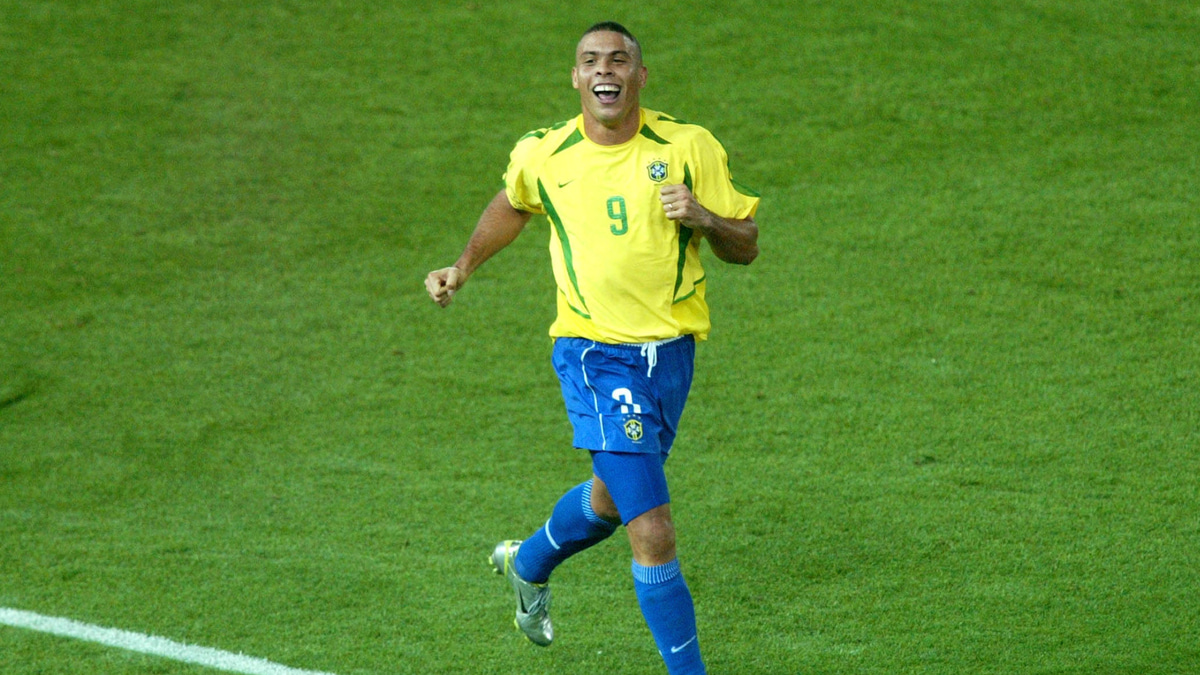
On a personal level it was a triumph for Ronaldo, the victim of 1998, who had returned on a mission of revenge and had scored both goals in the 2-0 defeat of a German side who had never expected to share in the final party in the Yokohama International Stadium.
Gold and green were the colours of glory, black and white the colours of what might have been. The 2002 World Cup had ended with world football’s hierarchy vindicated and the shocks and upsets of the past four weeks almost a trick of the memory.
When it came down to it, when push came to shove, when reality cut in, then it was the traditional giants of South America and Europe who had taken the last curtain call. It was almost as if the passion and ecstasy of South Korea, the dynamism of Japan, had been factors in a different tournament.
When fans and football historians look back through the game’s bibles they will see only Brazil beating Germany. The real tale of the first co-hosted World Cup will be enshrouded in the mists of football folklore.
The World Cup needed Brazil to rise to the occasion. Ronaldo and Co. did not let the game down
- Yet this first World Cup in Asia has been full of delight, not only for the home fans in South Korea and Japan but also for the record international tele-viewers. For one thing, co-hosting worked exceptionally well, despite the countries’ uneasy history. For another, hooligans were conspicuous by their absence from the 20 superb, mostly new, stadia. The only snags concerned those perennially problematic issues of ticketing and refereeing standards. Plus ça change.
Senegal, appearing in the finals for the first time, had provided the tournament with a sensational start by defeating holders France 1-0 in the opening match in Seoul. But the final rarely threatened to surprise.
Germany, despite the absence of suspended Michael Ballack, did take the game to Brazil as the best form of defence, and it was a tactic that had the Brazilians baffled for much of the first half. However, the mental and physical concentration demanded of such a tactic is enormous, and in the five minutes before the interval Rudi Voller’s men began to wilt.
In terms of chances, Brazil, for all the Germans’ impressive efforts, could have been four or five goals clear, and no one could have argued. But then this Brazil, for all the wonderful reputations of their forwards, had not proved themselves so ruthless around the goal area.
The initial exchanges brought yellow cards for Roque Junior for a trip on Oliver Neuville and Miroslav Klose for an elbow into Edmilson’s neck. But Edmilson proved he was not too badly hurt a minute later with a sharp clearance for a corner as the superb Bernd Schneider arrowed in a cross.
Schneider, Neuville and Torsten Frings were all lively down the German right, giving Roberto Carlos little chance to enjoy himself in attack. But Brazil should have taken the lead in the 19th minute when Ronaldinho unhinged the German defence. However, Ronaldo shot wide of both keeper Oliver Kahn and his left-hand post. On 30 minutes Ronaldo had another chance. This time Kahn was quickly forward to save the one-on-one opening.
“The only German shot of the first half came in the 41st minute when a Jens Jeremies drive flew safely high over Marcos’ bar. The remaining five minutes were all Brazil. First, the German defence stood still, allowing Kleberson to stride through the middle, but fortunately for them he shot horribly wide. Three minutes later the midfielder fired a 25-yard drive against the bar. Then, in first-half overtime, Ronaldo went clear, only to be foiled again by Kahn, this time with his legs.
The Germans revived briefly after half-time. Marcos dived to defy a Jeremies header, then the keeper tipped Neuville’s hard-driven free-kick on to a post after Schneider had been fouled by Gilberto Silva. And that was it. Once Ronaldo had punished a rare error by Kahn, spilling a low drive from Rivaldo after 67 minutes, it was all over. Germany did not have the attacking verve to score themselves and their vain attempts only exposed them, 12 minutes later, to a further killer blow from the player even his teammates address as “O Fenomeno” – “The Phenomenon”.
No doubt Ronaldo, the World Cup’s eight-goal top scorer, will go on to collect end-of-year awards as FIFA World Player of the Year and the European Footballer of the Year (on the grounds that he plays for Inter of Italy).
But his revival after an injury-scarred four years was a gesture exclusively for the people of Brazil. Four years ago, Brazil retreated from the Stade de France amid all sorts of controversies over Ronaldo’s collapse and their team’s similar failure.
Then, it did not matter in the greater scheme of things as the rest of the world rose to salute France. This time around, the World Cup needed Brazil to rise to the occasion. Ronaldo and Co. did not let the game down.
By Keir Radnedge
Read more about:
World Cup U20