
-
News
- 21 hours ago
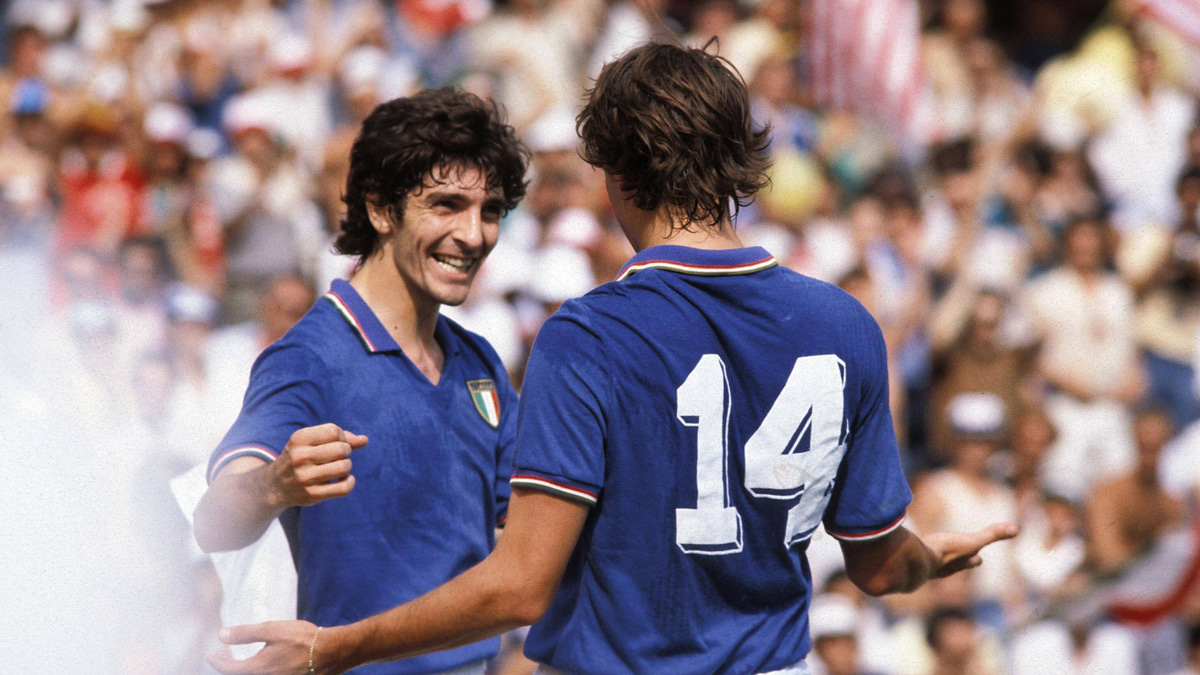
World Cup 1982: Paolo Rossi inspires Italy to glory after two year ban
9 Jun 2026 02:00 CDT |
6 min read
Analysis

In 1982, Spain hosted the tournament, which increased to 24 finalists, evoking considerable controversy long before a ball was kicked in what Argentina’s Diego Maradona would later label “a World Cup of bruises”.
Group 1 was dreadful: Italy offering little indication of the transformation to come, sneaking through after tedious draws with Poland, Peru and Cameroon.
In Gijon, Rabah Madjer and Lakhdar Belloumi scored against West Germany to create the upset of the finals, but Algeria were eliminated from Group 2 by the Austria-Germany “Anschluss” game.
Belgium’s Erwin Vandenbergh scored the first opening-game goal since 1962, against holders Argentina, but the latter still qualified from Group 3 after they beat Hungary and El Salvador.
In Bilbao, England beat France, Czechoslovakia and Kuwait without any fuss to progress from Group 4, while Northern Ireland took Group 5 with a momentous victory over hosts Spain.
In Group 6, Brazil’s magical football restored one’s faith in the game. After Socrates and Eder’s marvellous strikes v Soviet Union, Brazil scored four goals each past Scotland and New Zealand.
Four further groups of three provided the semi-finalists – a Zbigniew Boniek-inspired Poland; a resurgent West Germany, who knocked out England and Spain; Italy, whose renaissance saw the disappointing exit of the elegant Brazilians; and a superb France.
In the semis, Italy’s transformation continued. Poland, like Brazil, had no answer to Paolo Rossi, who added a double to his previous round hat-trick against the Brazilians. The superb West Germany v France semi-final had six goals, penalties and joined the elite list of all-time great matches.
To penalties after a barnstorming 3-3 draw following extra-time, and Toni Schumacher, villain, after his dreadful challenge on Patrick Battiston, turned hero to save Maxime Bossis’ penalty.
But West Germany had shot their bolt and, at the Bernabeu, Italy coasted to a famous third World Cup triumph.
Iain Macleod
THE ITALIANS CLINCH THIRD WORLD CUP CROWN
After a slow start to the 1982 finals, Italy’s star striker Paolo Rossi, just back from a two-year ban, inspired his team to World Cup glory in Spain...
Even after the first group stage of the 1982 World Cup, who would have put money on Italy to win it? They’d drawn three times, prosaically, in cool Galicia. It was just a couple of years after an outrageous match-fixing scandal, when scores of leading Italian players had participated in the so-called Totonero. Forward Paolo Rossi, surprise star of Italy’s World Cup in Argentina in 1978, had been one of those embroiled, and though he had had a year cut off his three-year ban, enabling him to be in Spain, he had been firing blanks.
Coach Enzo Bearzot had become a target for his enemies and relations with the media were at rock bottom. Mischievous reports saw the players impose what in Italy is known as silenzio stampa, a refusal to talk to the press, save through their hallowed veteran goalkeeper and captain, Dino Zoff.
The loss, through injury, of Roberto Bettega, who had dovetailed so well with Rossi in Argentina, was a serious blow to Italy. The more so as Rossi looked rusty and ineffectual – hardly a surprise as he had been out of action for two years.
So to 1982, and the first group stage games in Vigo. Italy opened by drawing 0-0 with Poland and then 1-1 with Peru, who should certainly have been given a penalty when notorious Italy defender Claudio Gentile brought down winger Juan Oblitas. The third, somewhat controversial, draw was against Africans Cameroon. The two goals were scored in the space of a minute. On the hour, Cameroon’s usually adroit keeper, Thomas N’Kono, slipped, enabling Ciccio Graziani to score. Away at once went Cameroon to equalise.
Did, as some believed, Italy benefit by playing in the cool of Galicia, while other teams had struggled in the heat? At all events, they came to life in the second group stage at Barcelona’s smaller Sarria stadium. Totally unfancied, the Azzurri proceeded to beat both Argentina – Gentile ruthlessly man-marking Diego Maradona – then Brazil.
Only in the second group game, against a highly-talented Brazil , did Paolo Rossi come suddenly and superbly to life
- “Italy won the first game in style, having been obliged – Gentile apart – to come out to play at last. Romanian referee Nicolae Rainea gave Maradona no protection. The first half was dire, Rossi was still firing blanks. But, in the second half, the Azzurri came to life. An inspired pass by accomplished playmaker Giancarlo Antognoni sent Marco Tardelli through to hit the first goal. Graziani did the same for Rossi, but when the striker’s shot rebounded from the keeper, Ubaldo Fillol, Bruno Conti pulled the ball back and full-back Antonio Cabrini scored. Late on Daniel Passarella netted from a free-kick when the Italians were still lining up their wall, but it wasn’t enough for Argentina.
Only in the second group game, against a highly-talented Brazil, did Rossi come suddenly and superbly to life. His three goals, his dazzling opportunism, won Italy a game that Brazil would surely otherwise have taken, a game that was worthy to have been the World Cup final.
Brazil’s coruscating midfield wasn’t equalled by the defence or the attack. Keeper Waldir Peres, with remarkable prescience, had said beforehand that his chief fear was that Rossi would take wing. This he did after only five minutes. Conti sent Cabrini down the left, and Rossi closed in on his precise cross to head past Peres, his timing exquisite. Seven minutes more, Zico passed impeccably to Socrates, who beat Zoff at his near post. After 25 minutes Rossi pounced on a careless pass by Toninho Cerezo to make it 2-1. Midway through the second half Falcao shot through a gap to make it 2-2, but Zoff defied further Brazilian attacks.
Then, 15 minutes from time, Tardelli drove back a half-cleared corner, the ball broke to Rossi and that was 3-2.
In the semi-final, still in Barcelona but at Camp Nou, Poland were far less of a problem than in Vigo. The Italians, with Rossi in deadly form again, outplayed a side badly missing their suspended star turn, Zbigniew Boniek. Rossi ably scored the goals in the 2-0 win but, alas, Antognoni, painfully kicked and subbed, would miss the final against West Germany at the Bernabeu in Madrid.
After the German goalkeeper Toni Schumacher went unpunished following his brutal challenge on France’s Patrick Battiston in the other semi, the rest of the football world hoped the Germans would be beaten. So it was to be.
The first half was poor and goalless. Halfway through, Italy were awarded a penalty when Hans-Peter Briegel fouled Conti but Cabrini shot wide – with regular taker Antognoni sitting in the stands.
Sweeper Uli Stielike should have been expelled for a foul on Gabriele Oriali but wasn’t even booked by Brazilian referee Arnaldo Coelho.
Then, on 57 minutes, Gentile put in a cross and Rossi, who had timed his run perfectly, headed home. Twelve minutes later, sweeper Gaetano Scirea broke up the right, swapped passes with Giuseppe Bergomi, and his cross was acrobatically converted by Tardelli. On 80 minutes, the inexhaustible Conti ran half the length of the field and substitute striker Alessandro Altobelli, brought in early on for Graziani, struck home the third.
Paul Breitner, on what was once his home ground, scored what was hardly a consolation goal for the Germans.
Italy and Bearzot had risen from the ashes of Galicia to triumph.
By Brian Glanville.
Read more about:
World Cup U20