

-
News
- 21 hours ago
World Cup 1954: West Germany stun the planet and beat Hungary in the land of clocks, cowbells and mountains
5 Jun 2026 19:14 CDT |
6 min read
Analysis

Everything leading up to the fifth World Cup had pointed to a Hungarian triumph, but West Germany had other ideas...
“he 1954 finals came to the land of clocks, cowbells and Alps. And though Switzerland’s World Cup was not the best organised in history, it has valid claims on being one of the best.
The 1950s was one of European soccer’s greatest eras and Hungary – arguably the finest-ever international side – arrived in Switzerland as the hottest favourites the tournament has ever known. In fact, Hungary were more than favourites. They appeared stone cold certainties. Unbeaten in four years, Olympic champions, the team who had ended England’s resistance at home by 6-3, and then, just to rub it in, won 7-1 in Budapest...this was the team of all the talents, one of the greatest of all time. And they were recognised as such at the time. It seemed impossible that they should fail where a Hungarian team had failed in 1938 – at the last stage. But fail they did, and in incredible circumstances.
Once more the format was altered. Sixteen nations were divided into four groups, though curiously, the two seeded nations in each group did not have to play each other. Yugoslavia, regarded as the second favourites, opened the tournament, with Milos Milutinovic’s goal beating France in Lausanne. Then, a 1-1 draw with a Didi-inspired Brazil ensured qualification for both, the Brazilians having beaten Mexico 5-0.
In Group 2, Hungary, irrepressible, beat South Korea 9-0, a Sandor Kocsis hat-trick being followed by another four against West Germany. It was this odd arrangement of only playing two of the teams in your group that West Germany coach Sepp Herberger took advantage of. The Germans, back in the FIFA fold now, deliberately fielded a weakened side against the Hungarians and lost 8-3. But they still qualified thanks to first a 4-1 win and then a 7-2 play-off victory over Turkey. But one more benefit from that 8-3 thrashing: a late tackle by centre-half Werner Liebrich that crippled Hungary captain Ferenc Puskas.
A late tackle by Werner Liebrich crippled Hungary’s Ferenc Puskas ...it would be a bitter blow
- The injury to Puskas would be a bitter blow. Puskas, years later, recalled: “At that time we couldn’t even go out in the street. Everyone would recognise and want to talk to us. No one spoke about anything except the World Cup. I suppose all the success went to our heads a little. When we went to Switzerland we believed we were unbeatable. That cost us very dearly.”
With West Germany plotting every step, Brazil flexing their muscles and Uruguay desperate to retain their title, the Hungarians had a lot to beat.
Uruguay’s defence of the trophy indeed began with a hard-fought 2-0 win over Czechoslovakia in the Berne mud, but they positively sparkled in Basel against a poor Scottish side that conceded seven in the broiling heat – Carlos Borges bagging a brilliant hat-trick. Austria’s fine team, consisting of legendary figures such as Ernst Ocwirk and Gerhard Hanappi, also qualified, beating Scotland and Czechoslovakia without conceding a single goal and striker Erich Probst notching four across both games.
In Group 4, England’s ageing side of many famous names threw away a 3-1 lead against Belgium in Basel, drawing 4-4. They clinched the group three days later by beating hosts Switzerland 2-0. In Lausanne, an Italian side that had lost heart, also lost to Switzerland – a match more notable for its generous ration of fouls. At the end, Italian players chased Brazilian referee Mario Vianna off the field. A resounding 4-1 victory against Belgium earned the Azzurri a play-off, but again they failed to match the exuberance of the host nation, who, in a better match, won 4-1.
As the tournament reached the knockout stages, it rained goals; West Germany, without injury problems and without too much upset, surprised fancied Yugoslavia 2-0, the tamest of the quarter-final ties.
Goalkeeper Gil Merrick’s poor performance in Basel gave England numerous problems against an understrength Uruguayan side, who also lost Obdulio Varela during the game. Consequently the holders’ 4-2 win said much for their character, with goals by Borges, Varela, Juan Alberto Schiaffino and Javier Ambrois trumping Nat Lofthouse and Tom Finney’s strikes.
In Lausanne, on a steamingly hot day, old Alpine rivals Austria and Switzerland provided a 12-goal classic in one of history’s great matches. With Roger Vonlanthen superb, Switzerland soon led 3-0 thanks to Robert Ballaman and a Josef Hugi double, but the classical Austrians, inspired by the gifted Ocwirk and some phenomenal shooting, scored three in as many minutes, adding two more before the interval. Theodor Wagner completed his hat-trick in the second half and Austria finally won a legendary encounter 7-5, Hugi also completing his hat-trick for the losers.
Sadly, Brazil and Hungary presented football’s uglier face as the notorious “Battle of Berne”, played in heavy rain, degenerated into the Mundial’s most sordid episode. Hungary scored twice early on, after which Brazilian intimidation and Magyar retaliation caused an on-running brawl. The Europeans eventually won 4-2, chief statistics being four cautions and early baths for two Brazilians and a Hungarian. And after the match was over, the battle continued in the dressing rooms.
Surprisingly, Austria collapsed in their semi-final in Basel, losing 6-1 against an improving West Germany side for whom Fritz Walter was a colossus. But all the attention focused on Lausanne, where Hungary and Uruguay produced a rich, six-goal feast, regarded by many as the finest match ever played.
The Magyars led through Zoltan Czibor at half-time, and shortly afterwards Nandor Hidegkuti made it 2-0. They held out until late on before Schiaffino twice put Juan Hohberg through to level matters. The feast continued into extra-time and though Hohberg hit the post, the glory was to be Hungary’s when Sandor Kocsis scored two glorious headers.
Despite West Germany’s semi-final heroics against Austria, Hungary were still clear favourites for the final in Berne. But then manager Gusztav Sebes made two controversial changes. He decided to bring back Puskas, who claimed he was now fit again, and dropped regular right-winger Lazslo Budai, switching Czibor from the left.
At first it seemed they had been masterstrokes when Hungary went 2-0 up inside eight minutes. First a half-fit Puskas snapped up a rebound, then a terrible muddle between Werner Kohlmeyer and goalkeeper Toni Turek presented Czibor with the second.
All over? Not a bit of it. Just three minutes later, Jozsef Bozsik miscued a clearance and West Germany’s Max Morlock struck the ball past Gyula Grosics. And after a few more minutes they pulled level, Helmut Rahn hitting in a corner from skipper Fritz Walter.
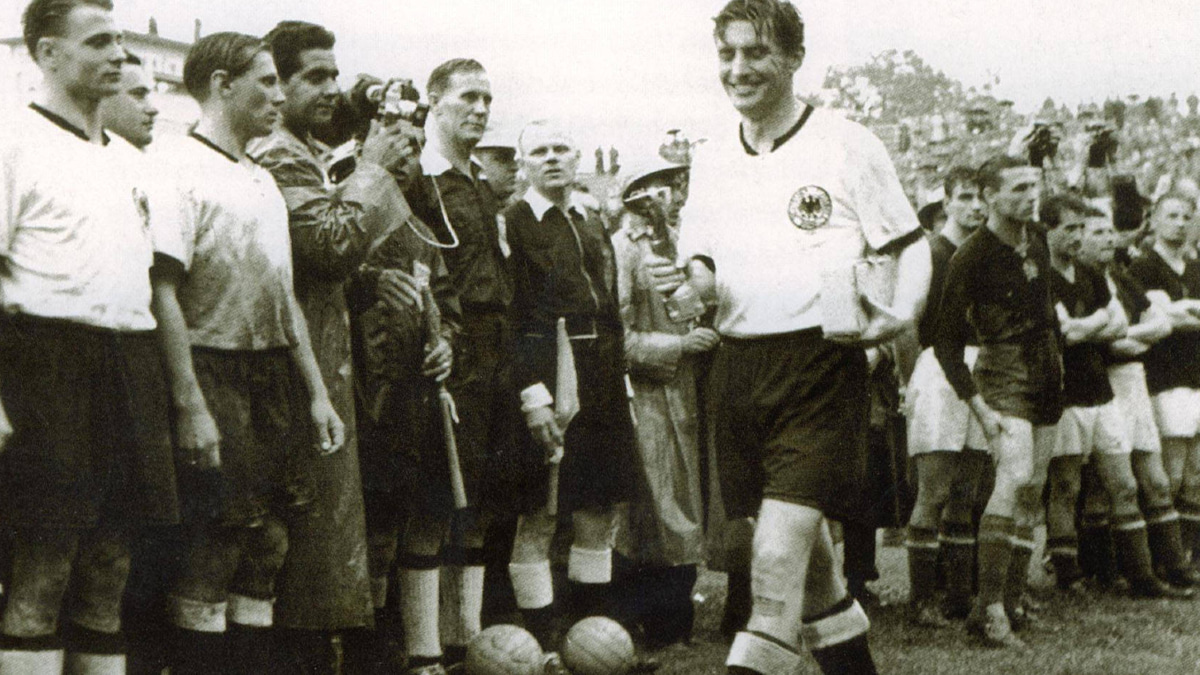
The Hungarians had to start again. But Puskas was clearly not match fit. As he started to labour, so did Hungary. The Germans sensed victory and after Turek made some brilliant saves at one end, the inspired Walter set up Rahn to hammer in what proved the winner.
Hungary fought back bravely and Puskas scored apparently, but referee Bill Ling ruled him offside. Hungary’s luck had run out – in the worst possible way, and on the worst possible day. “We’d sweated blood beating Uruguay and Brazil,” said Puskas. “And all for this.” Shocked beyond disbelief, they had been denied the coronation that should, rightfully, have been theirs.
By Iain Macleod & Keir Radnedge.
Read more about:
World Cup U20