
-
News
- 21 hours ago
The greatest team of all time? Brazil brilliance at the 1970 World Cup writes the Selecao into the history books
6 Jun 2026 07:00 CDT |
10 min read
Analysis

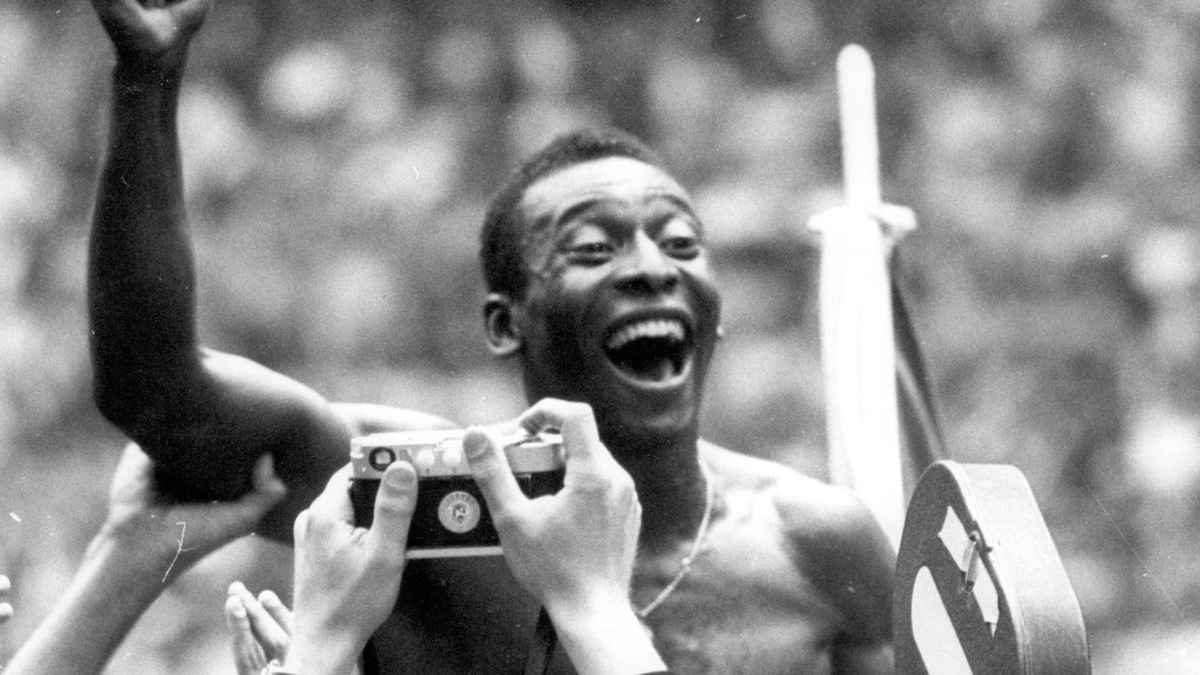
In a supreme advertisement for entertaining and attacking football, Pele and Co. brought the World Cup trophy back to Brazil...
Those lucky enough to be present in the Azteca Stadium on the afternoon of June 21, 1970 will never forget the scenes of emotion and jubilation they witnessed after Brazil had beaten Italy 4-1. Around the world, too, in front of television sets numbering hundreds of millions, soccer supporters joined in the applause for a superb climax to the 1970 World Cup finals.
It was not simply a magnificent and thoroughly deserved triumph for Brazil. Here was proof that football, played the way it was meant to be performed, with artistry and skill, can still succeed.
From their first match against the Czechs, the Brazilians showed that they had fully recaptured the magic that they lost four years ago. Pele provided proof that his genius lives on; and around him buzzed colleagues with finesse and enthusiasm that was poetry in motion.
Those who had any doubts about Pele’s position as the world’s greatest footballer will surely require no more convincing. Looking fitter and more determined than he has done for a long time, Pele stamped his incredible skill on the Mexico tournament. He is shown as an incomparable individual and a fine team player; a man of almost unbelievable ability and superb speed of thought. Who will ever forget his shot from inside his own half in that game against Czechoslovakia; or that magnificent dummy that sent Ladislao Mazurkiewicz into a different world in the semi-final with Uruguay?
Those who had any doubts about Pele’s position as the world’s greatest footballer will surely require no more convincing
- “Brazil ultimately won the final with goals to spare, yet during an absorbing first half the Italians never looked out of their class. Their tight marking and tremendous depth in defence left Brazil with little room in which to work. But, as in the semi-final against Uruguay, Brazil showed that they can only be contained for so long. Sooner or later the motor purrs into top gear and goals are conceived out of nothing.
In the earlier matches it was the opportunism of Pele, Jairzinho, Tostao and Rivelino that proved decisive but in the semi-final and final Brazil scored vital goals through their midfield duo of Gerson and Clodoaldo. Perhaps this is the secret; almost any member of the side is capable of becoming a match-winner.
Brazil were put on the road to victory over Italy with a splendid goal by Pele in the 18th minute. Tostao’s throw-in from the left flank was lobbed high into the middle by Rivelino and there was Pele, soaring like an eagle, to head past a helpless Enrico Albertosi.
Until this point, and for some time after, too, Brazil’s most consistent attacking force had been skipper Carlos Alberto. Jairzinho spent most of the opening period away from the right flank, taking Giacinto Facchetti with him, leaving a clear avenue for Carlos Alberto to exploit.
Brazil carelessly gave away an equaliser in the 37th minute; and again it was their habit of playing short, square passes across the back four that cost them dearly. Roberto Boninsegna had been quick to intercept previously and once through there is little or no cover.
It was Clodoaldo, trying a piece of ball-jugglery that was never on, who was dispossessed by Boninsegna. Felix advanced from his goal and was a little unlucky to see the ball rebound off a couple of players, leaving Boninsegna with an open goal.
Despite this lapse, and the fact that the teams were level 1-1 at the interval, one could never envisage Italy winning. Brazil were not fully into their stride and it was not until Gerson put them ahead that they hit a superlative peak.
The second half was 20 minutes old when Jairzinho, attempting to strike through the middle, lost the ball. Gerson, who had a fine match throughout, gained possession, accelerated to his left and sent a marvellous shot to the left of Albertosi.
From this moment on the Italian marking, not surprisingly, became relatively slack and Jairzinho came more into his own. His wonderful dribbling skills had been rarely evident but he was obviously determined to maintain his record of having scored in every match in Mexico.
It took another piece of Pele magic – showing that for all his individualistic skill he is very much a team player – to keep that record intact. In the 70th minute Everaldo pushed a short free-kick to Gerson; from almost the halfway line Gerson floated a high, diagonal ball to Pele – a frequent tactic – and the great man himself headed down into the path of Jairzinho, who scored with delightful relish.
Teams other than Brazil might have been content to rest on a two-goal lead – as England did against West Germany in the quarter-finals. But not the world champions. After three they wanted four and that is exactly what they got.
Again Pele was the key man; laying the ball off for Carlos Alberto to hammer an unstoppable shot across Albertosi into the bottom corner. It was a fitting reward for the Brazilian captain; with no orthodox left-winger to mark he ran endlessly along the right flank for Brazil.
And so another World Cup triumph for Brazil – their third in 12 years – and with it, the permanent keeping of the magnificent Jules Rimet Trophy.
MORE THAN A TEAM
Brazil’s 1970 World Cup-winning side are the most celebrated in the history of the game, but technical, tactical and training innovations were as important to their success as sheer individual brilliance...
By Tim Vickery
More than a football team, the Brazil 1970 side have become a myth. Consistently chosen as the best team ever, they are held up as the ultimate exponents of the beautiful game.
Sober judges might conclude that, man for man at least, Brazil’s 1958 side was better. But the team that won in Mexico had one huge advantage – television. The 1970 World Cup was the first shown live in Brazil and many other places around the globe.
The 1970 team also benefited from evolution in other areas. Their individual brilliance was backed up by tactical ideas and methods of physical preparation that put them ahead of the field.
The mythology makes little space for such matters. The popular perception is of a group who swaggered off the beach to enchant the world with off-the-cuff samba soccer. In 1972 Danny Blanchflower wrote that “great teams don’t need managers. Brazil won the World Cup in 1970 playing exhilarating football with a manager they’d had for three weeks. What influence can a man have who has only been with them for that length of time?”
In fact, Mario Zagallo had had two and a half months to coach the team, having taken over in the middle of March, and his predecessor, Joao Saldanha, had laid the groundwork. The colourful and charismatic Saldanha had shown the force of his personality from the day he was appointed in February 1969. The Brazil team had been dogged by regional rivalries, with journalists and directors from the various centres all pushing for the inclusion of their local heroes. But Saldanha put an instant stop to it all by immediately naming both his starting line-up and 11 reserves, and later that year his team cruised through World Cup qualification.
Saldanha was a very strange choice for the position, and not just because he had never been a player and was much more a journalist than a coach (though he had had a successful spell in charge of Botafogo a decade before). He was also vociferously on the political left at a time when Brazil’s military dictatorship was at its most brutal.
The pressure on Saldanha’s position brought out the worst of his volatile nature. And, critically, he fell out with Pele. As a consequence of their dispute, Saldanha seemed on the verge of dropping Brazil’s star player.
Saldanha was sacked. Dino Sani, a midfielder at the 1958 finals, turned down the post, and Otto Gloria, who had taken Portugal to the 1966 semi-finals, was considered. But the job went to Zagallo, then just 38. In his first training session, he was approached by Pele, who said: “You can drop me, but don’t play dirty with me.” Zagallo responded that the team would be Pele and ten others. And he made vital changes to the ten.
Zagallo had made a successful start to his coaching career, and had an immaculate pedigree as a player, having made a key contribution to the 1958 and 1962 World Cup wins.
The Brazil 1970 side have become a myth. Consistently chosen as the best team ever
- STRAIN ON MIDFIELD
As a means of combating the extraordinary ability of strikers in the domestic game, Brazilian clubs had pioneered the use of a back four, adding an extra central defender to the usual three-man defence. The national team adopted the same tactic, but Zagallo was aware that the continuing use of two wingers put an enormous strain on the remaining midfield pair. Even during his playing days as a talented left-winger, he had sacrificed his natural instincts by tracking back when Brazil lost possession. As a result, he created 4-3-3.
“I took over without a fixed idea of what I was going to do,” Zagallo recalls, “but I knew there would be a lot of changes, because I didn’t accept 4-2-4. There’s no way we could have won the World Cup using that system.”
Saldanha’s side, with Edu on the left wing, had no place for Rivelino, who was reserve for Gerson in midfield. At first Zagallo also left him on the bench, instead bringing in Paulo Cesar, a wonderfully skilful winger who would also work back. The press attacked it as a defensive move, Paulo Cesar was singled out for criticism, struggled for form and in came Rivelino, who seized the chance he was offered as a false left-winger.
Unhappy with his lumbering centre-backs, Zagallo pulled back Piazza from the holding midfield role to take one of the central defensive positions. It not only gave the coach more quality at the back but also created space for Clodoaldo to come into midfield.
The final piece of the jigsaw was slotted in up front. Although Tostao and Pele had played together under Saldanha, Zagallo initially thought they were too similar to work as a partnership. There was the added complication of Tostao’s race for fitness after an eye operation.
The coach, who favoured a target man, tried out both Roberto Miranda and Dario. But, as Tostao recalls: “The style of Roberto or Dario was not right for that team. Pele, Gerson and Rivelino needed a player of movement, technique and quick thinking to combine with them. Zagallo saw this and decided to try me out, but without much conviction that it would work.”
But it did, instantly, as Tostao stayed upfield as a reference point instead of taking his usual deep-lying role. The team was formed.
“We played as a block, compact,” Zagallo says. “Jairzinho, Pele, Rivelino, all tracked back to join Gerson and Clodoaldo in midfield. I’m happy to see the team in terms of 4-5-1. We brought our team back behind the line of the ball. We didn’t want to give space for the Europeans to hit us with quick counter-attacks.
“We preferred to defend in zones, to cover the space and not mark man-to-man. If we had gone with high-pressure marking, by the second half we would have run out of gas. So we saved our energy, dropped back, and then when we won possession the technical quality of the team stood out.”
COACHING UTOPIA
Zagallo’s experiments had taken him to the utopia of the coach – a balance between attack and defence. Final opponents Italy looked astonishingly naive in comparison. Defending on top of their keeper they left themselves stretched, forcing their midfielders to cover huge distances and leaving acres of space in which Gerson could pull the strings.
But Brazil’s advantage was not only technical and tactical, it was also physical. The 1970 World Cup was a triumph for the Brazilian concept of a technical commission, a group of specialists working together.
As far back as 1958 Brazil were experimenting with scientific methods in their preparation for games. By 1970, under Admildo Chirol, Brazil had assembled a group of physical preparation staff that included two future national team coaches – Claudio Coutinho and Carlos Alberto Parreira. Schedules were developed to cater to the individual needs of each player.
Zagallo says: “We had trained for 21 days at altitude [in Mexico] and knew scientifically, this would stay in the organism of the players. We then went down to Guadalajara, where we played all our games until the final [in Mexico City, 650 metres higher] – but we knew that altitude preparation was still inside them. No one else had done it. Our physical preparation was excellent – we won most games in the second half.”
“We were so well prepared,” adds Rivelino. “Even playing in that heat I don’t remember once having to go over to the touchline to drink water.”
Instead, Rivelino, who would not have been in the team had Zagallo not taken over, has been able to drink from the cup of glory ever since, and toast the moment technique, tactics and training came together to make magic.
Read more about:
World Cup U20