
-
News
- 18 hours ago
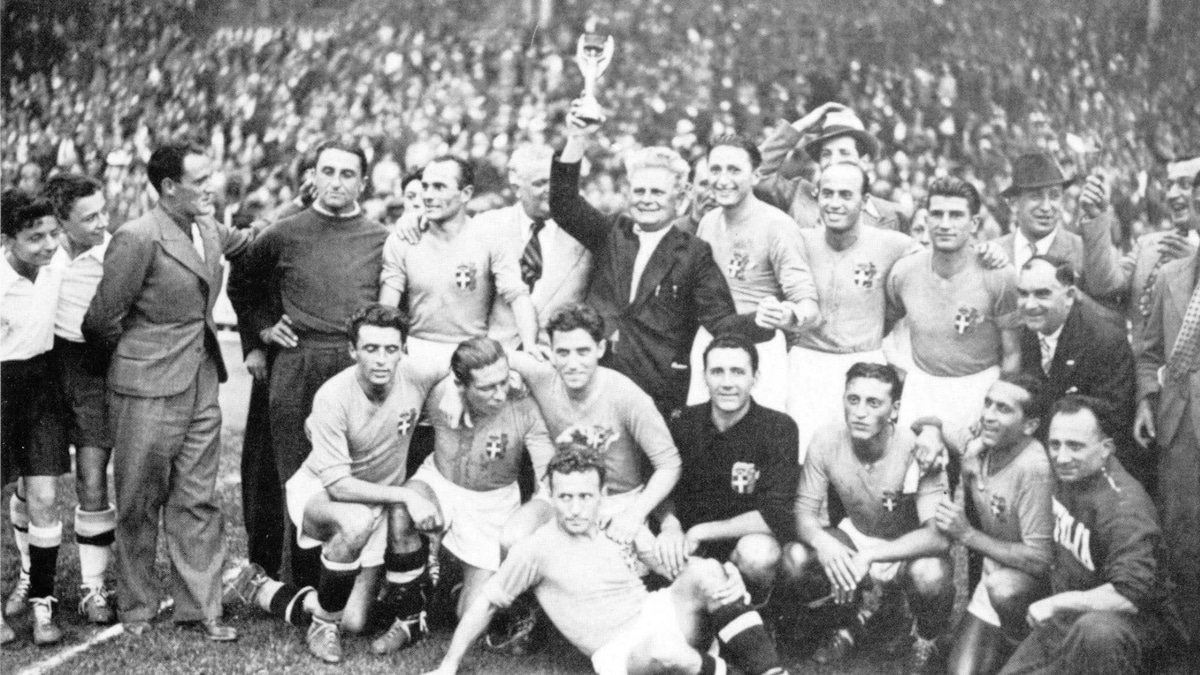
Italy boss Vittorio Pozzo secures immortality with back-to-back World Cup triumphs in 1938
5 Jun 2026 01:01 CDT |
5 min read
Analysis

Azzurri coach Vittorio Pozzo ensured his place amongst the game’s immortals after sealing back-to-back World Cup triumphs with an arguably even better Italian side in 1938...
“rance hosted the 1938 tournament, but the storm clouds of war hung over Europe with impending doom; Spain was already firmly in the grip of civil war. The German military machine had annexed Austria – and nine of its World Cup squad – with the Austrians having to withdraw. Argentina would not compete and Uruguay remained absent. But Vittorio Pozzo brought a much changed and arguably better Azzurri side; inside-forwards Giuseppe Meazza and Giovanni Ferrari, and right-back Eraldo Monzeglio (though the latter was omitted after the first game) only retained from 1934.
Holders Italy began against Norway in Marseille, but after Pietro Ferraris’ early goal they found themselves run ragged by a Norwegian strikeforce that caused many problems. It was only through the agility and bravery of Aldo Olivieri, who by now had usurped Carlo Ceresoli as the replacement for the retired Gianpiero Combi in the Italian goal, that the Scandinavians were thwarted. Arne Brustad equalised, had one chalked-off and, as the match went into extra-time, it required a Silvio Piola goal to ease Italian anxiety.
With Oldrich Nejedly and Frantisek Planicka still prevalent, Czechoslovakia beat Netherlands 3-0, whilst Hungary, again led by the legendary Gyorgy Sarosi, hammered six past Indonesia (then known as the Dutch East Indies) – with Sarosi himself and Gyula Zsengeller scoring two goals apiece.
France comfortably beat Belgium 3-1, and Cuba, having held Romania to a 3-3 draw, then created the upset of the round with a 2-1 win in the replay. But the most remarkable match was in Strasbourg; Poland and Brazil providing an 11-goal extravaganza, and highlighted were two immortal centre-forwards – Poland’s Ernst Wilimowski of the old world and Brazil’s Leonidas of the new.
Before Pele, Leonidas da Silva – to give him his full name – was the original “Black Diamond” – and the man who put Brazil on the World Cup map. He had been smothered in the Brazilian team beaten in the first round in 1934. But he returned in 1938 as the most outstanding South American footballer of his time. And he started the tournament with an extraordinary goal in an extraordinary match.
“Despite four brilliant goals from Wilimowski, Poland lost 6-5 to the Brazilians in extra-time – and Leonidas scored one of those goals with only one boot. As the other boot came off in the clawing mud, so a colleague put a pass clear through the Polish defence. Leonidas raced on to it, beat one defender then shot past the keeper.
In Paris, Andre Abegglen’s equaliser in a 1-1 draw gave Switzerland a second chance against Germany. German boss Sepp Herberger pulled in six new faces for the replay – including the talented Fritz Szepan – and led 2-0. The Swiss, however, were not discouraged and after quick retorts from Eugen Walaschek and Alfred Bickel shattered German confidence, the gifted Abegglen scored twice late on to seal a quite stunning 4-2 victory.
Three changes in personnel for their crunch quarter-final tie against France – full-back Alfredo Foni for Monzeglio and, crucially, wingers Gino Colaussi and Amedeo Biavati (who popularised the “over the ball feint stepover”) for Ferraris and Piero Pasinati – restored Italy’s killer instinct. Piola, a physical, old-fashioned centre-forward who had been chosen as Angelo Schiavio’s replacement as the team’s spearhead for these finals, dovetailed beautifully with the new fleet-footed wingers, and his two second-half goals ended the challenge of the host nation.
Hat-tricks for Gustav Wetterstrom and Harry Andersson enabled Sweden to overwhelm Cuba 8-0 and, in Lille, further goals for Sarosi and Zsengeller for the artistic and technically superior Hungarians finished off the tired Swiss.
Sadly the remaining match between Brazil and Czechoslovakia, inaugurating Bordeaux’s brand-new stadium, would pass into infamy after a vicious battle. Planicka – with a broken arm – and Nejedly – a broken leg – shortly after equalising for the Czechs, finished up in hospital: two Brazilians and a Czech were sent off. From the original 22 players, only eight contested the less volatile replay (six Czechs and two Brazilians). But despite taking an early lead through Vlastimil Kopecky, who then departed injured, Czech endurance snapped and goals from Leonidas and Roberto ended the hopes of a gifted generation of footballers. The Czechs’ chances of making up for their 1934 final defeat were over.
The two-leg tussle with the Czechs proved too much for the Brazilians. Some 48 hours later they had to face Italy in Marseille. Unlike in 1934, this time the referees and the crowds were not on their side. But a little luck was. They had four days’ rest before the semi-final. The Brazilians had barely two, and one of those was spent in a tiresome journey from Bordeaux to Marseille. The story goes that Brazil were so confident of reaching the final that they rested Leonidas. In fact, the long bus trip aggravated an old injury and he just wasn’t fit enough.
The holders’ game-by-game improvement continued and early goals from Colaussi and Meazza proved adequate to earn Italy a 2-1 win and a place in the final against the rampantly elegant Hungarians, Zsengeller’s double instrumental in the 5-1 dismantling of Sweden.
Slack Magyar marking allowed Meazza and his majestic artistry to turn the game
- “In the final, the clash of contrasting styles between the fast, powerful Italians and the graceful, gifted Hungarian outfit did not disappoint. Colaussi scored for Italy after only six minutes, but though Pal Titkos levelled matters within 60 seconds, slack Magyar marking allowed Meazza and his majestic artistry to turn the game.
Meazza set up two goalscoring opportunities, gratefully accepted, initially by Piola, then by Colaussi to score again. Though Sarosi’s goal after the interval briefly offered hope – one of the only times he had got the better of his man-marker Michele Andreolo – Hungary could find no further chinks in the Italian armour and another from Piola late on sealed a second successive Azzurri triumph.
For coach Pozzo, recapturing the trophy with a notably more attractive side sealed his place with the game’s immortals. But 1938 would be Pozzo’s final triumph and as German tanks rolled across Europe, the inevitable conflict of war engulfed the world for six, long dark years.
By Iain Macleod & Keir Radnege.
Read more about:
World Cup U20