
-
News
- 21 hours ago
Football Fight Club: The battle of Santiago and the brutality that shocked the 1962 World Cup
6 Jun 2026 01:00 CDT |
5 min read
Analysis

Thuggery and brutality marred the seventh World Cup finals but, in Pele’s injury-enforced absence, Brazil had the tremendous Garrincha to thank for a second glorious triumph...
Though the 1950s had been wonderfully entertaining, the 1960s brought defensive caution and an over-emphasis on tactics, which echoed throughout the 1962 tournament in Chile. Horrific earthquakes had devastated the country in 1960, and whilst the decision to go ahead was compassionate, Chile organised splendidly, a very disappointing tournament.
After 1958 there was a massive swing to imitate the new world champions and their 4-2-4 system. Winning was becoming ever more important and possible ways and means were all eagerly followed up. Sadly, as the Chile finals proved, some of those ways and means were not pretty.
Brazil had virtually the same team that had won the World Cup four years earlier, despite a lot of changes and experiments between tournaments. But how good they were is clear from the fact that after Pele was injured in the second game of the finals, Brazil carried on to win again without him.
Their new star was Amarildo, who replaced Pele after his injury, and he settled in quickly alongside his Botafogo colleagues in Nilton Santos, Garrincha, Didi and Mario Zagallo, who had now veered back towards midfield. Playing at the beautiful coastal resort of Vina del Mar in Group 3, they opened with goals from Zagallo and Pele against Mexico – the great man’s only full match.
Czechoslovakia, aided by the uncompromising central-defensive duo of Jan Popluhar and Svatopluk Pluskal, and the gifted midfield guidance of left-half Josef Masopust, beat a pseudo-Spanish side containing Ferenc Puskas and Jose Santamaria from the Hungarian and Uruguayan sides of 1954. A goalless draw with Brazil took Czechoslovakia through, though the holders required two late Amarildo strikes to beat Spain 2-1.
Along with Puskas and Santamaria, the Spaniards had also brought the great Alfredo Di Stefano with them. It was to be his first World Cup, at 35. Sadly, though, injuries prevented him from appearing. The Spaniards were managed by the controversial Helenio Herrera, who had originally been due to lead Italy. But that was only a minor squall in the storm which overtook the Azzurri.
A couple of Italian journalists had, before the finals, written highly-critical articles about Chile and its organisation, with the result that the Italians were highly unpopular even before a ball had been kicked. Further, their inclusion of ex-South American internationals in Humberto Maschio and Omar Sivori (of Argentina) and Jose Altafini (previously Mazzola of Brazil) upset local opinion.
Nonetheless, the hosts, in Group 2, opened the tournament with a 3-1 win over Switzerland at the Estadio Nacional in Santiago, where the snow-capped Andes provided a panoramic background, while West Germany, after a defensive goalless draw with Italy – which typified the finals – eased past Switzerland and Chile, Uwe Seeler scoring crucial goals in each match.
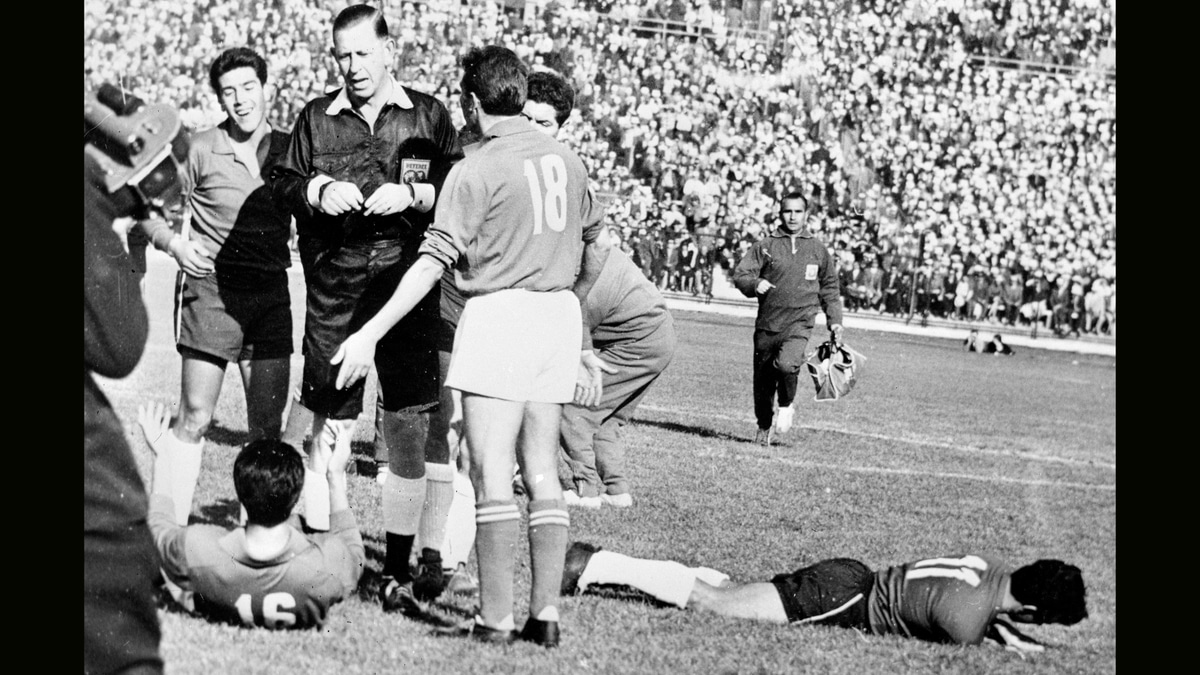
When Italy met hosts Chile in the so-called “Battle of Santiago” all hell was let loose
- “When Italy met the hosts in the so-called “Battle of Santiago” all hell was let loose, with those scurrilous articles by Italian journalists provoking a violent kicking match. Two Italians – Mario David and Giorgio Ferrini – were dismissed, though it took eight minutes and police intervention to persuade the latter to leave, while Maschio suffered a broken nose. In the continuing pandemonium, the nine-man Azzurri lost to late goals by Jaime Ramirez and Jorge Toro and, as Chile went through, Italy went home.
Group 1, played in arid Arica in the north, twice witnessed Yugoslavia involved in bad-tempered matches. Against Soviet Union, Muhamed Mujic, after breaking Eduard Dubinski’s leg, was sent home by his federation. The Yugoslavs lost 2-0. Then, against Uruguay, Vladica Popovic, together with the Uruguayan Angel Cabrera, received their marching orders, though goals from Josip Skoblar, Milan Galic and Drazan Jerkovic ensured victory.
After leading Colombia 4-1, the Soviets eventually had to settle for a share of the points, though, after Uruguay let Valentin Ivanov in for a last-minute winner, Yugoslavia’s five-goal drubbing of Colombia ensured both European nations of quarter-final places.
In Rancagua, Group 4 was dominated by a fine Hungarian side graced by the gifted Florian Albert. His goal beat England, and then he scored three as Hungary hit six past Bulgaria. England, with names like Bobby Moore, Jimmy Greaves and Bobby Charlton in the side, recovered to beat Argentina 3-1, and qualified on goal difference after a drab goalless draw with Bulgaria.
“The quarterfinals were hardly inspirational. Garrincha provided all the class and, at Vina del Mar, he tormented England and scored twice in a 3-1 win. And in Santiago, Petar Radakovic’s goal for Yugoslavia finally laid the West German bogey. Czechoslovakia, with goalkeeper Viliam Schrojf in fine form, ended the hopes of the talented Hungarian side, Adolf Scherer’s 13th-minute goal proving unlucky for the Magyars. In Arica, Lev Yashin, uncharacteristically, played poorly in the Soviet goal and was at fault on both occasions, as goals from Leonel Sanchez and Eladio Rojas sent the host nation into a frenzy of delight.
But in the semi-final against Brazil, watched by over 76,000 in Santiago, Chile found Garrincha a hot handful. He scored twice, set up another for Vava, but marred his part in the 4-2 win by being sent off in the dying stages. It proved the only defeat for the host nation who, under the astute Fernando Riera, would finish third.
In Vina del Mar, only 5,890 fans watched Yugoslavia fail to turn pressure into goals against Czechoslovakia in the other semi-final. Jerkovic cancelled out Josef Kadraba’s early goal, but Scherer, with a breakaway goal followed by a penalty, sent the jubilant Czechs into the final for the second time in their history.
Garrincha was permitted to play in the final, but the Czechs refused to be overawed and Masopust gave them an early lead, before Schrojf’s mistake, caught napping at the near post, let Amarildo in for what would prove a crucial equaliser. In the second half Brazil took command. Amarildo crossed for Zito to score and when the unfortunate Schrojf lost and dropped a Djalma Santos cross in the sun, Vava clinched a second world title for a good, but less than exhilarating Brazilian side.
By Iain Macleod & Keir Radnedge.
Read more about:
World Cup U20