
-
News
- 18 hours ago
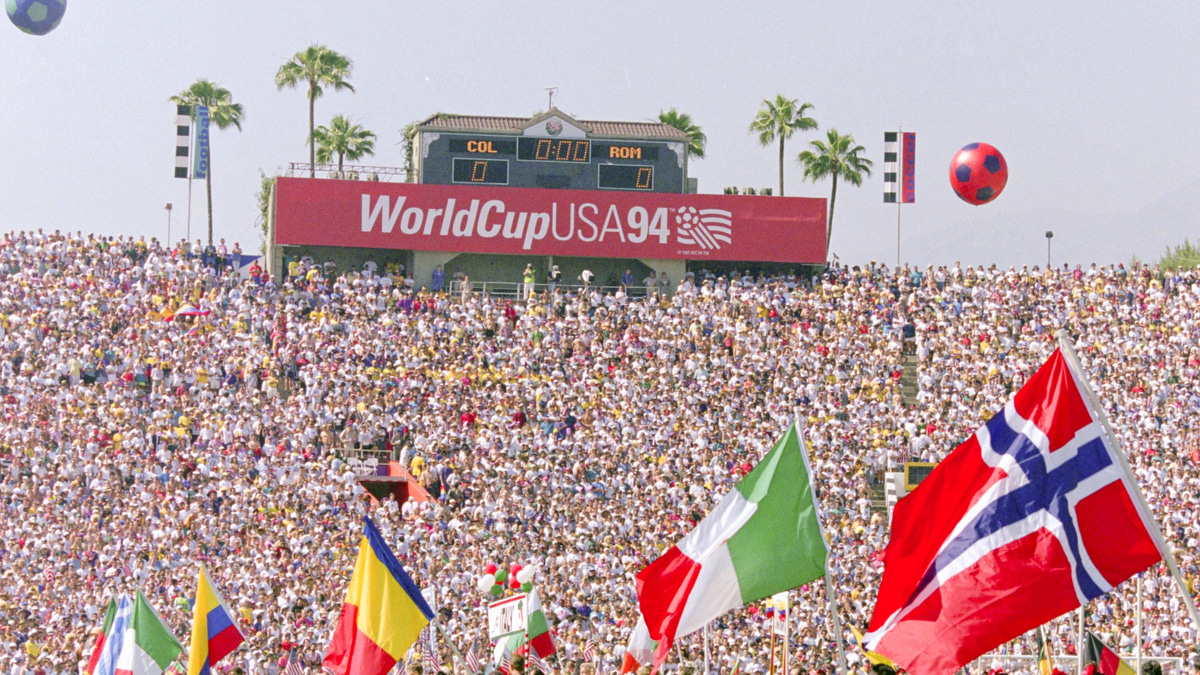
1994 World Cup: Soccer reaches the US on a global scale and Brazil win via first-ever final penalty shootout
9 Jun 2026 19:10 CDT |
9 min read
Analysis

Finally, after all the ifs and buts, all the will-he-won’t-he agonising over Diego Maradona, the Joao Havelange FIFA president sideshow, a multi-million-dollar spat among the sponsors, acres of hot air over the controversial host nation...let’s get down to the football.
This, in case you have forgotten it, is what the World Cup finals are all about; some 528 footballers, bound head to toe in hype, attempting to break the bonds of over-expectation and deliver 52 matches which are ensured a place in the sport’s history books.
Almost the least important issue now is the one over which most blood has been spilled: the USA as hosts. In a few frantic weeks the circus will move on. But what sort of a World Cup can we expect? Every finals is unique. The mix of nations is always different. The balance of power tilts one way then another. The key players vary. But the 1994 finals will be especially unique.
Rule changes approved by FIFA (the awarding of three points for a group-stage win and the implementation of the back-pass rule) have been employed to encourage attacking football and counter the low-scoring and defensive nature of matches at Italia ’90.
And in historic terms, Russia will appear as a separate nation for the first time following the break-up of the Soviet Union, while a unified Germany will take part in the tournament for the first time since 1938.
The finals were awarded to the US in particular circumstances: a one-off effort to attack a resistant soccer market and help provide the dynamic to establish a professional culture and a new league (MLS) which will last.
Such a context adds complication to the usual success or failure equation. World Cups are usually judged on two levels. The first is: were the finals an organisational, commercial and financial success? The second, and most enduring, is: were they a technical success i.e. did they produce football of quality with drama and excitement to sear the memory? Now also, the game will need to judge whether 1994 will have achieved its missionary goal.
Keir Radnedge
BRAZIL SPOT ON, BAGGIO AGONY
Brazil won their fourth World Cup crown as the final was decided by penalties for the first time in its history...
Each World Cup is distinctive in its own way. Each, in the immediacy of the live action, bears the personality of the host nation but then lives on in the memory through the quality and drama of the football (or lack of it).
Conflicting verdicts were there in abundance after the US experience. Predictably, most American observers who had never seen a soccer match before, let alone the pinnacle of the game, called it the greatest World Cup ever.
Such judgements, built on sand, were worthless. A coterie of European football intellectuals – or those who would like to consider themselves as such – dismissed USA ’94 as an over-hyped funfair, lacking class or any touch with “football reality.”
Such judgements were typical evidence of European insularity and built, in many cases, on little more by way of foundation than their own nations’ failures, either in the qualifiers or in the finals.
Truth, as ever, lies somewhere down the middle.
The introduction of three points for a win and the positive changes of interpretation over offside plus the insistence on outlawing the tackle from behind when the man is played before the ball (which is the key element and has never been a matter of dispute within the Laws of the Game) were all highly positive.
In the end, the 1994 World Cup – with all its fanfare – went out not with a bang but a whimper
- The back-pass “ban” also helped significantly in raising the amount of “real time” in a game to around 62 minutes. That is good for fans and for the game at a time when so many sports are competing so much more aggressively for the attention of public, broadcasters and sponsors.
In terms of moments on the pitch that will live long in the memory (for good or bad), like every World Cup, USA ’94 had its fair share. The final itself was a drab affair but what will forever be imprinted on people’s minds is Roberto Baggio’s look of utter despair after blazing over the crossbar the decisive penalty in the shootout.
Before the final, there were more positive memories – Russia striker Oleg Salenko scoring a record five goals in one game in the 6-1 thrashing of Cameroon; Republic of Ireland’s shock win over Italy thanks to Ray Houghton’s iconic lob; Saeed Al Owairan’s wonderful solo goal for Saudi Arabia against the Belgians; Yordan Letchkov’s diving header to knock out the defending champions Germany; and Mexico keeper Jorge Campos’ eye-catching (or rather eye-watering) attire.
However, in the end, the 1994 World Cup – with all its fanfare and, in the final, against the backdrop of the awe-inspiring Rose Bowl stadium in Pasadena, California – went out not with a bang but a whimper. A flurry of quite irrelevant penalties gave victory to a far from brilliant Brazilian team who probably, overall, with the one great player at the finals in Romario, deserved it.
By Keir Radnedge.
FOOTBALL, DRUGS AND EL DORADO
Tim Vickery remembers Francisco Maturana’s Colombia, the team that threatened to reshape the international landscape at the turn of the 1990s...
For a brief spell in the late 1980s and early 1990s it seemed that El Dorado was real after all. Glistening in their yellow shirts, Colombia played like exuberant ambassadors for the mythical golden city that had gripped the imagination of European colonisers. Their football sparkled and glittered, but when some were convinced they were on the gilded path, it crumbled to dust.
Much of the story takes place between two goals from centre-back Andres Escobar. In May 1988 his header earned the team a well-deserved 1-1 draw with England at Wembley during their first European tour. Their excellent performance confirmed the promise shown when coming third in the previous year’s Copa America, and it was seen as the moment that the team came of age.
Six years later they had come so far that many judges, Pele included, rated them among the favourites for the 1994 World Cup. It seemed perfectly justified but would prove to be too much too soon. Escobar’s own goal against the United States, the hosts, ensured that Colombia would be the first team eliminated from the competition, and defeat turned into tragedy when he was assassinated in Medellin ten days later.
These were the years when Colombia was in the grip of the cocaine cartels. Fuelled by drug money, the cities of Cali and Medellin boomed, and the cartels did as they pleased amassing untold fortunes – and one of the things they spent their money on was football. Domestic standards soared as star foreigners flooded in, especially to America, who won five national titles in a row from 1982 to 1986.
Medellin clubs hit back by taking a different path. Atletico Nacional responded to the challenge by resolving to pick only Colombian players. And so well did it work that their manager Francisco Maturana also took over the national team, holding both posts in the late 1980s.
In 1989 Nacional became the first Colombian winners of the Copa Libertadores. The club also provided most of the personnel and the philosophy of the national team.
Colombia were out of step with the traditional South American giants. Argentina won the 1986 World Cup defending with a sweeper and two stoppers, and Brazil followed their lead. But Maturana used a flat back four, with long-haired keeper Rene Higuita as sweeper. Higuita was years ahead of his time in terms of his ability with his feet and willingness to take responsibility 40 metres from goal. In 1990, Maturana wrote: “He gives us something no one else has, and we take full advantage. With Rene as sweeper, we have 11 outfield players.”
Maturana’s teams marked zonally and sought to reduce the space available to the opposition by putting pressure on the ball. “For our team to stay compact,” the coach wrote, “we have a norm of 15 metres between our lines [defence, midfield, attack], with the position of the ball as reference.” This enabled Colombia to squeeze the opposition while also ensuring that their own players were sufficiently close together for their characteristic tip-tap short-passing game – in which the key man was Carlos Valderrama.
The frizzy-haired midfielder was accused of being slow, but few players have ever moved the ball so deftly. It seemed that Valderrama was always in possession, but before he could be closed down the ball had gone, and he was off to receive it and kiss off his next cleverly angled pass. Valderrama dictated a rhythm as hypnotic as the salsa music that was the team’s constant soundtrack.
The style of play found its perfect home in Barranquilla, the Caribbean port that became Colombia’s base. Their possession game wore down the opposition, a process hastened by the sweltering heat and the huge pitch in the newly-built Estadio Metropolitano.
INTENSE RIVALRIES
Barranquilla also had the advantage of taking the team away from intense regional rivalries. Bogota and Cali would snipe that Maturana’s was a Medellin team. But on the coast, they were everyone’s. They made a point of being accessible. “As you live, so you play,” Maturana said. “If we are surrounded with affection, the chances of performing better are improved.”
And with Valderrama flanked by two athletic attacking midfielders, Bernardo Redin and the emerging Freddy Rincon, Colombia performed well at Italia ’90, especially in their final group game, when they bamboozled eventual winners West Germany. But disaster struck in the second round tie against Cameroon. The Colombians were a goal down in extra-time when the ball was played to Higuita well outside his area. Seconds after Colombia’s television commentator described him as “an exceptional sweeper”, Higuita was robbed by a swooping Roger Milla, who raced away to score what proved to be the winning goal. “It was a mistake as big as a house,” the keeper said.
But further progress would have been difficult with the lack of top-class strikers. This deficiency was soon ended with the emergence of the unusual, long-striding Faustino Asprilla and the powerful Adolfo “Train” Valencia. Both played a magnificent role in Colombia’s champagne moment, a 5-0 win away to Argentina in September 1993 which sealed Colombia’s place at USA ’94 in emphatic fashion. Colombia scored either side of half-time and it became a rout after the third went in with 17 minutes to go.
DANGEROUS SITUATION
It was Colombia’s 20th game unbeaten. The run was extended to 28, ended by a 1-0 defeat by Bolivia in April 1994. But they then won their next five games without conceding a goal and went to the USA with their status among the favourites confirmed. For a country that had never won anything, it was a dangerous situation.
As Maturana’s assistant, Hernan Dario Gomez, later pointed out, Colombia could beat anyone outside the conditions of a World Cup. Inside the pressure bubble it was a different story. The team, feted and fawned upon by their public and sponsors, swanned around like champions-elect – until all the hubris was pricked in the opening game.
Colombia played some attractive football against Romania in Pasadena. But where they had counter-attacked so well against Argentina, this time they were taken apart on the break by Gheorghe Hagi and company, going down 3-1.
The country’s ills came pouring out after the Romania defeat. Even before Italia ’90 the team had been receiving threats from betting syndicates allied to the drug cartels, but now it was much more serious. Being in the global spotlight had raised the stakes. Perhaps the death a few months earlier of Pablo Escobar, infamous boss of the Medellin cartel, had increased their vulnerability.
Asprilla recalled that before the now-crucial game against the USA: “Maturana came in crying like a baby. He said to midfielder Barrabas Gomez: ‘You can’t play. If you play they’ll kill you, me, everyone.’ We all ran to our rooms to call home. Our families had guards outside the door.
“During the anthem I looked around the crowd looking for someone aiming at me. I really thought I’d be shot.”
Unsurprisingly, the team struggled to string two passes together. Straining to cut out a cross Andres Escobar turned the ball into his own net and put Colombia on the way to a 2-1 defeat that left them with no chance of making the second round.
With nothing at stake they beat Switzerland 2-0 in the last group game. Valderrama and company really were much better than what their World Cup performances demonstrated – as they showcased a year later when beating the United States 4-1 to finish third at the Copa America. But their World Cup adventure was over prematurely, and soon so was Escobar’s life.
Read more about:
World Cup U20