
-
News
- 18 hours ago
1966 World Cup: When football came home and legends were made
6 Jun 2026 01:30 CDT |
5 min read
Analysis

Geoff Hurst’s hat-trick and a controversial decision by an Azerbaijani linesman sealed English football’s greatest moment, but the tournament had its ups and downs...
When England hosted the 1966 tournament, the Mundial was big business. The Jules Rimet trophy disappeared temporarily, though football as an art form would prove a more permanent loss.
The patriotic instincts are to rejoice in a victory for the “Mother of Football”, yet the more one thinks about the 1966 tournament as a whole, the more the disappointments loom large.
The glory, glory days disappeared forever, epitomised by Uruguay’s eight-man defence gaining an archetypal goalless draw with England at Wembley’s opening Group 1 match. Bobby Charlton’s stupendous 30-yarder set up England’s 2-0 win over Mexico and though a nasty Nobby Stiles tackle on Jacques Simon marred the match with France, Roger Hunt’s two goals secured a quarter-final place. Goals from Pedro Rocha and Julio Cesar Cortes against France and another goalless draw with Mexico earned Uruguay second place.
In Group 2, West Germany beat Switzerland 5-0 at Hillsborough, with Helmut Haller and Franz Beckenbauer scoring twice, though in a fierce match at Villa Park, neither German nor Argentinian could score. The South Americans had Rafael Albrecht sent off. Also at Villa Park, Luis Artime scored twice in Argentina’s 2-1 victory over Spain, but then laboured in beating Switzerland 2-0. Germany recalled Lothar Emmerich against Spain and he scored a remarkable goal to equalise Josep Maria Fuste’s earlier effort. Uwe Seeler’s late goal, however, gave Germany victory and top billing in the group.
In Group 3, Pele’s blistering free-kick and an ageing Garrincha’s marvellous “banana” shot highlighted Brazil’s 2-0 win over Bulgaria. But at Goodison Park again – this time without Pele – Brazil found a Hungarian side, which had gifted Portugal a 3-1 win at Old Trafford, quite majestic. Though Tostao equalised after Ferenc Bene netted an early goal, Janos Farkas scored a wonderful second-half volley and Kalman Meszoly made it 3-1. An identical scoreline against Bulgaria ensured Hungary’s qualification. Portugal also beat Bulgaria, and at Goodison Park Brazil’s changed side surrendered their title, bowing out 3-1 to Portugal.
Group 4 provided a monumental shock. Though Italy lost to Igor Chislenko’s goal against the Soviet Union at Roker Park, they had beaten Chile 2-0, and little did anyone suspect what was to follow. Against North Korea – whom the Soviets had comfortably beaten – Italy made seven changes and consequently lost to Pak Doo-ik’s sensational goal. They returned home to a barrage of rotten tomatoes. The North Koreans captured the nation’s hearts and progressed along with the Soviets.
So many nations approached the finals with high hopes, only to prove their own worst enemies
- As in any World Cup, so many nations approached the finals with high hopes, only to prove their own worst enemies. At Hillsborough, German provocation increased and incensed Uruguay, who finishing the match with nine men and lost 4-0.
The Hungarians were excellent in the group stage, but the lack of an in-form goalkeeper – Jozsef Gelei was wholly responsible for ending Magyar hopes, gifting goals for Chislenko and Valeriy Porkuyan – spelled elimination in the quarter-finals to the Soviet Union.
That was the stopping point too for the most individually gifted of the finalists, Argentina. They were let down by their temperament in the 1-0 defeat to England which provided the almost tragi-comic confrontation between the giant Antonio Rattin and the little German referee Rudolf Kreitlein.
And who, of all those at Wembley watching the disgraceful England v Argentina clash, can forget the staggering shock of seeing the scoreboard suddenly announce: Portugal 0 North Korea 3?
The Portuguese, stridently led by Golden Boot winner Eusebio and his phenomenal four-goal performance, hit back to win 5-3 and take part in a fine semi-final at Wembley, losing 2-1 to an England side who chose the right moment to find their true form. Eusebio left the field in tears, his late penalty insignificant, as Charlton’s two goals won it for England in an old-fashioned match with the emphasis on attack and free of foul play.
But though the Portuguese finished in a blaze of glory, don’t forget this was the same team who had earlier viciously kicked Pele out of the World Cup as the supra-veteran Brazilians relinquished their title.
In a miserable, physical semi-final between the Soviet Union and West Germany, Chislenko turned villain, and as he went for an early bath goals from Haller and Beckenbauer got an uninspiring German side into the final.
For the first time in 12 years the final was an all-European affair: England against West Germany. A defensive error by Ray Wilson presented Haller with the opening goal, but Geoff Hurst glided through to head home the equaliser and Martin Peters put England ahead late in the second half. It looked all over, but in the dying seconds Wolfgang Weber knocked in a German equaliser from close range after Emmerich’s free-kick cannoned off the wall, and the match steamed into extra-time.
Now was the moment for one of the biggest controversies. Did Hurst’s shot, in extra-time, land behind the goal-line after it ricocheted down from the crossbar? The Azerbaijani linesman Tofiq Bahramov said it was over the line before Weber then headed clear. The Germans dispute it to this day, and for once television has been unable to clear up the matter.
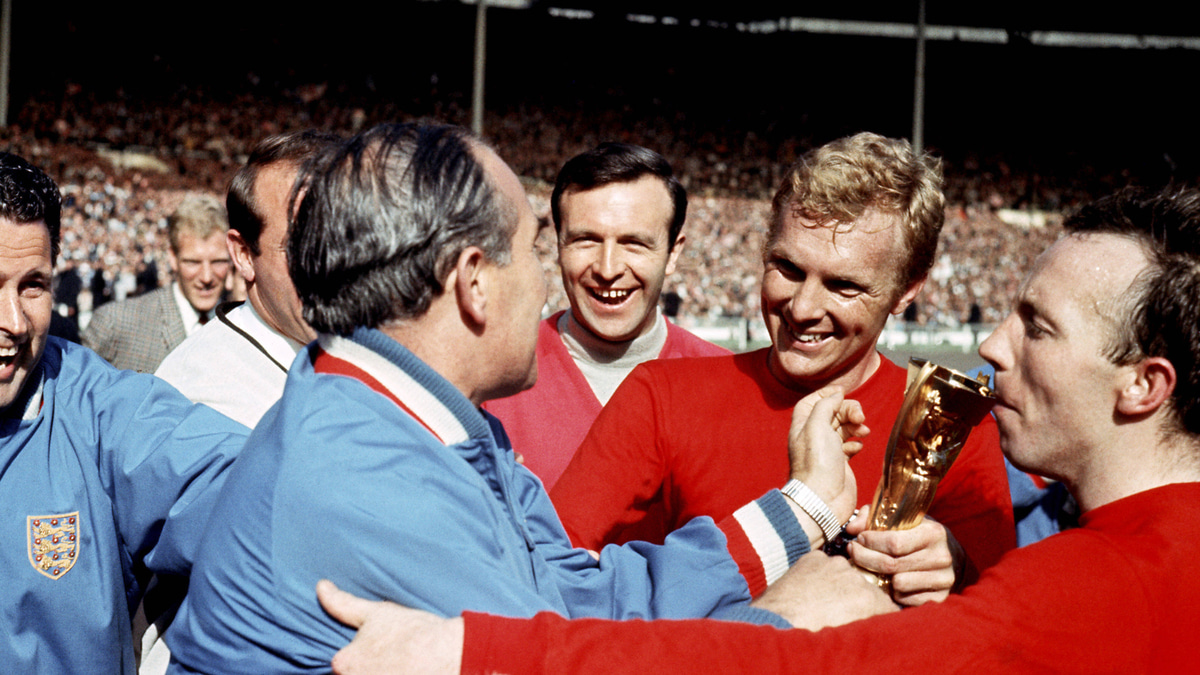
Now 3-2 behind the Germans had to attack in force, and in so doing let Hurst run away in the dying embers to complete his hat-trick. Sir Alf Ramsey’s “wingless wonders” were the new world champions.
By Iain Macleod & Keir Radnedge.
Read more about:
World Cup U20