
-
Analysis
A new era of Soccer Wars: Can USL survive the MLS onslaught?
5 min read
Analysis

The United Soccer League is aiming to rival Major League Soccer's Division I status with the launch of USL Premier in 2028, but if push comes to shove, there will only be one winner.
USL made headlines in early 2025 when it unveiled plans to create a new first tier and, shortly thereafter, also announced that it would look to implement a promotion and relegation system - a first in professional American sports.
The current USL comprises a professional Division II league, the Championship, a third tier, League One, and League Two, a regionalized, semi-professional summer league. With this pyramid in place, it is only natural that there should also be a first division, right?
Well, it's not that simple because MLS exists. It's the top dog in American soccer, and it wants to retain that status. Most people would concur with the sentiment that USL is not a genuine threat to MLS. The latter has been around for too long.
It has entrenched itself as the pinnacle of American soccer and works like a well-oiled machine. This is in stark contrast to its ostensible competitor, where, despite the impressive growth of the USL ecosystem over the past decade, clubs still go bust left, right and center.
But, of course, MLS (like USL) is not just a soccer league - it's a business. And this is where things get tricky.
A new era of Soccer Wars
MLS, as a business, wants to retain its monopoly on elite-level men's soccer in the United States. You can't have upstarts come in and take away your customers in one of the most fiercely contested markets in all of sports.
MLS and USL are in the unique position that neither is the favored product in its home market. Most soccer fans in the States prefer Liga MX or the Premier League. Naturally, then, MLS can't stomach the thought of another Division I league potentially robbing it of eyeballs.
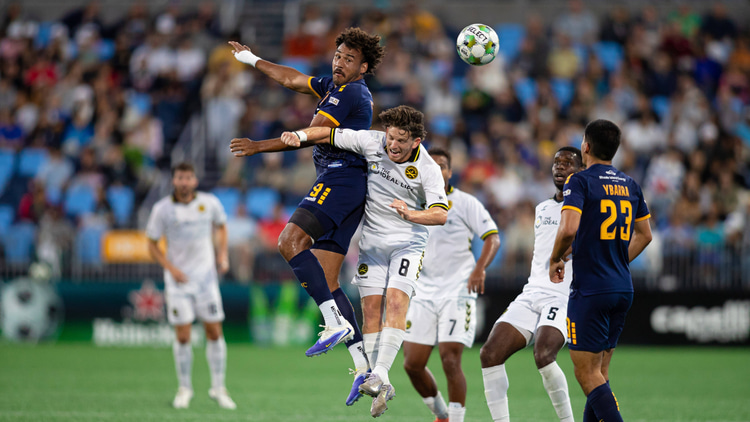
Soccer in the United States has a long history of cannibalizing itself. There have been various eras of "Soccer Wars" - leagues and clubs fighting each other - and it seems we are about to enter a new one.
Earlier this year, the revamped North American Soccer League, on "hiatus" since 2017, officially lost its decade-long legal battle with MLS and US Soccer, in which it argued that the two had conspired to deny it Division II sanctioning back in the day.
The NASL's claim that MLS and US Soccer ran an anticompetitive monopoly over pro soccer was dismissed, thus maintaining the status quo. This is relevant to USL's proposed launch of USL Premier in 2028.
In order to receive Division I sanctioning, the newly founded league must adhere to strict standards such as having a certain number of clubs. These teams, in turn, must also meet detailed criteria, like playing in a 15,000-capacity stadium, having a majority owner with a net worth of at least $40 million and other seemingly arbitrary things.
Because of the incredibly specific nature of these requirements, critics believe their only purpose is to protect MLS against any would-be challengers such as USL. At this stage, it seems all but impossible for USL to assemble enough teams that meet all the criteria.
This isn't necessarily an issue because the federation can grant waivers, as it has done for MLS on several occasions. However, USL would potentially require blanket exemptions for most of its clubs on several requirements - like stadium size - and this is where MLS could cry foul and potentially seek legal action.
Instead of letting it come to this, US Soccer could readily decide to pull the rug out from underneath USL Premier. MLS's recent actions certainly suggest that it won't stand idly by and let USL get a slice of its pie.
For one, MLS has announced that, starting with the calendar shift next season, all 27 US-based teams will participate in the Open Cup again. This is major news as it finally relegitimizes America's oldest soccer competition, one beloved by many fans.
The fact that MLS pulled out - although not all teams - in the first place earlier this decade was scandalous. It should never have even come to this, and MLS's prioritization of the astroturfed Leagues Cup gave away its real motives - it was never about fixture congestion; it was only ever about money.
MLS's full return has cranked up the pressure on USL. It means that the former is now fully compliant with Division I requirements, which state that teams must compete in all US Soccer- and CONCACAF-sanctioned competitions.
Consequently, MLS now has firmer ground to stand on when arguing that USL Premier should not receive waivers - "we're fully compliant, why should they get exemptions?"
That's not all, however. Developments in Next Pro also point to a more aggressive strategy from MLS. The so-called Hometown Soccer Holdings initiative will see MLS feeder clubs move out of market to become more independent - at least in terms of their branding.
A new chapter for the next generation of local soccer players and fans begins in July 2027 ⚽️
More Information ➡️ https://t.co/lFejqwjD5j pic.twitter.com/2NCuig4BsI— New York City FC (@newyorkcityfc) September 2, 2026
This week, NYCFC's reserve outfit became the first team to relocate as part of this initiative, moving to Middlesex County, New Jersey. The club will be rebranded but still function as a development side for the MLS franchise.
Ironically, this is reminiscent of the affiliate program USL used to have with MLS in the 2010s. Not only did the latter field reserve teams in USL, but it could also freely link up with independent USL clubs and use them as feeder teams.
Long before NYCFC II was a thing, the MLS franchise partnered with the now-defunct Wilmington Hammerheads in North Carolina. The Philadelphia Union, meanwhile, brought back one of the most iconic names in American soccer history by refounding Bethlehem Steel.
The creation of a new league in Next Pro allowed MLS better control of these reserve teams, and it also provided the opportunity to absorb independent teams into its orbit. There are currently three such teams in Next Pro, but as many as five are already on the list of planned expansion clubs.
The new initiative of relocating MLS reserve teams looks to be an attempt at doubling down on the penetration of possible USL markets. Of course, MLS isn't unique in this. USL also has a long - and dirty - history of bullying smaller leagues and oversaturating markets.
Just look at Chattanooga - was there really a need to create the Chattanooga Red Wolves when Chattanooga FC - now in Next Pro - were an immensely popular and successful lower-league team? There wasn't.
Jacksonville, too, could soon have two professional teams. Sporting Jax is in its inaugural season in the USL Championship, while the Jacksonville Armada, a former NASL team, are slated to join MLS Next Pro.
However, the latter currently find themselves in limbo because, the owners claim, Next Pro has been dragging its feet in ratifying all the necessary paperwork, which has, in turn, left the club's stadium plans in disarray.
The owners released a statement earlier this week insisting that they remain committed to bringing "pro soccer back to Jacksonville" - completely ignoring the fact that the city currently has a pro soccer team. This is the kind of cannibalization that does soccer in the States no favors.
USL might be winning the Soccer War in Jacksonville - for now - but looking at the bigger picture, if MLS really gets serious about defending its Division I status, then there will only be one winner.
USL can't hang with MLS, that's just a fact. There is no way that USL could win a legal battle or a war of attrition with the commercial juggernaut that is MLS. What's more, the federation will not go out of its way to support USL and spite MLS.
Building a coherent pyramid with promotion and relegation would be good for soccer in the US, but for the federation, it would not be worth the risk of antagonizing its biggest attraction.
USL can do pro-rel without a Division I league, of course, but failing to get USL Premier off the ground would be hugely damaging to its legitimacy. It will be fascinating to see how this situation develops - and how far MLS is willing to go to defend its place in the sun.
Read more about:
MLS
USL Combine