
-
News
- 6 minutes ago
Whistleblower who kickstarted Man City trial is now coming for Gianni Infantino
4 min read
News

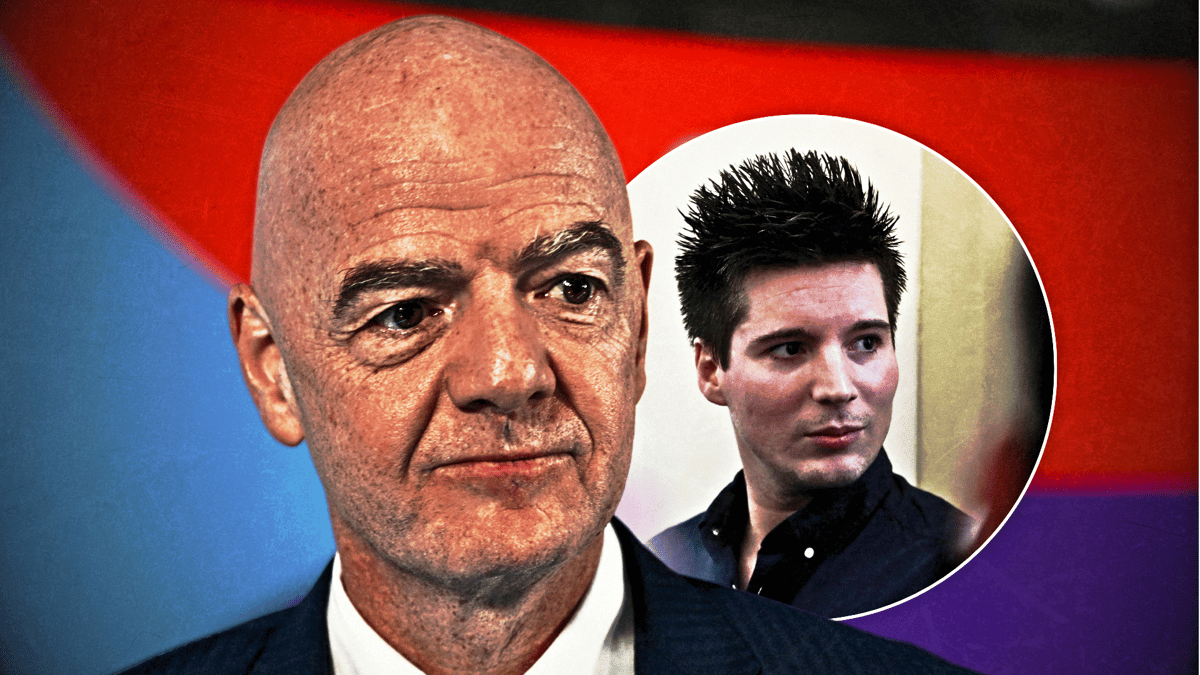
Rui Pinto, the Football Leaks whistleblower who exposed the dark side of the world's most popular sport, has drawn attention to FIFA president Gianni Infantino's entanglement in the Manchester City case.
On Tuesday, the Premier League formally announced that the division's eight-time champions had been found guilty of the majority of their 115 charges of financial breaches and non-cooperation.
The independent commission overseeing the case concluded that Man City had handed out "sham" contracts, falsified their accounts, broke spending rules between 2009 and 2018 and impeded the subsequent investigation.
The commission found that Man City "artificially inflated the club’s revenues, and reduced its costs, by more than £900 million during the affected period, to appear to comply with financial rules."
Premier League CEO Richard Masters described the club's actions as a "systematic breaking of Premier League rules for nearly a decade." Man City deny all allegations and have appealed the verdict. Sanctions will be decided once the appeal process has concluded.
"A cancer on football"
The Man City case ostensibly started a decade ago when the Football Leaks bombshell dropped. Portuguese hacker Rui Pinto leaked confidential documents from clubs, players and governing bodies, exposing the various dodgy dealings in the sport.
The leaks started in 2016, but it wasn't until late 2018 that Man City's alleged offences were revealed. The disclosed information, published in German outlet Der Spiegel, kickstarted the Premier League investigation that culminated in the club being charged with 115 breaches in 2023.
In truth, however, some of the relevant authorities were already aware of financial malpractice well before November 2018. In 2014, Man City faced expulsion from the Champions League for breaking UEFA's Financial Fair Play rules. They were bailed out by none other than Gianni Infantino.
Before being hailed as football's great reformer when he assumed the mantle of FIFA president in 2016, Infantino acted as UEFA's General Secretary and went out of his way to shield Man City and PSG from the very financial rules he had helped to create in 2011.
In light of the Man City verdict, Pinto has now taken aim at Infantino over his involvement in the case. He wrote on X: "Back in 2014, there was a man who was already aware of the irregularities involving Manchester City. That man now runs FIFA.
"The infamous Gianni Infantino, then UEFA General Secretary, abused his authority, shared confidential documents and, in short, outmanoeuvred the Investigatory Chamber, doing everything in his power to ensure that both Manchester City and PSG would merely receive a fine, avoiding a deeper investigation that could have led to a Champions League ban.
"All of these details were also revealed through Football Leaks. Given his actions as UEFA General Secretary and, more recently, as FIFA President, I can only say, in my humble opinion, that Gianni Infantino has become a cancer on football and should have no place in the future of the game."
Infantino's role in City scandal
Indeed, as part of the wave of 2018 leaks, Der Spiegel detailed how Infantino had "failed to clean up football" in his two years as FIFA president.
Infantino was described as being no better than the "despots" who had previously bent "the global organisation to their will," with the publication claiming that he had already abused his power while still at UEFA.
In 2014, UEFA had "spent months investigating nine clubs on suspicions they had massively violated, or were continuing to violate, the new set of budgetary rules," including Man City and PSG. Yet despite Infantino's strong rhetoric in public, both clubs ultimately reached a laughable settlement with UEFA and were spared Champions League expulsion.
The report on the 2014 incident noted that both Man City and PSG exerted "enormous" pressure on the governing body and "met almost every step taken by UEFA with threats" - with the full support of Infantino.
"The decisive ally to both of the clubs was the man whose job should have committed him to complete neutrality: UEFA General Secretary Gianni Infantino. The Football Leaks documents show just how unconscionably the top functionary sided with the newly wealthy clubs, both of which didn't just violate the Financial Fair Play rules. They held them in contempt."
UEFA's General Secretary is not permitted to influence the Club Financial Control Body (CFCB) in any way during its investigation of alleged offences, but that was "the red line that Gianni Infantino crossed" in 2014.
It is reported that "during the FFP proceedings, Infantino met with club bosses from Paris and Manchester on several occasions for secret talks, even supplying them with confidential materials." Moreover, he "proposed compromises that he was unauthorised to propose."
When FFP was officially implemented in 2013, Man City were well aware that they were in "deep trouble" after losing €451 million between 2009 and 2011. In the words of then-finance director Andrew Widdowson, the club were banking on "mitigating factors" to avoid painful sanctions.
Auditors PricewaterhouseCoopers found in January 2014 that a whopping 84% of City's "other commercial income" had originated from Abu Dhabi, while the club were also accused of hiding €35 million in costs from UEFA in their annual statement of accounts.
Like PSG, Man City were said to have artificially inflated the value of their sponsorship agreements with "related parties." Readers may recall Man City's lengthy battle with the Premier League over "associated party transactions" earlier this decade.
In 2014, Man City's sponsorship agreements with Abu Dhabi-linked companies were deemed not to have adhered to fair market value. That didn't matter, however, because Infantino had already instigated the process of absolving City of their violations.
CEO Ferran Soriano allegedly attempted to pressure UEFA into reaching a "sensible settlement" by threatening to challenge FFP in the courts of the European Union. Wanting to avoid this, Infantino arranged a meeting in which City were to put forward an "amicable solution."
The report likened this to "a bank robber proposing an appropriate sentence to the prosecutor." The process of actually agreeing a settlement was anything but amicable, however. The meeting with Infantino, and subsequent talks, yielded no results.
Only when City considered "overwhelming" UEFA with lawsuits, which they believed could have destroyed the organisation, a breakthrough was reached. UEFA ordered City to pay a €20m fine, the same trifling punishment it had earlier meted out to PSG, and the matter was put to bed.
The fine "does not materially affect us," CEO Soriano wrote in an email to his colleagues.
Read more about:
Premier League
Man City