

-
News
- 12 Sep 2026
Why the transfer market is more difficult than ever for Celtic and Rangers
29 Jan 2026 06:55 CST |
6 min read

Analysis

In Brief:
The Squeezed Middle: Teams dominant domestically in smaller leagues are finding the transfer market an increasingly difficult realm to navigate
1. If they spend in the €15-€20m range on a deal, they simply must get it right
2. The transfer progression of small-medium-big club has been destroyed
3. The ‘middle’ market is populated by more sharks than ever - especially lower-end Premier League teams that will happily take the plunge
4. The data is (currently) homogenous and the talent pool shrinking
5. Getting access to youth data is easier than ever, meaning the competition is higher
Earlier in the 2026 January transfer window, Brentford spent €10m on Kaye Furo from Club Brugge.
The 18-year-old has played just 84 minutes of Jupiler League football across five sub appearances, and another 45 mins in the Champions League. That’s it.
Ubiquity in analytics
Yet data analysis goes so deep, and so young, these days, that players can be profiled long before they reach the first team. Furthermore, the abundance of teams who have embraced data analytics increases by the day, and those teams are beginning to understand, specifically, what they want.
Conversations that I’ve had with scouts and others in the know are telling me the same thing: the specific skills for modern football are becoming homogenous across teams, and that talent pool is shrinking.
At a very basic level, people are opening their scouting tool of choice with a set of metrics in mind and hitting ‘filter’. But the number of players able to play in a defined style are being wrestled amongst every team, at every level.
Believe me, this wasn’t always the case. But the same as when any method is unilaterally adopted, the advantage gained from that method is lost.
Who are the “Squeezed Middle”?
Who does that represent? Well, teams that have outgrown the domestic markets in which they operate, but are now being frozen out of the type of mid-level deal that Furo’s move to Brentford absolutely represents.
We can broadly categorise these terms of terms of consistent revenue. Ajax, PSV and Feyenoord in Netherlands. Porto, Sporting and Benfica in Portugal. Celtic and Rangers in Scotland. Basel and Young Boys in Switzerland. RB Salzburg and Sturm Graz in Austria. Sparta Prague, Slavia Prague and Viktoria Plzen in Czech Republic.
Indeed these five leagues - who are traditionally competing for automatic participation in the Champions League for their teams - have won 73 of the last 75 domestic league titles available in their respective leagues. We also see Copenhagen in Denmark, Dinamo Zagreb in Croatia, Crvena Zvezda in Serbia and Shakhtar Donetsk and Dynamo Kyiv in Ukraine holding similar controls over their leagues. (Galatasaray have a dominance in Turkey, but spend huge sums of money in doing so - over €230m in the past three summers).
Each transfer is becoming increasingly risky for the Squeezed Middle
Luckily for Portugal the market still values their players at a high level, but that is never traditionally invested in kind, in one major deal. Porto and Sporting’s all-time record transfers hover around €22m, though Benfica have always looked to spend a little more (their record being Enzo Fernandez at €44m).
In essence, deals in and around €15m are the types that represent a significant outlay for these teams. Their domestic TV rights deals do not remotely compete with their Big Five rivals but their regular European football means that they massively outstrip their home counterparts. Celtic, for example, in 24/25 earned €5.5m from domestic rights, but collected €40m from European competition upon reaching the play-off round of the Champions League.
PSV Eindhoven (€64m), Club Brugge (€64m) and Feyenoord (€61m) hammer home the point. PSV and Feyenoord took home around €13-15m each domestically, and so you can see how the Champions League expansion is basically making qualification life or death for a team’s expenses beyond the secondary market of player sales, which is becoming a revenue stream all of its own.
The point is, they have money to spend to maintain the domestic status quo, but the squeezed middle represents the €10-€15m market, one where they simply cannot get things wrong, and if they do, other dominos can fall.
Case Study: Ajax, Celtic and Benfica
Let’s look at the example of Ajax. In 2023 they raised €157m through player sales and chose to spend €112m of it on new talent, including eight players valued €6m or above, which they hadn’t done before, nor since.
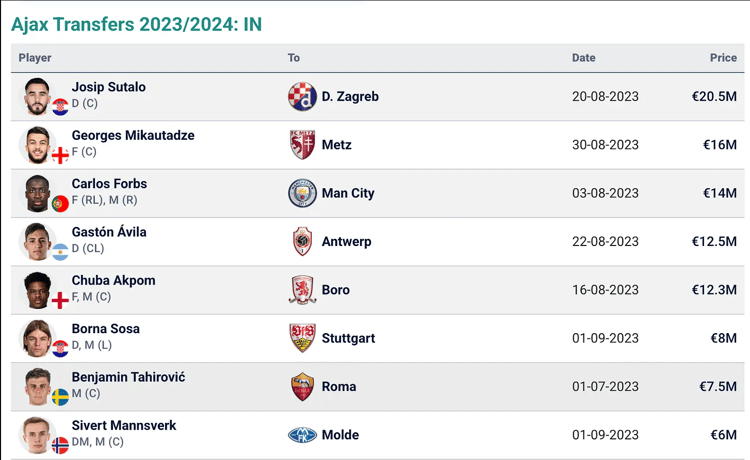
That summer splurge is now regarded as Ajax’s disaster, setting the club back significantly and ultimately meant they missed out on Champions League in 24/25. In short, you can’t take that many punts and afford to get them wrong.
Celtic, too, have suffered similar struggles. They took a €45m swing in the summer of 2024, but of the four signings €7m or above, one has been injured for nearly a year (Jota), one has gone (Adam Idah), while to say that the other two have flattered to deceive would be putting it lightly (Arne Engels and Austin Trusty).
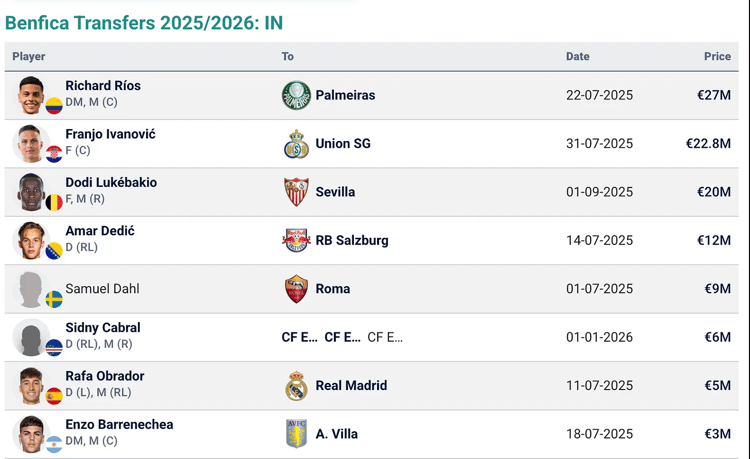
Benfica this summer have splurged over €100m and their reward for three €20m+ deals has been to be 10 points off the Primeira Liga pace, while they remarkably had to rely on one of the craziest moments of the season - a goal in the last minute against Real Madrid scored by their goalkeeper - to survive in the Champions League.
To a lesser extent Club Brugge, competing with the hyper-advanced Tony Bloom-backed Union Saint-Gilloise, spent more than they had ever done in a single summer but the season so far sees a sacked coach, trailing in the league, and making the Champions League playoff by just a single point.
OKAY…
Bear with us, we’re getting there. The fact is that the scouting networks are so deep, data so readily available and teams largely homogenous in their approach that the talent pool has drastically shifted and this subset of teams are left with nowhere to go.
Tactical styles evolve, as always, but ball-playing centre-backs, and quick, effective wingers are the current trend. What is unlikely to shift back, however, is age profile. Everyone wants a player in the 19-24 bracket, and this is because of perceived sell-on value. If you are 28 and signing a five-year deal, the likely end-of-contract trade is a free one, and so clubs try to look younger to guarantee a return, even if a deal doesn’t work out.
As the Premier League hoovers up everything, we’re almost at a tipping point. How do you run a club in the middle?
The FootballTransfers app
Check out FootballTransfers' new app for all of football's big storylines, transfer rumours and exclusive news in one convenient place directly on your mobile device.
The FootballTransfers app is available in the Apple App Store. Download here: