
-
News
How much work goes in to a commentator preparing for a live match?
4 min read
News

Some football fans think that football commentators only work for a couple of hours, one or two days a week.
An easy job, right?
Not quite, as being a football commentator is a full-time job due to the work and preparation that goes into presenting live matches.
As well as simply describing the action for viewers, commentators must have a fundamental understanding of the league, the two teams playing, the players, and the specific situations for all the factors involved.
It's more than just firing out stats, too, as history needs to be alluded to and the scene set.
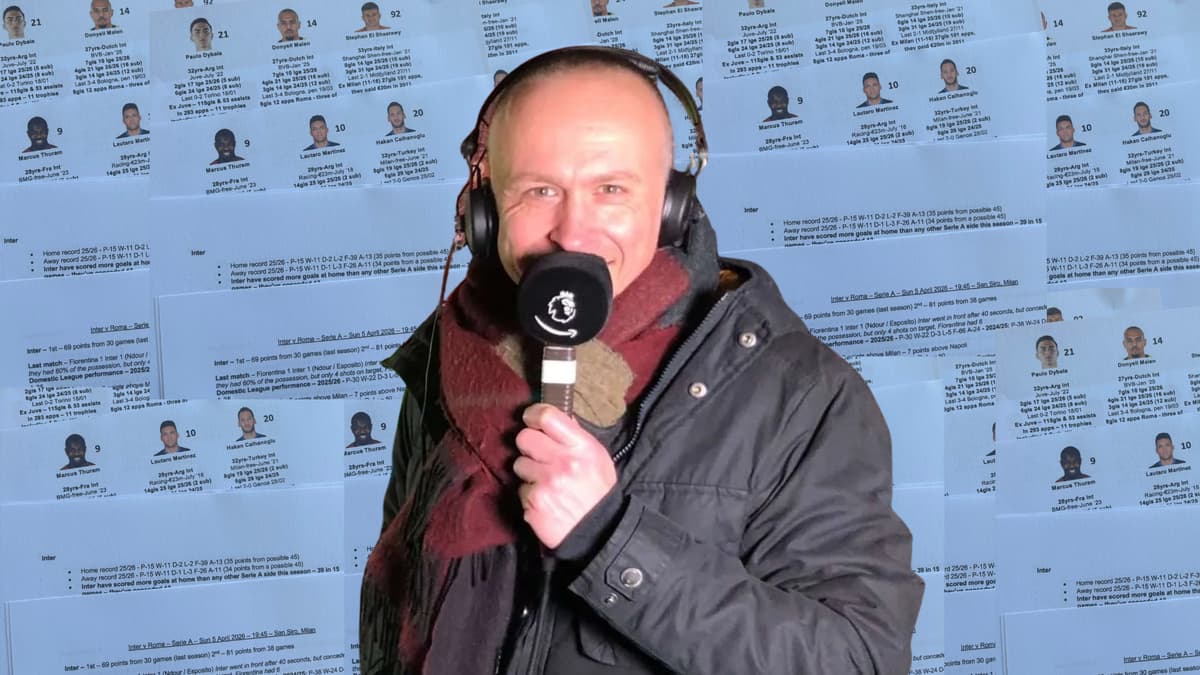
Commentator Adam Summerton provided a fascinating insight into his preparation when asked about it on X.
He posted a picture of his 'cheat sheet' for the Roma versus Inter match on Sunday evening, and when an X user asked how long it takes to prepare for a single fixture, he responded:
"I’m usually juggling prep for a few different games at the same time, so it’s difficult to say exactly.
"It also depends on how often/recently you covered the teams involved - there’s a difference between topping existing prep up and starting with a blank sheet of paper - but I’d say the average would be a couple of days.
"Even with two teams you’ve covered many times there’s a challenge to find new lines that people may find interesting, or that’ll spark conversation with co-comm.
"You must also be prepared for narratives that may develop during that particular game - part of the job is story telling.
Summerton insists it's important to treat each fixture with the focus it deserves, not matter the competition.
"What’s key is to give the same diligence to Real Madrid v Man City as Notts County v Boreham Wood - as to the supporters of those clubs that’s the most important game of the day," he continued.
"I’d also say research breeds knowledge, knowledge breeds confidence, and confidence (hopefully) gives a broadcast some level of authority.
"Nobody, as a lead comm, cares much for my opinion on anything - there’s a co-comm for that - but I might be able to tell them something they didn’t already know about a player or coach etc."
Summerton was treated to a hell of a match on Sunday as Inter ran out 5-2 winners against Roma at San Siro.
Lautaro Martinez was the star of the show, scoring two goals on his comeback from injury as the Nerazzurri created a nine-point gap at the top of Serie A in the race for the Scudetto.
Prep printed and off to cover Inter v Roma for @tntsports
To be honest this next week is an absolute joy as a long time lover of European football
Then heading to Barca v Atletico and Bologna v Aston Villa - fortunate to a job I enjoy so much pic.twitter.com/rRpld8fzEU— Adam Summerton (@adamsummerton) April 5, 2026
How do you become a football commentator?
Derek Rae is the voice of the Champions League in the United States and has worked on a range of leagues throughout his career, from the Premier League to the Bundesliga, while he's known to many as one of the voices of EAFC.
He once revealed what it takes to become a football commentator.
"It was always something I wanted to do from a very young age," Rae told Goal.
"I started as a seven-year-old in Aberdeen making tapes of the 1974 World Cup, which is the first tournament I really fell in love with. From that point on, I always knew that's what I wanted to be.
"But wanting to do something and actually doing it is a different matter. From the age of 11, 12, I used to go to games, usually Aberdeen reserve games, and make tapes for myself and people around me would give me funny looks, saying: 'You're that strange laddie that makes tapes to himself.' From the age of 13 on, I went on to hospital radio where you're making programmes for the patients in local hospitals. I got the gig as one of the commentators for Aberdeen games on hospital radio, which was the only way you could broadcast Aberdeen games in those days because there wasn't community radio or a local station covering the team week in, week out. I continued doing that all the way until I went to university.
"I also had written to my broadcasting hero David Francey who was the voice of Scottish football on radio. I worshipped his broadcasting style which was a rich distinctive Scottish style. I sent my tapes to him and got some great feedback from him and we stayed in touch. I sent another to him when I was at university when I was 19 and instead of just sending back a letter of advice, what David did for me was he passed it on to the BBC. I got a call back from the producer there and I ended up on the air at 19. My second game as a commentator was England vs Scotland at Wembley in 1986 because David was unable to do the game."
The FootballTransfers app
Check out FootballTransfers' new app for all of football's big storylines, transfer rumours and exclusive news in one convenient place directly on your mobile device.
The FootballTransfers app is available on Google Play and in the Apple App Store. Download here:
Read more about:
Serie A