
-
News
Edgar Davids and the free transfer that changed football forever
5 min read
Analysis

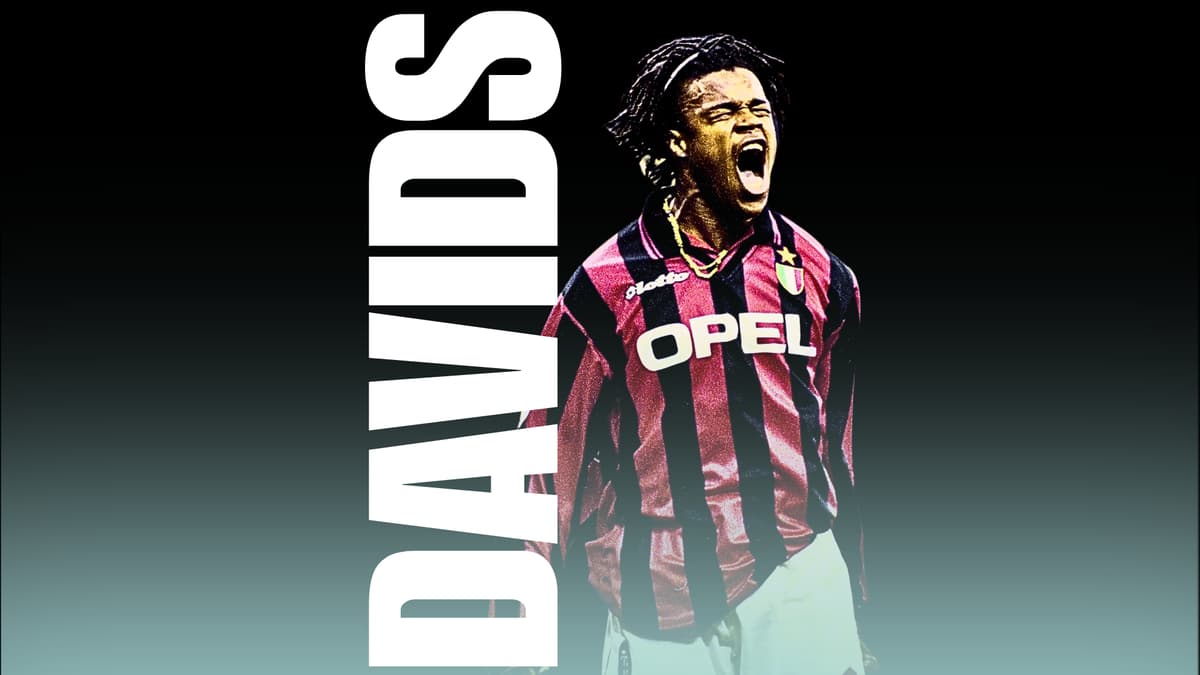
Edgar Davids changed the football transfer market forever when he left Ajax for AC Milan in 1996.
The Dutchman was one of the most recognisable footballers of his generation due to playing with protective goggles after undergoing surgery on his right eye for glaucoma.
Davids represented the Netherlands at one World Cup and three European championships, while he also made headlines in 2012 for joining League Two side Barnet as player-manager. The midfielder was a fine player, but his most enduring legacy was created outside of the football pitch.
In 1996, Davids was the first high-profile beneficiary of the recent Bosman ruling, which allowed him to leave Ajax for AC Milan on a free transfer. It would change the landscape of the transfer market forever.
Why did AC Milan sign Davids?
By the time Milan signed Davids, he was already a well-known commodity in European football. A product of Ajax's famed academy, he played for the senior team for five years between 1991 and 1996.
During that time, Davids won three Eredivisie titles, a UEFA Cup and a Champions League in 1995. A defensive midfielder by trade, Ajax manager Louis van Gaal nicknamed him "The Pitbull." What he lacked in size at 5ft 7in, he made up for in tenacity.
Despite his success, his time in Amsterdam would ultimately end in disappointment. Ajax reached the Champions League final for the second consecutive season in 1996, but the Dutch giants lost to Juventus on penalties, with Davids missing a crucial spot kick.
At that point, the writing was on the wall. Ajax's great team was beginning to fall apart, eventually culminating in a talent exodus of epic proportions.
Davids was one of the first to jump ship. His contract was expiring, and he made use of the new Bosman ruling to switch clubs for free. Like many of that generation's great players, his destination would be Italy.
The transfer
As an accomplished midfielder, the Dutchman had his pick of clubs. Sir Alex Ferguson wanted to make Davids the face of his Manchester United rebuild in 1996, but the allure of the star-studded Serie A proved too great.
"AC Milan, why? Because in that period, Italy was the top of the top," Davids explained in an interview with Total Media. "I always say that if that wasn’t the case, I would have signed for Man Utd for sure."
A year after selling Paul Ince, Ferguson discussed a deal with Davids. "That conversation with Sir Alex Ferguson was one of the best I had, that man is something else," the midfielder recalled.
However, he ultimately turned down a move to Old Trafford and elected to join the reigning Serie A champions instead. This decision was a devastating one for Ajax.
The Amsterdam giants lost their star midfielder and did not receive a single penny because of the Bosman ruling that would change football forever in 1995.
Belgian player Jean-Marc Bosman took his club RFC Liege, the Belgian federation and UEFA to court in the early 1990s after being denied a transfer to French side Dunkerque despite his expiring contract.
At the time, clubs were allowed to request fees for out-of-contract players, and Liege's demands were deemed excessive by Dunkerque, dooming Bosman's transfer.
Consequently, he argued before the European Court of Justice that this rule restricted the free movement of labour and that it amounted to a restraint of trade. After years of back-and-forth over three separate cases, Bosman won his legal battle in December 1995.
It came at a great personal cost to him, though, as his compensation was largely spent on legal fees. Despite winning, Bosman was essentially bankrupt and never managed to recover financially.
However, his sacrifice was not in vain as the ruling changed the landscape of the transfer market forever. Not only did his legal victory enable players to complete free transfers at the end of their contracts, but it also resulted in the abolition of limits on EU foreigners in domestic leagues.
A few months later, Davids and teammate Michael Reiziger became the first high-profile footballers to make use of the new free agency regulation when they joined AC Milan on what became known as a "Bosman transfer."
Did the transfer work out?
Despite their seismic transfers, neither Davids nor Reiziger had a particularly great time of it in Milan. Both players endured a first season marred by injury and departed the club again after just a few months.
In the case of Davids, he suffered a broken leg in February 1997 in what was proving to be a disastrous season for the reigning Scudetto holders. Ultimately, Milan would finish in a lowly 11th.
After his recovery, he struggled to get back into the team, and Milan swiftly decided to cut their losses. In December 1997, Davids was sold to Juventus for £3 million, which was a dream transfer for him.
Legend has it that he one day rocked up at the Rossoneri's Milanello training base with a Juventus kit tucked under his arm while the two clubs were negotiating his move.
Described as a difficult character previously, Davids matured in Turin. His newfound seriousness was reflected in his performances. It was at Juventus where the Dutchman really began to blossom into one of Europe's best.
He was at the peak of his powers and helped the club win three Scudetti. When he left to join Barcelona on loan in January 2004, Davids had become such an impactful midfielder that he catalysed the mid-table club's surge into second place, laying the foundation for their future domination.
After six months in Catalunya, he left Juventus for Inter. He later had stints at Tottenham, Ajax for a second time, Crystal Palace and Barnet.
Legacy
While Davids' transfer to AC Milan did not work out on the pitch, it had a huge impact off it. As the first major player to utilise the Bosman ruling, the Dutch midfielder heralded the era of player power.
Players became agents in the transfer market rather than simple commodities to be traded at the behest of their respective clubs. Since Davids' move to Milan, scores of high-profile players have decided to run their contracts down and move via free transfers.
The likes of Sol Campbell, Andrea Pirlo, Robert Lewandowski, Lionel Messi and Kylian Mbappe have all walked in the footsteps of Davids by forging their own destinies.
Be it because they had outgrown their clubs, didn't feel valued by them, or because they simply wanted to join the teams they grew up supporting, all of these transfers were made possible because Davids had blazed a trail with his move back in 1996.