
-
News
- 16 Sep 2026
A shot heard round the world, and a money-grabbing legacy - how USA 1994 might not have happened
4 Mar 2026 18:10 CST |
Updated: 23 Mar 2026 02:00 CDT |
8 min read
Analysis

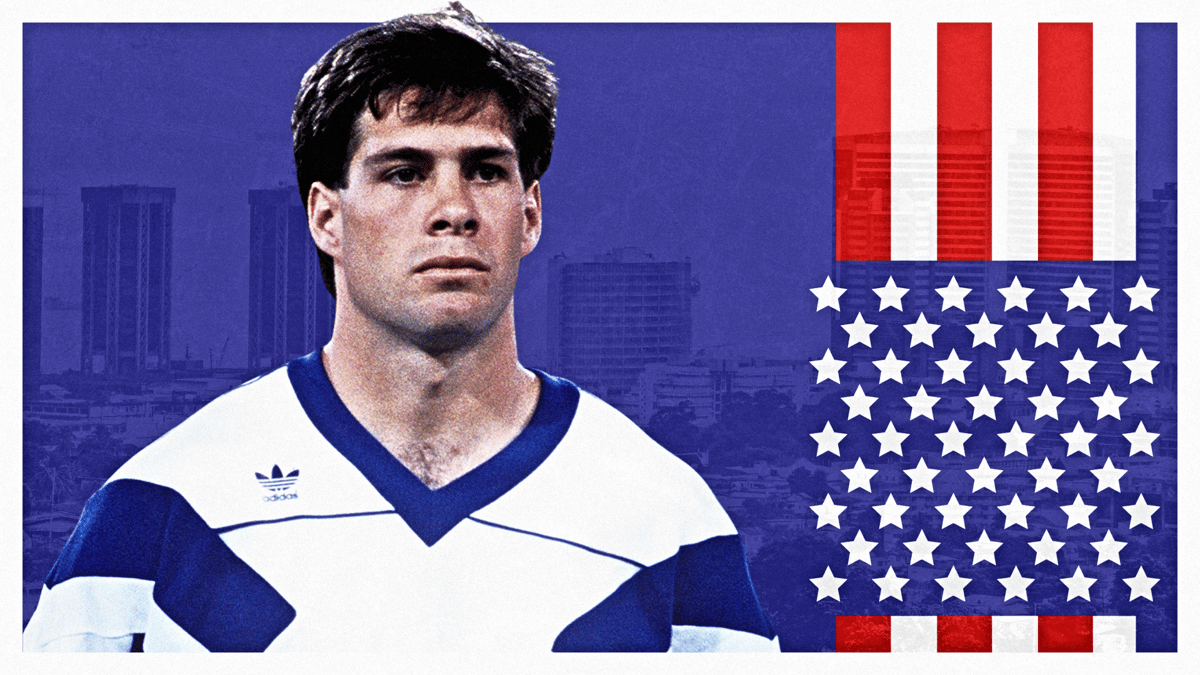
On 19 November 1989, USA played out their last Concacaf qualifier for the 1990 World Cup against Trinidad and Tobago. Paul Caligiuri scored the winning goal, a quite brilliant effort where he flicked past an onrushing defender before volleying sweetly into the net.
That was in the 30th minute, and from there T & T had plenty of the ball, but nothing in the way of obvious chances. It was a solid win for a USA team that, at the time, was far from the well-funded, competitive entity they are today.
So far, so much. But the underlying politics of this game stretches five years before and five years after, contributing to the most mundane, but important, match in the history of USA soccer since defeating England in 1950.
Step back to 1982. Colombia are already the confirmed hosts for World Cup 1986 and Joao Havelange, FIFA president, has made it clear that the tournament is set to expand to 24 teams for the ‘86 event. This had been an election promise to the African delegates that voted for him, and one that he refused to renege upon.
Colombia chairman, Alfonso Senior, pressed him as time moved on. They claimed that they only had the facilities to host 16 teams. Havelange refused to budge. Therefore a new host had to be found, and a bidding process from nowhere had begun.
At that time a tournament was assigned to a geographical location and the location rotated between, as it was then, the two main football ‘blocs’, Europe and the Americas.
From 1958 the tournament had moved from Sweden, Chile (62), England (66), Mexico, (70), West Germany (74), Argentina (78) and then Spain (82). This was the formula and there was no possibility of deviating - at least at that time.
But most of South America, however, was in various stages of economic turmoil. Chile had wanted to do it again but simply had no possibility to do so. Argentina had already had it on the last rotation. Brazil was still under hostile military rule. Hosting a 24-team tournament was simply not possible. Therefore the FIFA flare was fired; USA and Canada were first to answer the call.
If the USA seemed too green to be hosting ‘soccer’ in 1994, they were infinitely more naive to the process in 86. While USA were strategising, Havelange had already met Mexican Executive Committee member Guillermo Canedo who, as Keir Radnedge noted in World Soccer in 2016, was ‘one of his most loyal supporters’. Canedo was also a TV executive and, if reports are to be believed, had a vested financial interest to ensure the tournament went to Mexico ahead of the other representatives.
The ExCo members had already been shown the Mexico offering and effectively made their decision to vote them as hosts in March of 1983, a full two months before the formal voting procedure.
Yet the charade continued; the USA drafted in political heavyweight Henry Kissinger to present their case, flanked by Pele and Franz Beckenbauer, who had both competed in the North American Soccer League, in front of the Exco panel. Their bid by every FIFA economic metric was vastly superior; stadia, attendances, commercial opportunities. But it was moot; thanks to Havelange’s relationships, the USA had thrown down their three-of-a-kind against what should have been a busted flush, yet the game was clearly rigged.
After an hour of lobbying, the USA bid came up woefully short. By comparison, the Mexican delegation took eight minutes to present what was an empty, but ultimately winning, proposal.
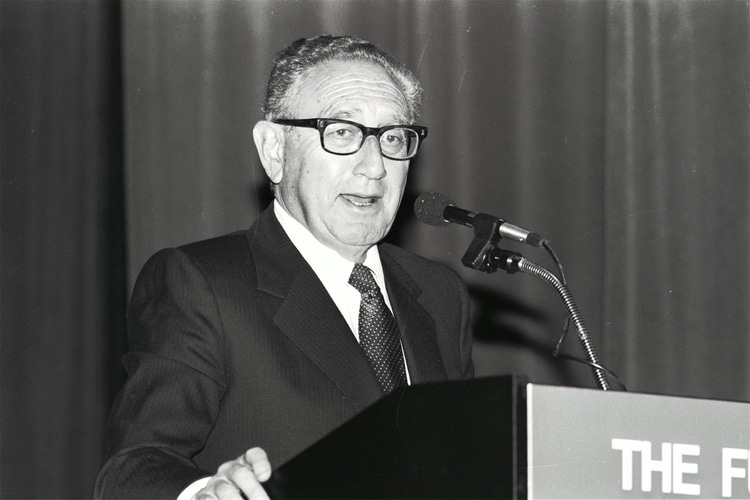
It may well be apocryphal but Kissinger is thought to have said, having had his first brush of FIFA secret handshakes, that the experience ‘made him feel nostalgic for the Middle East’.
So the USA, fingers suitably burned, had to play the politics of FIFA’s bidding process in order to make sure theirs was the one and only destination for 1994. The Europe/Americas rotation should have meant that the USA were certainties to follow up Italia 90. And yet a rogue, well-supported bid from Morocco had started to gain real momentum. Nothing pleases certain FIFA powerbrokers more than taking the game to somewhere it hasn’t been before (see Sepp Blatter with Japan & South Korea, South Africa and, fatefully - Russia and Qatar), and at that time the lobbying was looser and less defined.
So the idea of usurping the rotation between the established forces appealed to certain members of FIFA hierarchy, who could therefore influence other ExCo members. Then USSF president Werner Fricker, was able to scrape a 10-7 win, but that simply wasn’t emphatic enough, nor Fricker skilled enough in the arts of handshaking, to convince anyone he was the cash machine FIFA were looking for.
The commercial potential of the World Cup was obvious. But it was felt that Fricker was an obstacle to the tournament fulfilling its entire potential. After the failure of the North American Soccer League (NASL), despite European talent being paid handsomely to be there, the USA had one final shot to embrace soccer - and Fricker wasn’t the fella.
And so despite being the one who ultimately won the bid, Fricker wouldn’t last long enough to see the tournament under his tenure. He was seen as a difficult figure to work with, not commercially acute enough, and unable to think of the biggest picture. The federation was driven into significant debt in order to wrestle the bid from Morocco in the first instance and so, three-and-a-half-years from kick-off, it was decided he wasn’t the guy.
Step forward a lawyer: Alan Rothenberg. Fresh from a home-run Los Angeles Olympics in 1984 which was an immense sporting and commercial success for the International Olympic Committee (IOC), where he had been the commissioner of soccer and had overseen record attendances for the discipline, he was in the crosshairs of FIFA’s bigwigs before he even knew it.
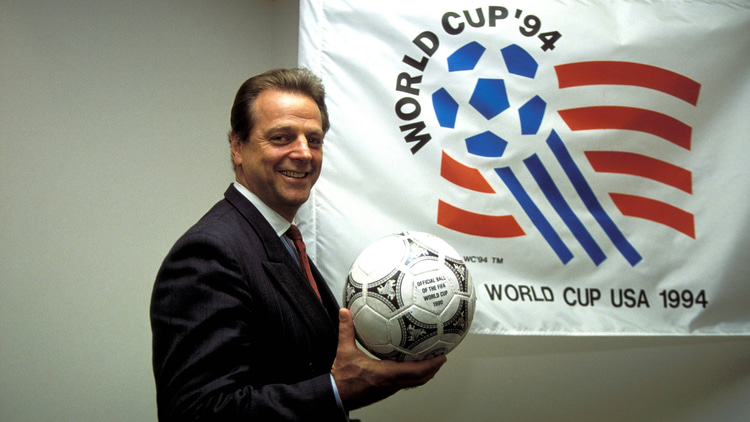
But simply having it did not compute being able to host it. Rothenberg was the man that FIFA wanted; he had worked the room well with the IOC in 1984, and being a lawyer from LA by trade, knew what he could extract from this relationship. Rothenberg won the election to manage the USSF by a landslide.
As Jonathan Wilson notes in his book ‘The Power and The Glory’, New York Times columnist, George Vecsey, wrote at the time of the announcement that ‘The United States has been chosen because of all the money to be made here. We’ve been rented as a giant stadium and TV studio.’
Therefore there were significant fears about the knock-on effect of the USA failing to qualify for the 1990 event in Italy. Would they be renting an empty space without building momentum from 1990 onwards?
Back then, North American qualifying was condensed into a final six-team section and the USA’s performances had been less than stellar; with Costa Rica already through, they stumbled to a dismal 0-0 draw in El Salvador - a team who wouldn’t record a win in the group - before drawing 0-0 at home to Guatemala in St. Louis in front of a sparse 8,000 fans.
With two to go through out of the six, Trinidad and Tobago could therefore draw in the Port of Spain and knock the US out of Italia 90.
What happens next is the stuff of legend, conjecture and allegation - former Trinidad and Tobago Football Federation president Jack Warner himself has singularly denied any wrongdoing or involvement - but the crowd watching Caligiuri’s now seminal volley were unfeasibly packed into the stadium.
There were serious concerns over the safety of the 35,000 in attendance, and if you care to delve into the grainy YouTube footage, you’ll find a tiny stadium filled to the brim with people.
As the story goes, Warner had held a meeting the day prior to discuss the ramifications of USA failing to qualify for Italia 90. Chuck Blazer was his confidant. Both men were subsequently handed lifetime bans from all football-related activities by FIFA’s Ethic Committee, Warner in 2015, Blazer earlier the same year. There is no suggestion that the events in the Port of Spain had any involvement in that decision.
But, for the moment, indulge the narrative. The build for 1994 was supposed to begin there, showcasing the USA as a soccer power preparing to come back stronger to host four years later. With the USA unable to qualify from this feeble group, would there be sufficient interest from fans and sponsors to justify FIFA’s clear preference for their host nation?
In reality, as FIFA ultimately proved when it was convenient to them, Warner was an immensely greedy individual and kickbacks were merely part of his 9-to-5. There is the case that the packed crowd simply allowed him to pocket the difference and that there was no broader foul play - aside from that corruption - involved.
In any event, it didn’t matter. Caligiuri’s volley got USA to 1990 and the naysayers would point to their chastening display there - Tomas Skuhravy taking them to the woodshed in a 5-1 defeat to Czechoslovakia in a group where they finished bottom with zero points - as having negligible resonance anyway.
But the myths and the truths tie together in a neat bow. USA was the last commercial frontier at that time to expand FIFA’s capabilities, and their deal with the USSF designated that a domestic league had to be launched afterwards. This was Major League Soccer, which exists and is relatively thriving to this day. It unlocked a market and a level of tournament reserves that gave FIFA a thirst for what came next.
USA 1994 was a massive success. Rothenberg had been given so many different roles by FIFA - tournament organiser, USSF president, and future founder of MLS - that he was basically negotiating with himself for most of the trip. He took no money up front, but took a colossal chunk on the other side, with conservative estimates suggesting that he was good for at least $10m for his facilitation of the event.
The total attendance record smashed every tournament that came before, the atmospheres were thrilling and family friendly, and presented to FIFA the idea of their little tournament being an unrelenting roadshow, which finds us where we are now.
FIFA’s deals for host nations now export all of the logistics and costs of organising the event onto the hosting country, including negotiating aggressive tax breaks for doing so. It could be argued that USA 1994 was the seed that became the plant, which became the rotting timber of this event.
Read more about:
FIFA Club World Cup
United States