

-
News
North American heatwave may render World Cup matches unplayable
3 min read
News

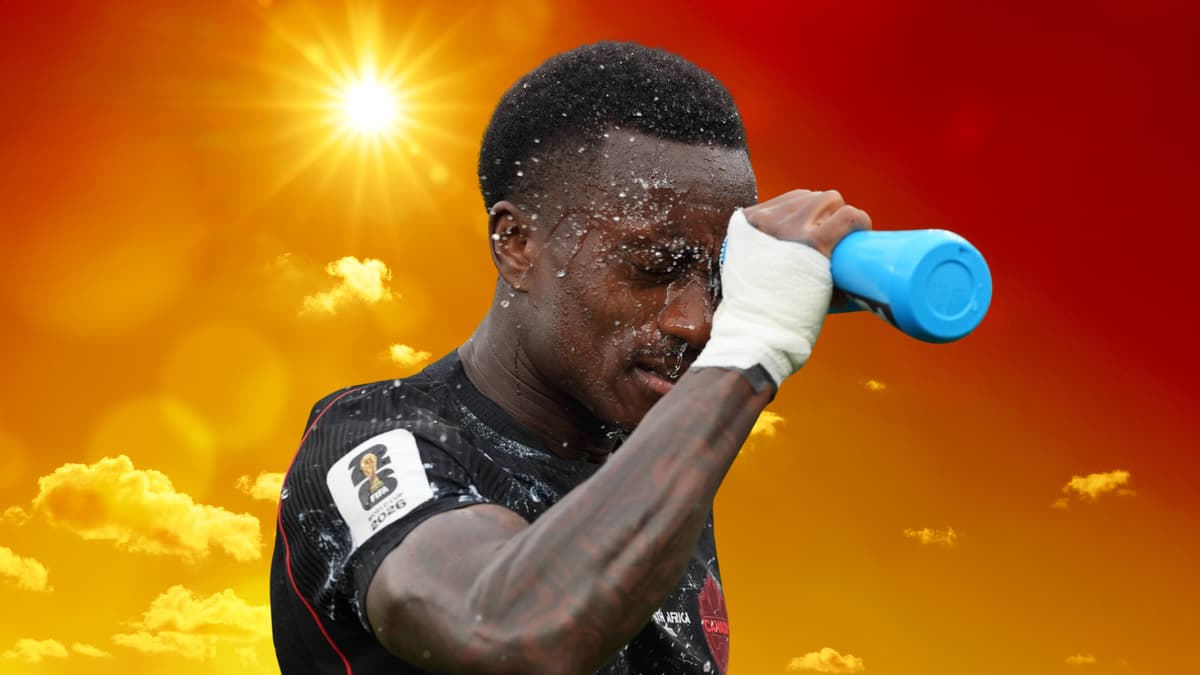
In parts of the United States and Canada this week, temperatures could exceed the threshold where global players' union Fifpro consider it too unsafe for play.
The National Weather Service (NWS) reports that 'feels like' temperatures could reach as high as 45C (113F) in certain areas of North America, the location of the 2026 World Cup.
Actual air temperatures will reach at least the high 30s and close to 40 and the BBC reports that some high temperature records could be broken in some of the eastern states of America.
Mandatory water breaks have been introduced by FIFA at the World Cup and benches will be cooled for staff and players, though fans cynically believe the hydration stoppages are mostly there for advertising purposes.
Not all World Cup matches will be impacted by the heatwave this week but some notable ones will be, including France versus Sweden in New Jersey, Portugal versus Croatia in Toronto, Argentina versus Cape Verde in Miami and Colombia versus Ghana in Kansas City.
Temperatures in excess of 32C (90F) are widely expected and when you add in the humidity, it will actually feel like temperatures are up to 46C (115F). The Wet Bulb Global Temperature (WBGT), a measure of how heat and humidity impacts humans, has determined potential temperatures for games that Fifpro deem unsafe for players.
Due to the high temperatures and high humidity, the World Cup games taking place also risk stoppages due to thunderstorms.
Scientists warned FIFA over heat during games
Twenty world-leading climate scientists previously wrote an open letter to FIFA warning of the health risks of playing in extreme heat in North America this summer.
Andrew Simms, director of the New Weather Institute, who coordinated the letter, told BBC Sport:
"Player safety is an immediate and urgent concern because things can go wrong very quickly when people overheat.
"We're worried that Fifa is playing recklessly with the health and safety of players."
Professor Douglas Casa from the University of Connecticut, said: "The hydration break in each half absolutely needs to be longer than three minutes - at least five minutes for each break and preferably six.
"We hope this open letter convinces FIFA to update its heat guidelines before the World Cup."
World Weather Attribution (WWA) analysed that heat and humidity was expected to be more severe than the 1994 World Cup which took place in the USA due to climate change.
The open letter from the group of scientists partly states:
"Player health and safety must remain the non-negotiable foundation of football governance and the heat risks for the upcoming World Cup make this question more urgent than ever. We ask if FIFA will commit to evaluating and updating its guidelines in accordance with the best practice and science, and in line with its stated prioritising of player safety?"
Concerns about the climate during the tournament intensified last summer when the US held the Club World Cup.
During Juventus' clash with Real Madrid in Miami, head coach Igor Tudor said ten of his players asked to be substituted with temperatures reaching 30°C and humidity 70 per cent, while Dortmund boss Niko Kovac said he was "sweating like I've just come out of a sauna" during the victory over Mamelodi Sundowns.
Then-Chelsea manager Enzo Maresca joined the chorus of complaints. Ahead of Chelsea's Group D match against Esperance in Philadelphia, Pennsylvania, the Blues boss said: "It is almost impossible to train or to make a session because of the weather. Now, we are trying just to save energy for the game."
"I had to lie down on the ground because I was really dizzy," added Enzo Fernandez after Chelsea's semi-final at MetLife Stadium in East Rutherford, New Jersey.
"Playing in this temperature is very dangerous!"
Read more about:
World Cup U20