
-
News
- 19 Sep 2026
France win again as England improve - a look back at a chaotic 2018 World Cup in Russia
12 Jun 2026 01:30 CDT |
7 min read
Analysis

In the event, it has to be said that England surpassed themselves in Russia, maintaining a brave challenge while other more fancied teams fell by the wayside: Germany, in the most embarrassing manner; Brazil who, even if they avoided anything like the humiliation of Belo Horizonte and Germany in the previous World Cup, were never the power of bygone times; Spain fell early; Portugal, even with Cristiano Ronaldo, made scant progress; and Italy were not even there.
For a gloriously deluding first half it did look as if England could defeat Croatia. They scored that magnificent early goal through Kieran Trippier’s sublime free-kick. They largely bettered a Croatia team that looked predictably weary after playing extra-time in their previous two games. Harry Kane, not at his sharpest and perhaps not even at his fittest, had an excellent chance to make it 2-0 at which point I believe England would have gone on to win.
But Kane missed and England went out. Instead of looking still more tired in the second half, Croatia suddenly, vigorously and impressively came to life and took control of the game.
The simple fact of the matter is that they are a much more talented team than England, who do not have a Luka Modric, that gifted little conjurer in midfield who became more and more of a dominant figure as the game went on.
Gareth Southgate, alas, did not have a creative midfielder to touch Modric, arguably the best player on the field.
Brian Glanville
FRANCE REACH THE SUMMIT AGAIN
Les Bleus win the World Cup for a second time in a finals to remember
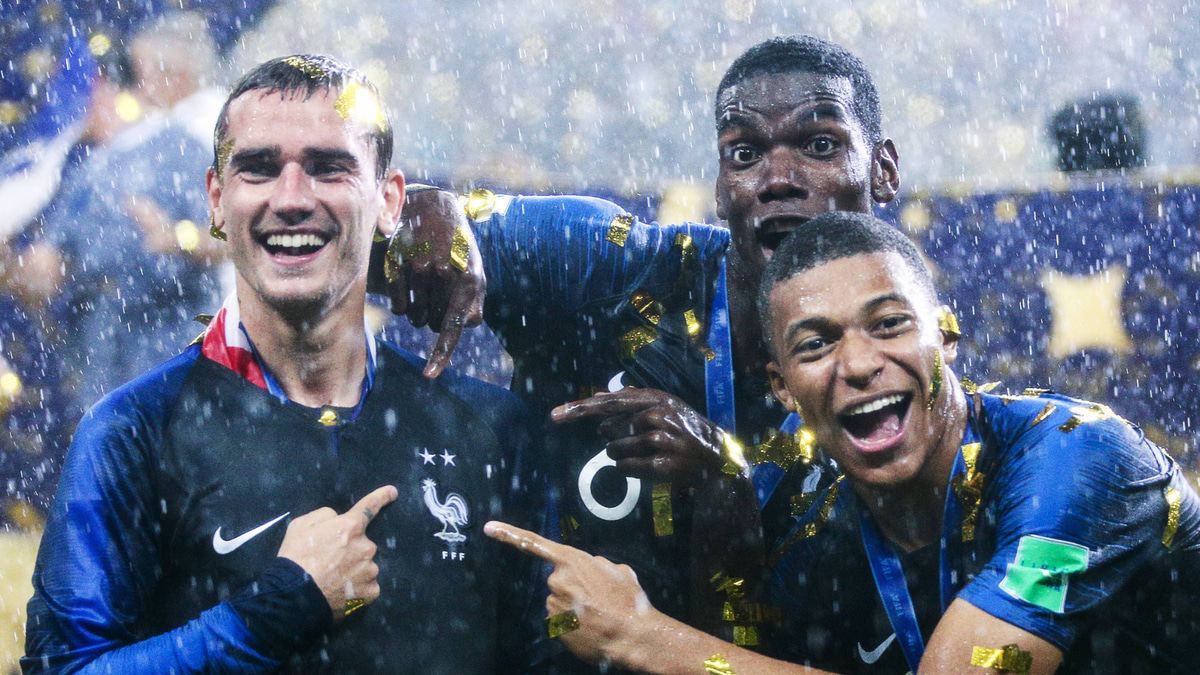
Golden ticker tape showered down on France’s rain-soaked players as they celebrated winning the World Cup for a second time in one of the most memorable finals of the modern era. Minutes earlier, as the players queued up to receive the trophy, the heavens had opened, soaking the FIFA dignitaries and adding to the chaos of an already frenetic night in Moscow.
It was a frantic finale to a hugely eventful tournament. Thirty-two days packed with incident and drama, shocks and surprises. France were the last men standing, but they fully deserved their victory having overcome a Croatia side that had finally been undone by fatigue after an exhausting journey to the final.
Croatia were left nursing a sense of injustice when, having brought the final level at 1-1 after half an hour, they conceded a penalty to a controversial refereeing decision. By the letter of the law, Ivan Perisic had handled the ball at a corner, but referee Nestor Pitana took an age to assess the images on the pitchside VAR monitor.
The game had been evenly matched until that point, but Croatia were visibly affected by a decision which resulted in Antoine Griezmann’s penalty giving France a lead they never surrendered.
Croatia, having staged a remarkable comeback in all three of their earlier knockout games en route to the final, tried to rally themselves, but then their energies evaporated. Goals in quick succession by Paul Pogba and Kylian Mbappe cemented France’s impregnable lead. Although Hugo Lloris gave Croatia hope with a goalkeeping howler that brought the deficit back to two goals, Croatia could not find the energy to challenge in the remaining minutes.
Throughout the tournament, starting with a controversial penalty against Australia – the first to be awarded by VAR – Didier Deschamps’ men did just enough to overcome their opponents.
Set-pieces were key against Uruguay in the quarter-finals, when a goalkeeping mistake confirmed their victory, while Samuel Umtiti’s header from a corner saw off Belgium in a tense semi-final.
The one match when France did cut loose was against Argentina in the last 16, when the brilliance of Mbappe tore the South American defence to shreds – even if the 4-3 scoreline did suggest Argentina had made a game of it.
The chastening experience of losing to an unexceptional Portugal two years ago on home soil prompted the coach to make bold changes. Fourteen of the squad from Euro 2016 did not make it to Russia. Those that were brought in were younger and more capable of adapting to the coach’s way of thinking.
And so France won their second World Cup and Deschamps became only the third man to win the World Cup as a player and coach. He had been the heartbeat of the team that sparked wild celebrations across France 20 years ago.
Indeed, there are many parallels with 1998. There was the teenage striker from Monaco (Thierry Henry/Mbappe); the workaholic “water carrier” (Deschamps/ N’Golo Kante); the striker who failed to score (Stephane Guivarc’h/Olivier Giroud) and the goalscoring right-back (Lilian Thuram/Benjamin Pavard).
And while the 2018 winners did not have anybody of the class of Zinedine Zidane, they did have Griezmann and Pogba, two players who, when it mattered most, majestically rose to the occasion.
It had all begun 32 days earlier in the same stadium, when a Russia team – beset by injuries and unsure of itself after a string of poor friendly results in the build-up – took to the pitch against Saudi Arabia, arguably the weakest team ever to contest the opening match.
Russia lost their best player, Alan Dzagoev, to injury early on. But five goals, including two for substitute Denis Cheryshev, ignited their campaign and energised the home supporters.
The following day, a thrilling 3-3 draw between Spain and Portugal in Sochi further set the tone for attacking football in the group stage – Cristiano Ronaldo scoring a scintillating hat-trick.
Any suggestion that the tournament’s big guns would find the group phase easy pickings were quickly dispelled. Argentina scraped into the knockout stage, drawing with debutants Iceland and being humbled 3-0 by Croatia before a brilliant Lionel Messi goal inspired them past Nigeria. While the biggest shock of the group stage saw Germany crash out.
After falling 1-0 to a vibrant Mexico in Moscow, the Germans looked back on track following Toni Kroos’ dramatic free-kick winner in the dying seconds against Sweden. But, with complacency never far away, they fell to already-eliminated South Korea with Son Heung-min tapping home after goalkeeper Manuel Neuer, the embodiment of German confidence and superiority in Brazil four years ago, was caught upfield as he tried in vain to join his team-mates as they frantically searched for an equaliser.
Fellow Asian nations Iran, Saudi Arabia and Australia joined Korea in exiting in the groups, and that’s where the African challenge ended too. With Senegal and Japan unable to be separated other than by their disciplinary records, the Senegalese, with more yellow cards, lost out, leaving the round of 16 lacking any African representation with Morocco, Nigeria, Tunisia and Egypt already out. The other nations to fall in the first round were a terrific and unlucky Peru, plus Iceland, Serbia, Costa Rica, Panama (who England hit for six) and Poland.
And so to the round of 16 – where the draw started to skew with one side much stronger than the other – and the big guns starting to fall. First Argentina went, gone after a seven-goal thriller with France in which Mbappe stole the show from Messi. A few hours later, Portugal joined them on the way out after Uruguay’s Edinson Cavani put them to the sword. And the next day, Spain were out after hosts Russia took them to a penalty shootout. At least Andres Iniesta converted his spot-kick, but it was still a miserable way for the great man to end his international career.
Colombia and Mexico went too. The Mexicans fell to Brazil, with Neymar raising his game when his country needed him. Colombia will wonder what might have been had they been more positive, but their main contribution was to help England end their World Cup penalties hoodoo.
Belgium and Croatia both showed remarkable powers of recovery. Belgium came from 2-0 down to stun Japan, who had been on the brink of a memorable victory until Belgium’s second-half substitutes helped turn the game, while Croatia demonstrated the mental strength that would come to serve them so well in the latter stages by triumphing over Denmark on penalties.
Sweden claimed the final place in the last eight after grinding down Switzerland. The Swedes had not played particularly well but they could now, along with England and Croatia, see the draw opening up before them.
Into the quarter-finals and Uruguay’s challenge, missing the injured Cavani, ended as France did just about enough, helped by a goalkeeping error from the unfortunate Fernando Muslera. But Brazil, just as they looked capable of competing for a first world crown since 2002, were taken apart by Belgium.
Russia’s journey ended after an epic battle, settled by penalties, with Croatia, who again dug deep to equalise and then compose themselves for the shootout after handing Russia a lifeline late in extra-time. England, meanwhile, reached their first semi-final for 28 years after seeing off Sweden with relative ease.
The first semi-final between Belgium and France felt like a final in all but name, with two heavyweights engaged in a high-quality showdown. France again did just enough, defending diligently against a vibrant Belgium.
And just as England began to dream of the final, they met their match in Croatia, who came from behind to take a game into extra-time for the third match running.
Croatia’s players claimed afterwards that English arrogance – epitomised by the song, “Football’s Coming Home” – drove them on when their physical powers were waning.
Ultimately, football did not come home but, for some, the song that revelled in self-deprecating humour had come back to haunt English football.
By Gavin Hamilton
Read more about:
FIFA Club World Cup