
-
News
- 19 Sep 2026
Total football to total failure: When the Netherlands fell at the last hurdle in the 1974 World Cup
8 Jun 2026 19:15 CDT |
5 min read
News

The 1970s were a unique era in world football. It was the first decade of colour television, and the dazzling tones and textures of the football played by Pele at the 1970 World Cup – and then by Johan Cruyff and Franz Beckenbauer at the 1974 finals – propelled the game at high speed towards its present remarkable pre-eminence.
The perspective of time lends an ever-sharper edge to the personal duel between the greatest-ever players of the Netherlands and Germany; a duel played out in personal achievement built on the contrasting foundations laid at Ajax and Bayern Munich and also on the international stage, where the great rivalry of the age was reignited at its most rarefied level: the 1974 World Cup final.
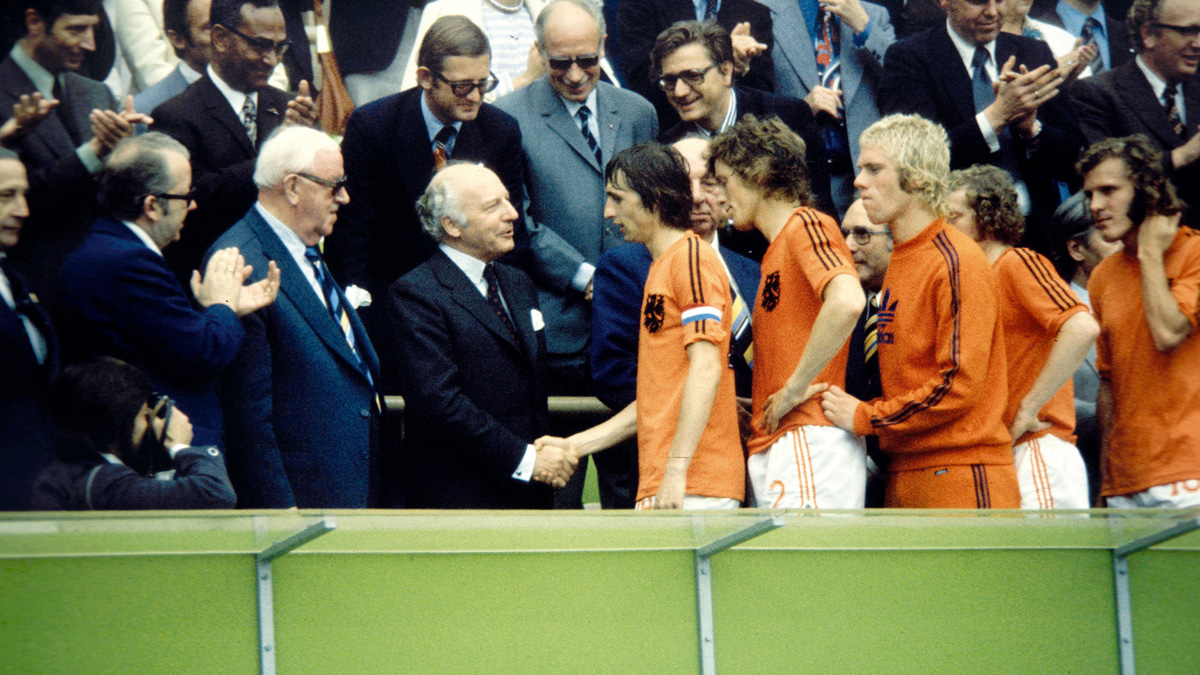
Sadly for the Oranje, it was not “total football” but “total failure” and the Dutch went the way of Hungary – also against West Germany – 20 years earlier in 1954.
Thus it was Beckenbauer, not Cruyff, who would hoist the brand-new World Cup trophy, which was revamped for the 1974 tournament after Brazil had been awarded the Jules Rimet trophy permanently following their third World Cup triumph in 1970.
Keir Radnedge
TOTAL FOOTBALL TO TOTAL FAILURE
The Netherlands, without doubt the most outstanding team throughout the 1974 World Cup finals, fell at the final hurdle against the hosts West Germany...
The Netherlands, with Johan Cruyff and their total football, had swept past Uruguay, Sweden and Bulgaria in the first round, then Argentina, East Germany and Brazil to reach the final against the hosts at the 1974 World Cup in West Germany. But there it was to end in Dutch devastation.
Here the Ajax-Feyenoord mixture, which had been good enough to dominate European club soccer since 1970, let them down. After a first-minute penalty awarded by Jack Taylor, the Wolverhampton butcher, and converted by Johan Neeskens, the Netherlands sat back.
Instead of trying to ram home their advantage they tried to play with the Germans, tease them in front of their own Munich crowd. And they paid the literal penalty. A spot-kick to West Germany, and Paul Breitner equalised, and just before the half-time interval the inevitable, ever-dangerous Gerd Muller pushed in what proved the winner.
The Dutch tried to play with the Germans, tease them in front of their own Munich crowd
- Not that the Germans had enjoyed such a straightforward passage. Their team had come to its peak in the 1972 European Championship, and manager Helmut Schon and skipper Franz Beckenbauer chopped and changed the side in the early games.
The 1-0 defeat by East Germany in Hamburg, in the first and only meeting between the two zones, seemed the ultimate humiliation at the time. Instead it proved ideal for Beckenbauer and Co. It meant they were kept apart from the Netherlands in the second-round group stage and, with the introduction of the hard-tackling midfielder Rainer Bonhof, won well against Yugoslavia, Sweden and Poland to reach the final.
The Poles, surprise victors over England in the qualifiers, reaffirmed the quality which had brought them the Olympic title in Munich two years earlier when they beat a prosaic, defence-orientated Brazil 1-0 in the third place game with a strike from the tournament’s seven-goal top scorer Grzegorz Lato.
Lato was among the competition’s best performers. German sports magazine Kicker held a poll among leading journalists and trainers to determine the best player of the finals and, as expected, Cruyff topped the voting with rival Beckenbauer a close runner-up. Poland playmaker Kazimierz Deyna, Dutch general Neeskens and Yugoslavia midfielder Branko Oblak also finished in the top five, with Lato, Brazil centre-back Luis Pereira, Scotland terrier Billy Bremner, Argentina schemer Carlos Babington and West Germany attacker Uli Hoeness completing the top ten.
World Soccer’s best XI contained six of those players – Luis Pereira, Beckenbauer, Neeskens, Deyna, Lato and Cruyff, with goalkeeper Dino Zoff, full-backs Wim Suurbier and Breitner, Bulgarian midfielder Hristo Bonev and striker Gerd Muller making up the rest of the team.
Yugoslavia’s disappointing failure in the World Cup in which they won only one game – astonishingly enough a record-equalling 9-0 against Zaire – did nothing to aid the cause of team manager Miljan Miljanic, already under fire at home for deciding to join Real Madrid after the finals.
Few of the Yugoslavians, who promised so much beforehand, lived up to their pre-World Cup reputations, with only Ivan Buljan, Stanislav Karasi and Jovan Acimovic maintaining any real level of consistency.
With their 1970 World Cup-winning team decimated, Brazil really had no chance. They were left with free-kicks – which was virtually all that was left of Rivelino’s artillery – and the grafting of a much slower Jairzinho. Even so, they managed to get to fourth place. And if they could have found someone who could shoot straight, they might have got to the final itself, which, in the end, was won for the second time by the West Germans.
By Keir Radnedge & Philip Rising.
Read more about:
FIFA Club World Cup