
-
News
- 19 Sep 2026
How Maradona magic and the 'Hand of God' defined the 1986 World Cup
10 Jun 2026 01:01 CDT |
7 min read
Analysis

The greatest test of any World Cup is the impression it makes on the casual viewer around the planet. On that simple basis, Mexico ’86 was a winner.
But after every World Cup comes the moment for truth: when one tries to take stock of the state of the game based upon a month watching the supposedly finest exponents in competition at the apex of the greatest of games, analysing such things as format, tactics, etc.
When the first World Cup took place in 1930 the teams were sorted into four first-round groups. A knockout system was employed in 1934 and 1938 but proved unpopular. Thus the pendulum swung to the other extreme in 1950 when even the final stage was a mini-league event. A mixture of groups and knockout was tried in Switzerland in 1954 before FIFA came up in 1958 with the format which remains the model for 16-team tournaments. That remained good enough until 1974 when FIFA created the second round mini-leagues. It was not until 1982, and the semifinals, that FIFA went back to a knockout element. This proved such a breath of fresh air that it was extended in Mexico, and this finals’ knockout section was a huge success with the standard of play improving 100 per cent.
No revolutions this time tactically; nothing to compare with the awakening into 4-2-4 in 1958 or “total football” in 1974, although there was confirmation that a five-man midfield is the most flexible way to approach a major finals.
In terms of the hosts, the bulk of initial hostility to Mexico was down to fear of the altitude and the heat. On both counts, the concern now appears to have been overstated, demonstrating the advanced physical standards set and maintained by today’s players.
Profits from the 1986 World Cup will not be confirmed until later this year but ticket sales, television rights, and sponsorship and merchandising income are expected to run into the millions.
But while the accountants count the money, the rest of us can bask in the memories. Memories such as that of Diego Maradona’s great, great second goal against England. Those of us who were there will not forget Mexico ’86. Nor will the game itself.
Keir Radnedge
MARADONA MAGIC SHINES
Argentina and their mercurial skipper Diego Maradona prove worthy winners of the 1986 World Cup
World Cup history has shown us time and again that it is not always the best teams that win the game’s greatest prize.
Hungary in 1954, Brazil in 1950 then the Netherlands in 1974 have demonstrated clearly and bitterly that the World Cup is not only about consistency, it is about producing the necessary performance on a given day; it is being able to raise your game to the occasion.
On that basis, we can at least recognise that Argentina deserved to win the 1986 World Cup crowned in silver and gold in the sunshine of Mexico City’s Estadio Azteca.
Skipper Diego Maradona was hoisted shoulder high by teammates and a disorganised, uncontrolled mass of fans as he waved the golden trophy towards the sky…and the sky – or at least the stadium roof – responded by opening up a shower of silver confetti, which glinted in the sun with reflected glory.
\
That reflected glory was also Argentina’s in the amazing shadow cast by their own captain throughout the finals. Maradona was not only the winning captain, he was the star of the tournament and he provided moments of magic and inspiration which left every other player looking pedestrian.
This was Maradona’s World Cup – just as Argentine manager Carlos Bilardo had promised us it would be. He took on players with teasing regularity yet he showed against Uruguay in the second round that his talent was built on brave foundations. He did not shirk a tackle though few people would have blamed him if he had; a couple of his solo breaks against Uruguay were incredible and hinted strongly at things to come…against England, Belgium and West Germany.
This was Maradona’s World Cup – he provided moments of magic and inspiration
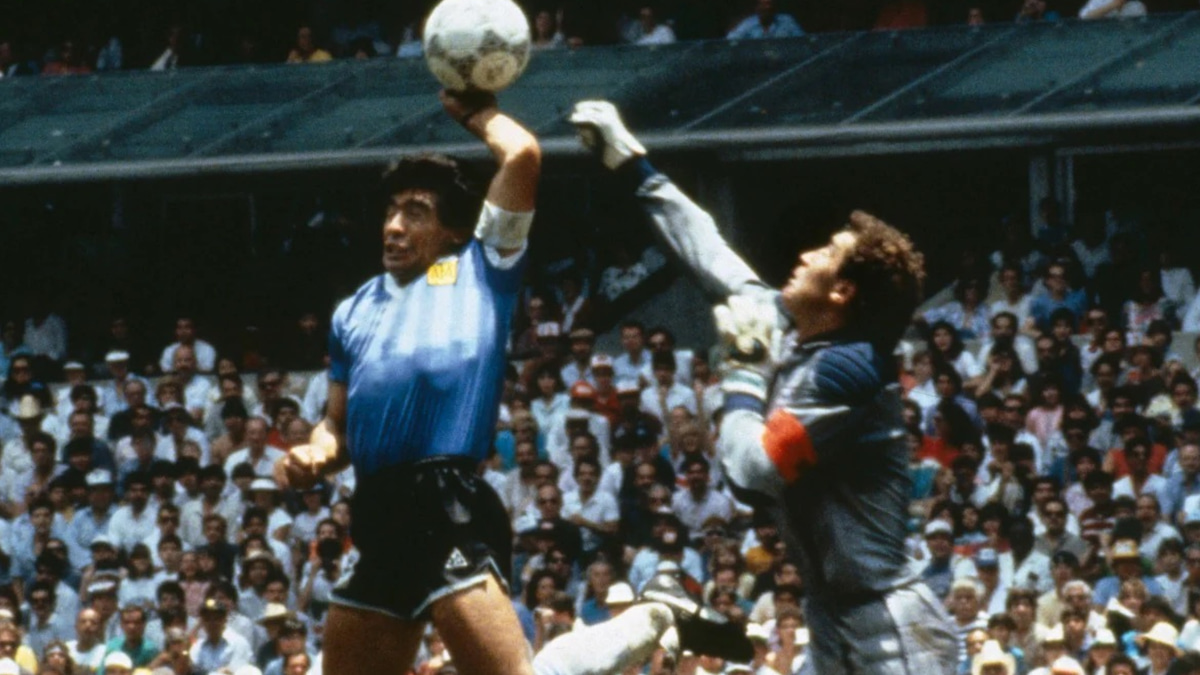
- Maradona’s contribution against England remains a matter of some controversy. Television replays appeared to indicate handball for his first goal. Maradona then, of course, produced one of those fabulous individual slaloms which took him from the halfway line, through the England defence and Peter Shilton was beaten again.
For me, Maradona’s second goal was one of the great goals of this, or any other, World Cup. It was not merely the supreme skill but its achievement under immense pressure and at the game’s highest level. That this was no freak was underlined when two-goal Maradona repeated the trick against Belgium in the semi-finals. The Belgians never gave up trying; but they were never in the same league.
Nor, to be frank, were the West Germans in the final although they contributed to a classic climax and to the dramatic content with their late comeback when it seemed the entire occasion had passed them by.
West Germany had struggled to reach the final in the first place and in the showpiece itself looked unusually short of will-power. In the first half there was little organisation about their play, a total lack of penetration in attack and even goalkeeper Toni Schumacher spoiled an otherwise excellent tournament with a giveaway mistake on the first Argentine goal.
The scorer was Jose Luis Brown, the sweeper who had owed his place in the team to the absence through illness and then injury of 1978 Cup-winning captain Daniel Passarella. Brown had been rock-solid at the back and provided a lethal element of surprise when he made his annual foray beyond the halfway line to head home Jorge Burruchaga’s free-kick in the 23rd minute.
Brown later damaged his shoulder in a fall after heading clear in defence but refused to come off. His courage and confidence was one key aspect of both his goal and Argentina’s entire display. Another decisive role was that of Burruchaga. His consistently high standards throughout the finals, tying together all the loose ends in midfield and alternating attacking positions with Maradona and Jorge Valdano, was an essential factor in the South Americans’ overall triumph. His passing accuracy was a delight to watch and the curling free-kick with which he fooled keeper Schumacher was typically effective.
“As for Maradona, he had been fouled by Lothar Matthaus for the free-kick in the first place. Matthaus stuck to the task of trying to subdue Maradona with tenacity, skill and a praiseworthy degree of fair play. But while the fact that Maradona did not get his name on the scoresheet may be cosmetic proof of the success of the Matthaus mission, the facts reveal that Maradona played vital roles in all three goals.
Under his leadership it would not have been beyond Argentina to have scored again before half-time. Instead it was not until ten minutes after the interval that striker Valdano, enjoying far greater freedom of expression under Bilardo than in his club role with Real Madrid, doubled the lead.
Valdano, at this World Cup one of the game’s most impressive all-round attackers, underlined that general consensus by starting and completing the move. He was back in his own half on the right when he made space then moved the ball on. Hector Enrique and Maradona carried the move forward and Valdano then turned up over on the left on the edge of the German penalty area to lure Schumacher from goal then slide the ball coolly past his left hand and just inside the far post.
It should have been 3-0 shortly afterwards. A beautiful angled through pass from Burruchaga curled into the path of Enrique, who had run clear of the West German defence. He was well onside when the ball was played but Costa Rican linesman Berny Ulloa Morera, panicking, raised his flag, to Argentine annoyance.
To rub salt into Argentine wounds, the Germans celebrated their escape by pulling level. First skipper Karl-Heinz Rummenigge then half-time substitute Rudi Voller pushed the ball past Nery Pumpido from close range before Burruchaga wrote his name into World Cup history with the winner for Argentina. Maradona, of course, was again the creator.
It was all over – the entire 1986 World Cup – bar a great deal of happy shouting in the Azteca, in Mexico City and, of course, in Buenos Aires.
By Keir Radnedge.
Read more about:
FIFA Club World Cup