
-
News
- 19 Sep 2026
1990 World Cup: Gazza's tears, Schillaci's Golden Boot and Milla's moves
10 Jun 2026 06:00 CDT |
13 min read
Analysis

No one can pretend that Italia ’90 produced a football feast. Much of it was mediocre. Instead it will be remembered for its drama with penalties resolving both semi-final ties; for Argentina’s remarkable progress despite themselves; for the emergence of “Toto” Schillaci; for the African confirmation provided by Cameroon’s incredible progress; for England’s best-ever “away” finish.
These finals were supposed to be about super teams and superstars. And superstars there were in abundance. The trouble was, many did not live up to their reputations. Three obvious failures spring to mind: Marco van Basten, Emilio Butragueno and Ruben Sosa.
What about Diego Maradona and Ruud Gullit, the game’s great heroes?
Maradona, performing as a lone striker, was soon being trodden on to such an extent that one ankle virtually swelled to double its size. He played against Brazil in intense pain. Yet he still managed to deliver the decisive pass for Claudio Caniggia’s winning goal.
As for Gullit, he paid the penalty of more than a year out of the game. But with each succeeding display you could see his route to rehabilitation.
The other big-news injury victim was Gianluca Vialli, whose side-lining gave Italy manager Azeglio Vicini the excuse to give young Roberto Baggio his head ...with results we all know. Baggio is a great talent, but his solo goal against Czechoslovakia, though magnificent, was not in the Maradona ’86 class.
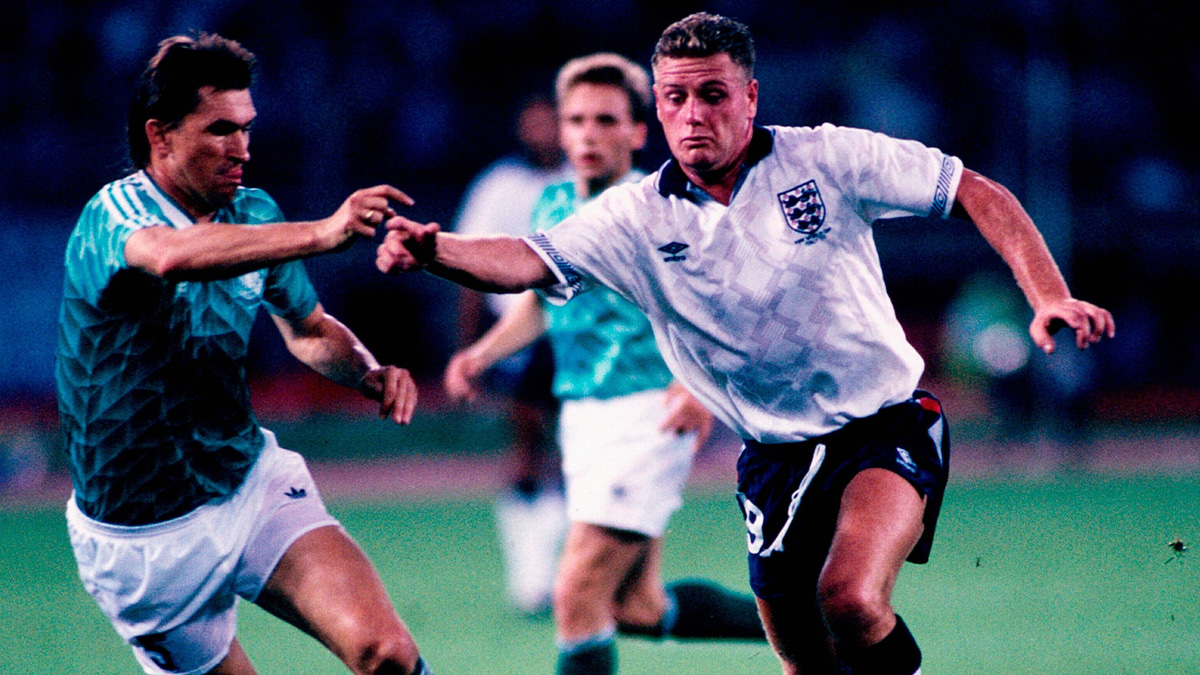
West Germany provided one of the finals’ outstanding midfielders in skipper Lothar Matthaus, but Italy, in Giuseppe Giannini, possessed the most skilled and creative general. Belgium’s Enzo Scifo, Colombia’s Carlos Valderrama and Yugoslavia’s Dragan Stojkovic remained among that peripheral group of talented but tantalising individuals who constantly promised more than they delivered, while England’s Paul Gascoigne was the revelation.
The best attacking partnership was West Germany’s Rudi Voller and Jurgen Klinsmann. Their hard work, the miles they ran, the way they pulled defences around was exemplary modern football.
Keir Radnedge
GERMAN JUSTICE
Franz Beckenbauer made history at Italia ’90, as Maradona and his Argentine team-mates spoiled the big occasion
- Simply, it was the right result. West Germany were the best team in the 1990 World Cup finals and they were, by a long way, better than a sorry bunch of ill-assorted Argentines on the big night in Rome.
The Franz Beckenbauer legend thus expands still further. Der Kaiser is the first man to have captained and managed a World Cup-winning side. Not that this victory was as pretty a sight as West Germany’s 2-1 defeat of the Netherlands in Munich in 1974.
We had to endure a “phoney war” first half, two Argentines sent off in the second – Pedro Monzon and Gustavo Dezotti thus creating final history – and the decisive goal arriving courtesy of a highly-contentious penalty.
A World Cup, which had seen plenty of drama but not a lot of outstanding football, thus ended with probably the final it deserved.
As Beckenbauer’s star continued to rise so Diego Maradona failed to rise to the occasion. He has to withstand enormous personal derision everywhere he goes and plays. Yet he does not help himself. No sooner had he tearfully received his runners-up medal than he walked straight on down out of sight to the dressing rooms.
Happily, most of his team-mates – including the likes of Sergio Batista and several others who had been manhandled away from referee Edgardo Codesal at the final whistle – stayed to watch the end of the ceremonials and applaud their West German conquerors.
This World Cup has had its heroes: Lothar Matthaus, Salvatore “Toto” Schillaci, Paul Gascoigne and Roger Milla among them. But it fell to Andy Brehme to write his name into the record books with the penalty goal in – again, appropriately – the lowest-scoring final of all time.
Those who live by the penalty shall die by the penalty, it seems. Argentina had scraped their way to the final with immense guts, agreed, but a lot of luck. They were temperamentally indisciplined; that’s why they missed four players in the final and that’s why they had two more sent off. And, ultimately, that’s why they lost their world crown. The final does not always produce the right winner. This one did.
This was a final which aroused all the elements of great drama – not to be confused with great football. Maradona and West Germany skipper Matthaus had faced each other man for man in this same final four years earlier. Then Matthaus had been the marker. Now that role had passed on down the line: the question now was not so much who would mark Maradona as who would mark Matthaus. In the event, Argentina just marked zones in midfield.
No final had ever been repeated before and the Argentines took the circumstances, cautiously, as a good omen remembering 1986.
This was a final which aroused all the elements of great drama – not great football
- If anything Beckenbauer had an embarrassment of riches from which to choose in midfield. He opted to use Pierre Littbarski and Thomas Hassler to attack the Argentines on the flanks and left out Olaf Thon and Uwe Bein.
Carlos Bilardo, of course, had his team virtually selected for him by the suspensions of key midfielders Julio Olarticoechea and Ricardo Giusti, flying forward Claudio Caniggia and the lumbering Batista.
On the face of it Bilardo was at a disadvantage with new players; yet on the plus side, at the end of a long tough competition he was the one with the fresher players. The trouble was, in terms of ability, they were just not World Cup final class.
The first half was a passionless affair as if both sets of players were a little intimidated by the occasion. Argentina marked man-for-man at the back with Jose Serrizuela on Rudi Voller and Oscar Ruggeri on Jurgen Klinsmann. But the play was too one-sided to be even a satisfactory contest.
The question was just, when would West Germany score? Or, more intriguing as time went on, was it Argentina’s intention to kill the match and take us, yet again, to penalties?
The Germans had plenty of first-half chances. Four fell to Voller. Once he sliced over the top, once he headed too high, once he delayed his shot and another header flew off target as well.
If Argentina were not always happy in dealing with angled centres across the face of their goal, they had Brehme summed up more successfully.
Whenever the Germans won a free-kick near goal the Argentines were quickly out to block the German left-back’s drives. Not one bothered goalkeeper Sergio Goycochea and Littbarski’s one effort flew over the bar.
By way of reply Argentina managed the pitiful contribution of one first-half goal attempt and that was a chipped Maradona free-kick which flew high over the bar. If anything, German keeper Bodo Illgner was more worried about one of Brehme’s back-passes a few minutes later which bounced awkwardly.
Maradona was moving more actively than in any previous match in odd contrast to the German strikers, Voller and Klinsmann, who were not seeking space with anything like the eagerness of early games. That was the penalty, of course, of fatigue.
But it also appeared that Voller was still feeling the right-knee nerve injury which had led to his early departure in the semi-final against England.
West Germany maintained their total domination in the second half and the tackling and physical harassment became tougher and sharper.
Littbarski, Thomas Berthold, Voller and Brehme all went close and Klaus Augenthaler might well have been awarded a penalty when he was tripped by Goycochea in an incident which almost ended in an Argentine own goal.
As time drifted on so the Germans began to lose their attacking cohesion. The expulsion of Monzon for an awful foul on Klinsmann was justified. But that was no gift for the Germans. We had seen throughout these finals how teams appeared sometimes to play better with ten men (or nine, in Cameroon’s case) than with 11.
Just as that first expulsion had been, sadly, on the cards, so it was not surprising that the match was decided by a dubious penalty. Replays appeared to show Roberto Nestor Sensini playing the ball rather than the man but Voller fell and the referee pointed to the spot.
Brehme’s kick only narrowly defeated the intuition of Goycochea. And then, the Germans’ decision to play out time led directly to the expulsion of Dezotti, who had already been booked.
As time ran out for Maradona, Bilardo and Argentina so Beckenbauer permitted himself a grin of delight.
Deutschland uber alles, worthy world champions.
By Keir Radnedge.
SPOTLIGHT ON SQUILLACI
Salvatore Schillaci emerged sensationally at the 1990 World Cup. He is not a great footballer but he is very quick, brave, direct and fearless. All old-fashioned qualities, but found in very few of the attackers at Italia ’90.
Forwards were a real area of confusion at the finals. Some teams used a winger, some ignored wingers. Some used forwards not to score goals but to lay the ball off for midfield men coming through to look after the goalscoring. But not Italy. They used their forwards to strike for goal…and strike for goal Schillaci did.
“Toto” was thrilled to become an overnight hero, surprised by his top-scoring success and amazed at the instant adulation his six goals inspired.
Italian president Francesco Cossiga was fascinated by Schillaci’s eyes which appeared on the verge of popping out of his head when he celebrated his goals against Austria, Czechoslovakia, Uruguay, Republic of Ireland, Argentina and England.
Schillaci told him: “I don’t know why my eyes look like that in the pictures or on television. But it’s all right...they go back to normal after a match!”
In truth, away from the penalty box, back on the training ground, in the team hotel or on the team bus, Schillaci’s eyes contain far more suspicion than charisma. Then you see not the wealthy modern hero but the unmistakable ghost of the boy from the deep south, from the wrong side of the tracks.
Schillaci squeezed into one of the last remaining gaps in Italy’s World Cup squad, having made his Azzurri debut earlier this spring against Switzerland. But anyone who thought he was there merely for the ride was not listening closely enough.
The day before the World Cup finals began Giampiero Boniperti, recently departed president of Juventus who then became the national team’s World Cup delegation chief, told anyone who cared to hear: “We need another Rossi. But have you seen Schillaci? He’s become a sort of favourite kid brother with the other players. Keep an eye on him...”
That was a piece of advice Austria failed to hear or heed. Schillaci appeared as a second-half substitute for the off-target Andrea Carnevale and, three minutes later, headed the decisive goal.
Schillaci says: “It was like a miracle. Vialli deserves the credit. It was a great cross…and I had thought I was not going to get a game. Vicini told me to warm up. But then Baresi was injured and I thought: He’ll put on Vierchowod and then he won’t dare use another substitute. I’ve lost my chance. But then Baresi signalled to the bench that he was OK – and I was on!”
A custom, particularly in soccer’s Latin countries, is for a player to “dedicate” his goals – and Schillaci is no exception. His goal against Austria was a special one. “I wanted to dedicate the goal to everyone,” he says, “but in the end I realised there were special people: my neighbours and friends where I was born and brought up in Palermo, and then to my wife who was expecting our second child.” Schillaci’s home city of Palermo went collectively wild as soon as the match had ended. And Domenico, Schillaci’s father, was carried shoulder-high through the streets by friends and relatives.
Schillaci’s appearance as substitute again, against the United States in Italy’s second game, did enough to earn him a place in the starting XI for the Italians’ third game, against Czechoslovakia.
Nine minutes into that game and it was Toto who opened the scoring. By now his wife Rita had given birth to their son, Mattia, and it was to the latest Schillaci that this goal was dedicated.
There was plenty more goals – and glory – to come. Schillaci scored the 64th-minute breakthrough goal against Uruguay in the second round; he scored the lone decider after 38 minutes of the quarter-final against the Republic of Ireland, and he snapped up a rebound for the 17th-minute goal which sent Italy into the semi-final lead against Argentina.
But, with cruel timing, fatigue and a muscle strain began to wear Schillaci down. Unusually he was several times caught wearily offside. And, when it came to the penalty shootout, coach Vicini did not think Schillaci fit enough to take a kick. Certainly he could not have achieved less than luckless Roberto Donadoni or Aldo Serena. But that is history.
In the shattering aftermath Schillaci recalled his stock reply to all the earlier flattery: “I’m not Paolo Rossi. Maybe I’m the same height and maybe I’ve got similar acceleration. But that’s all. He was one of the greats. He won the World Cup...”
That dream was denied Schillaci. But it was the third-place play-off against England which, of course, established his place in the history books. He pulled himself together, created Roberto Baggio’s controversial first Italy goal then struck the winner himself from, ironically, the penalty spot.
Not that Schillaci was first choice to take the penalty. Baggio had been singled out by Vicini in training. But when referee Joel Quiniou pointed to the spot after Schillaci himself had been tripped, Baggio said: “Toto, you take it. I want you to be the top scorer.”
THE MAN WHO PUT CAMEROON ON THE MAP
The 1990 World Cup will not be remembered for the technique or brilliance of the football on display. It will, however, be remembered for the sheer drama and for the projection of some remarkable characters.
None were more remarkable than Roger Milla, the 38-year-old Cameroon striker who can boast a place in soccer history. He is the oldest man ever to have scored a goal at the World Cup – overtaking Sweden’s Gunnar Gren, who was 37 when he shot home against West Germany in the 1958 semi-finals.
Milla was the man who appeared as a second-half substitute to transform Cameroon’s matches. He was the man whose two late goals overturned Romania; the man whose opportunism destroyed Colombia’s reckless goalkeeper Rene Higuita; and it was Milla, having shaved his head, who came very close to upsetting England in that never-to-be-forgotten quarter-final in Naples.
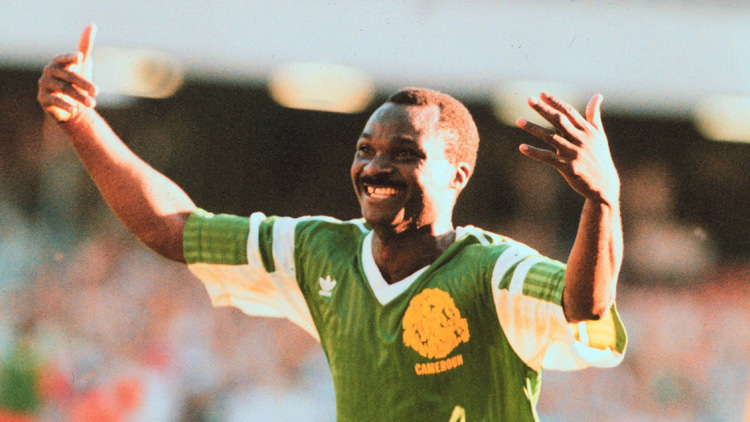
Cameroon came to the World Cup finals dreaming of being acclaimed as the “African Brazil.” Who else then, but Milla, would have dared take the Mickey out of Brazil’s star striker, Careca, by emulating his jig with the corner flag on scoring a goal?
Now Milla can look back with pride. He says: “We were very disappointed to lose against England. We believed we played the better football in that quarter-final. Perhaps we were too tired. Perhaps we did not concentrate quite hard enough in the closing stages.
“But that is behind us now. Looking back we are all happy that we made people all round the world take notice of Cameroon.
“Personally, it was a fantastic experience. Even better than 1982. It was all new for me then. This time I could appreciate a little more all we had achieved. Also, I appreciated more this time just what it meant for Cameroon and our people. They celebrated every goal with us.”
Yet, all is not as it seems. Cameroon were not the happy-go-lucky squad they had been painted and as for Milla, well, “Milla” was not even his real name.
The genie of Italia ’90 was born Albert Roger Mooh Miller, son of a railway worker with a German connection on May 20, 1952. Friends believe that, rather than Miller the original name which the family appropriated was “Muller”. No matter. Milla was born to a family of four brothers, has always remained close to his family and homeland, and might well have been sitting at home with them watching the World Cup on television instead.
Two years ago he retired from the national team. He was bitter and furious over events surrounding his mother’s death while he was away playing for Cameroon against Saudi Arabia in the Afro-Asia Cup.
He says: “Our directors at the federation told me I was not to worry. That while I was away they would take care of everything. Instead, when I got back, my was mother dead. Not only had no one taken any care over her but they would not even pay the hospital bills. I was bitter and angry and so sad. After that I didn’t want anything more to do with the national team.”
It took the personal intervention of Cameroon state president, Paul Biya, an old acquaintance, to persuade Milla to change his mind. President Biya and officials of the Sports Ministry decided that Milla’s experience – after starring at the 1982 World Cup finals in Spain – would be of enormous value to his team-mates at Italia ’90.
Not all of those team-mates agreed. But all his years of experience did indeed bring that vital extra degree to the Cameroon game. As managers insist, particularly at international level: “It’s a 13-man game now. The substitutes are just as important as the players who start the game.”
And so it proved with Milla. Not that his eventual role had been foreseen by anyone. Officials and team-mates, media and supporters, all believed Milla was present in Italy merely to let his voice of experience be heard in the dressing room and training camp. Milla thought so, too. The one man who did not was Cameroon’s Soviet coach, Valery Nepomnyashchy.
It was Nepomnyashchy’s decision to use Milla as he did. Nobody else. And without Milla’s goals Cameroon would not have achieved all that they did.
Milla claims to have scored more than 1,000 goals in his career, but there is no documentation to support it from his spells back home with Leopard Douala and Tonnerre Yaounde, then in France with Valenciennes, Monaco, Bastia, Saint-Etienne and Montpellier, and laterly Jeunesse Saint-Pierroise, a team from the French island of Reunion off the east coast of Africa near Madagascar in the Indian Ocean.
Instead, it’s his four goals at Italia ’90 which will serve as a promotional vehicle not only for himself and for Cameroon, but for African football in general.
By Keir Radnedge.
Read more about:
FIFA Club World Cup