

-
News
Uefa's Champions League revamp only serves to strengthen the Premier League
5 min read

Analysis

IN BRIEF:
- English clubs set to take home upwards of 25% of the total Champions League revenue pot of €2.4 Bn for this season
- The structure, instead of providing competition to the Premier League, has solidified their dominance
- Only a small group of clubs, led by Real Madrid, remotely benefit in the long term
Nice one, Uefa. Your main problem to sort was to bridge the gaping chasm in revenue between the Premier League and the rest. Not only has the new Champions League structure not achieved this, but it has also solidified the position of the elite.
Over the past five seasons, Premier League clubs have consistently taken a disproportionately large share of Champions League prize money compared with clubs from any other domestic league.
In most seasons since 2020, English teams have earned around 18–20% of the total Champions League pot despite making up only four of 32 clubs (now six of 36) in the competition.
This reflects not only how often Premier League sides reach the latter stages but also the way Uefa’s coefficient and value pillars amplify earnings for clubs from big TV markets.
In 2020/21, when Chelsea won the Champions League and Manchester City were runners‑up, English clubs earned roughly €405m out of a €2.04bn prize pool, around 19.8% of all money distributed. In 2021/22, with Liverpool in the final and all four English clubs reaching the knockouts, their combined earnings were just under €400m, again in the region of 19% of the total available.
Even in less dominant sporting years, like 2022/23 and 2023/24, Uefa’s distribution still favours the English sides in the mid‑ to high‑teens as a percentage.
Then we shifted the tournament to 36 teams. 2024/25 didn’t weaken the position; if anything, it reinforced it.
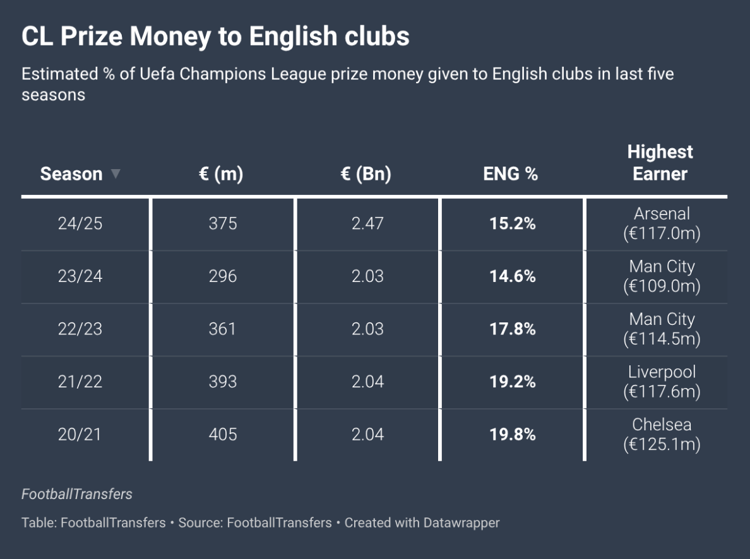
Now, if you look at the above graph, the situation since 2020 looks to be getting better; the Premier League’s total % of prize money falls from 19.8% in 2020/21 (two English teams, Chelsea and Manchester City, in the final), to 15.2% last season, the first of the 36-team Champions League structure.
But this belies a number of key points.
Firstly this is due to English teams’ relative underachievement last year; Arsenal were the sole team in the semi-finals, while Manchester City, Liverpool and Aston Villa fell at the Knockout Round, Round of 16 and quarter-finals respectively.
Secondly, the introduction of the bonus mechanism of two extra league phase places every year for the best performing countries in the previous season. These are based on a single season’s performance, not the five‑year ranking. In other words, the classic five‑year country coefficient still sets the basic number of places, and this new rule can add up to two more countries with one extra club each. This massively benefits England, who regularly perform with consistency across the board.
This season we’ve got six English teams of the 36. The top four from the league, the fifth spot from the league courtesy of this bonus coefficient (Newcastle), and the winner of the Europa League (Tottenham). Recent Uefa statements have projected what each club has earned in the Champions League 2025/26 this season to date, and the positioning of the English clubs is interesting, and depressing.

From the above (projected) data, the six English clubs have earned €520m of the €2.134 billion that has been made available to date. That’s TWENTY-FIVE PER CENT of the total money available heading into the pocket of English football. It’s the highest margin ever and if the English teams get far, it could get even more lop-sided.
A key reason the Premier League’s percentage is so high is the structure of Uefa’s distribution model. The ‘value pillar’ of revenue - around €850m this season - is shared based on the size of domestic TV markets and historical success. Because the Premier League’s broadcast market is the richest in the world, its clubs systematically rank high in this pillar, which boosts their income and helps perpetuate the broken system which we all now have to oblige.
Easy draw for English teams?
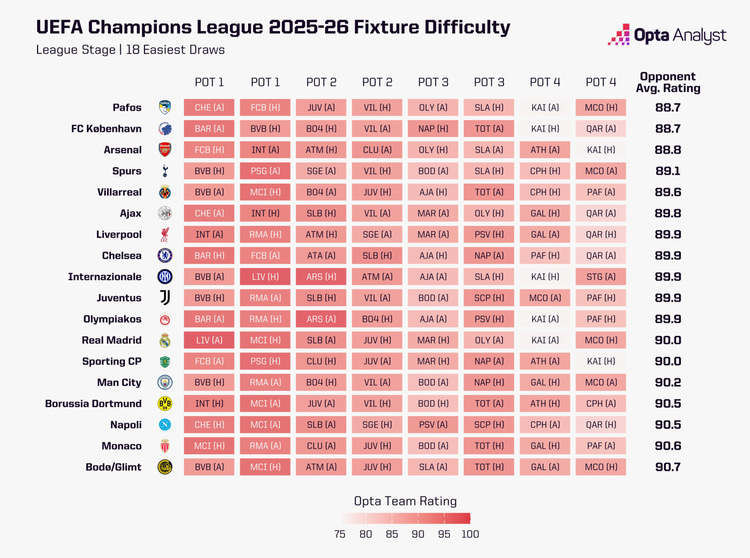
Magnifying this dominance of English clubs is the manner in which the group stages are run. Teams from the same country cannot play each other, and with the Premier League dominating the strongest sides in the competition, it plays a role in shielding them from the most difficult draws.
Fixture-difficulty models back this assertion up. Following the league phase draw in August, Opta used their ratings for every club involved to determine which clubs had, statistically, the easiest set of fixtures.
It was determined that four English clubs - Arsenal, Tottenham, Liverpool and Chelsea- had four of the top eight easiest draws.
While it's true that not every Premier League side will get a comparatively 'easy' draw, it changes the odds in their favour.
What this means for European football
In reality, in terms of actually winning the competition, this model only helps English clubs, Barcelona, Real Madrid, Bayern and PSG. No-one has the sustained revenue consistently in order to compete and therefore we have a Super League at the top, and quite another league of interchangeable actors in behind. Nothing, really, is guaranteed for anyone outside of the true elite now, and the difference in not making it, if you are from a mid-tier league, can be devastating.
For an Ajax, or Celtic, qualifying or not can mean a €40-€45m difference in budget for the season ahead. Even performing modestly in the tournament can generate €30m in revenue; doing the same in the Europa League is only likely to deliver €10m for a club like that, at best. It’s a hole in the budget they can only fill by doing one thing - selling players. Which in turn makes them worse, and we enter a vicious cycle.
So in reality, the Champions League has been revamped to give, in effect, four clubs the financial capability to take on the Premier League. That’s where the competition now stands. That’s what Uefa has built. And it’s difficult to see how we walk back from this - especially given the new deal from 2027 in the UK and Germany with Paramount has delivered above expectations, and that’s with plenty more tenders to come in other core markets.
We’ve created an eco-system where individual leagues may cease to exist, because the concentration of money makes matches domestically pointless, and all roads lead to the same teams winning the same titles. In some ways, we’re already there, but instead of fixing that problem, Uefa has doubled down. And it will be football that will ultimately pay the price.
The FootballTransfers app
Check out FootballTransfers' new app for all of football's big storylines, transfer rumours and exclusive news in one convenient place directly on your mobile device.
The FootballTransfers app is available in the Apple App Store. Download here: