

-
News
- 19 hours ago
Five radical rule changes being implemented at the 2026 World Cup
1 Jun 2026 05:45 CDT |
5 min read
News

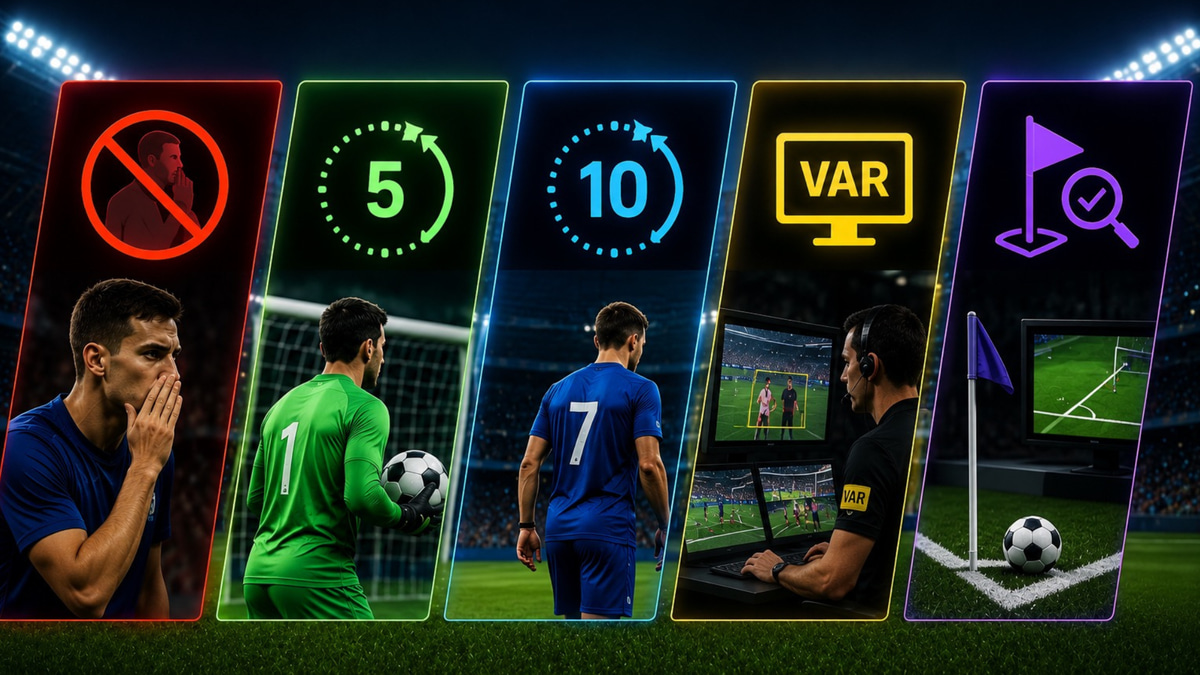
FIFA will implement five major rule changes at the 2026 World Cup in the United States, Canada and Mexico.
The main reason for the majority of these rules being added is that football's governing body is keen to limit time-wasting at the tournament, while they also want to expand the powers of VAR.
Over the last few years, time-wasting has become more and more prevalent within the game and FIFA want to ensure that there is as much actual football being played as possible to maximise the entertainment value for a global audience.
Here are the five new rules being introduced:
No goalkeeper injury timeouts
We've seen a cynical rise in the number of occasions a goalkeeper goes down with a supposed injury only for his team-mates to use that opportunity to regroup either by rehydrating or receiving tactical instructions from their manager.
It's become known as the 'tactical timeout' and the most egregious example came when Chelsea's Robert Sanchez went down with an injury in the FA Cup semi-final against Leeds. As soon as the referee stopped play to allow for treatment, all the other Chelsea players ran over to the side of the pitch to receive instructions from interim boss Calum McFarlane.
Everyone knew exactly what Chelsea were doing but referee Jarred Gillett was ultimately powerless as the rules state goalkeepers must receive treatment on the pitch if they claim to be injured, which results in the stoppage of play.
It completely stopped the momentum of Leeds, who were on the ascendancy.
Under the new rules, if a goalkeeper goes down, then players will not be permitted to approach their manager and may actually be told to stay inside the centre circle.
10-second subs
Everyone has seen it.
A manager makes a substitution and the player coming off just happens to be the furthest away player on the pitch. FIFA combated that by introducing a rule that says players must leave the pitch at the nearest side to which they are situated.
Players still often take an age when leaving the pitch, however.
🚨 New World Cup rule in action:
Hlynsson 🇮🇸 took more than 10 secs to leave the field during his substitution.
As a result, his replacement had to wait a full minute before entering.
In that minute, Japan 🇯🇵 scored. pic.twitter.com/fcCaYgdFtz— World Cup HQ (@WorldCup26HQ) May 31, 2026
Now, players will have 10 seconds to leave the field and if they take longer than that, the substitute coming on will have to wait a full minute before entering the action.
We saw this new rule implemented in a friendly between Iceland and Japan.
Yellow cards checked by VAR
Yellow cards will now be checked by VAR where a player received a second yellow card and is sent off.
This is being put in place to determine whether the severity of the offence merits a subsequent dismissal and also to make sure there isn't a case of mistaken identity.
A new yellow card amnesty is set to be introduced.
Under previous tournaments, there has been one yellow card amnesty at the quarter-final stage so any bookings accumulated before that stage are wiped off a player's record. If they receive two yellow cards before the quarters they will receive a one-match suspension.
However, the next World Cup has been expanded to 48 nations and so there is an extra knockout round between the group stage and the last 16.
As such, FIFA are planning to introduce a secondary amnesty after the group stage in addition to the one before the quarter-final stage.
These are the five major law changes that we'll see in use at the FIFA World Cup this summer. pic.twitter.com/jkZZxXOx9w
— BBC Sport (@BBCSport) May 31, 2026
Corners checked by VAR
Corners will also be checked by VAR to determine whether or not it was correctly given, in the event that it leads to a goal.
However, the checks must be completed before the corner has been taken.
You cover your face, you're off
Players who cover their mouths while speaking to opponents during confrontations at the World Cup will be given a straight red card.
The subject made headlines due to the investigation into Benfica forward Gianluca Prestianni, who was accused of racially abusing Vinicius Junior during a Champions League match between the Portuguese side and Real Madrid. In the end, the Argentine admitted to using homophobic language, but not racist. He was given a six-game ban, three of which as suspended for three years, but the invesigation was made difficult by the fact his hand covered his mouth.
Infantino previously told Sky News of his plans to introduce the new rule to send players off for covering their mouths.
"If a player covers his mouth and says something, and this has a racist consequence, then he has to be sent off, obviously," he said.
"There must be a presumption that he has said something he shouldn't have said, otherwise he wouldn't have had to cover his mouth.
"There are situations which we did not foresee. Of course, when you deal with a disciplinary case, you have to analyse the situation, you have to have evidence, but we cannot just be satisfied with that going forward.
"I simply do not understand if you don't have something to hide, you don´t hide your mouth when you say something. That's it, as simple as that.
"And these are actions that we can take and we have to take in order to be serious about our fight against racism."
Read more about:
World Cup U20