

-
News
- 19 hours ago
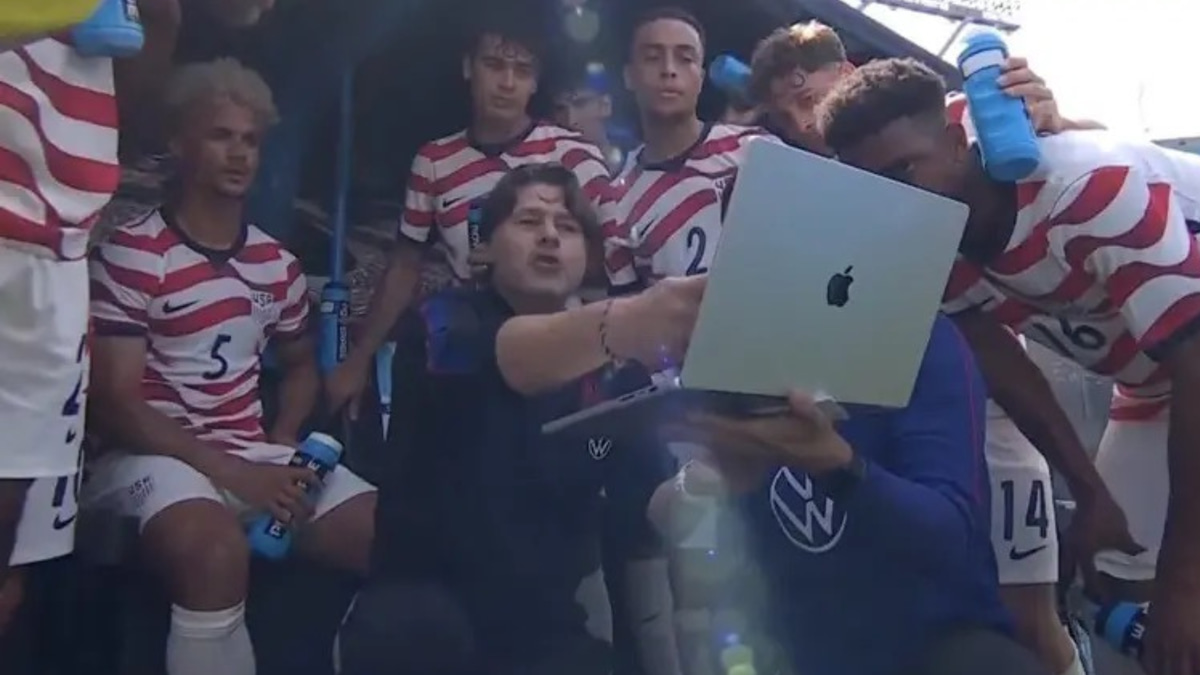
Confusion over World Cup water breaks as USMNT uses the time for a laptop huddle
1 Jun 2026 09:45 CDT |
3 min read
News

At the 2026 World Cup, there will be a cooling break in each half that will allow players to rehydrate in the hot North American sun.
In December, FIFA confirmed that hydration breaks will be implemented in the tournament this summer after players, fans and managers complained about the heat in the Club World Cup in the United States in the summer of 2025.
“For every game, no matter where the games are played, no matter if there’s a roof, (or) temperature-wise, there will be a three-minute hydration break. It will be three minutes from whistle to whistle in both halves,” said Manolo Zubiria, Chief Tournament Officer for the USA.
“Obviously, if there’s an injury (stoppage) at the moment of the 20th or 21st minute and it’s ongoing, this will be addressed on the spot with the referee."
FIFA said: "The use of hydration breaks is part of a focused attempt to ensure the best possible conditions for players, drawing upon the experiences of previous tournaments, including the recent FIFA Club World Cup, which took place in the United States last summer."
Though this is obviously a positive for players on the pitch, fans at home have complained that it will allow broadcasters to insert advertisements mid-match. Though this is common in the USA, matches featured on television in the United Kingdom run uninterrupted each half.
Now, another problem has arisen and that is coaches using the time allocated for rehydration for a team meeting instead.
This happened in the USMNT's friendly against Senegal, in which head coach Mauricio Pochettino gathered his players around a laptop for a huddle rather than allowing them to rest.
The incident raised questions as to whether this is allowed and the Argentine himself doesn't even know.
“I think it’s very helpful for the players to see actions,” Pochettino later explained. “It’s not only to tell what you want (them) to improve, or what they need to do. When they see the image, it’s really important now.
“We’ll see now in the World Cup if they can allow that, and how we are going to do that."
A group of world-leading scientists previously wrote an open letter to FIFA warning that the protocols of water breaks and cooled benches is not enough to protect players and fans from the heat this summer.
They want longer cooling breaks and for games to be delayed or even postponed if the heat becomes unbearable for the players.
In southern US states and northern Mexico, average daytime highs usually sit in the low to mid-30s Celsius and can climb to around 40C during hotter periods.
Once temperature, humidity, wind speed and sunshine intensity are taken into account, players in these World Cup host cities face the highest risk of severe heat stress.
The 20 experts from around the world who have signed the letter, want the following protocols introduced:
- Delaying or postponing matches above 28C WBGT
- Longer cooling breaks of at least six minutes
- Improved cooling facilities for players
- Regular updates to guidelines based on the latest science
WBGT is wet-bulb globe temperature. It’s a heat-stress measure that combines air temperature, humidity, wind speed and sunlight to show how hard conditions are on the human body.
It’s often used for outdoor work and sports because it gives a better picture of heat risk than temperature alone and FIFA have this in place for the World Cup.
World Weather Attribution (WWA) analysed that heat and humidity is expected to be more severe than the 1994 World Cup which took place in the USA due to climate change.
The open letter from the group of scientists partly states:
"Player health and safety must remain the non-negotiable foundation of football governance and the heat risks for the upcoming World Cup make this question more urgent than ever. We ask if FIFA will commit to evaluating and updating its guidelines in accordance with the best practice and science, and in line with its stated prioritising of player safety?"
Read more about:
World Cup U20