
-
News
- 14 hours ago
The 50 greatest World Cup kits in history
Updated: 20 Mar 2026 08:46 CDT |
22 min read
News

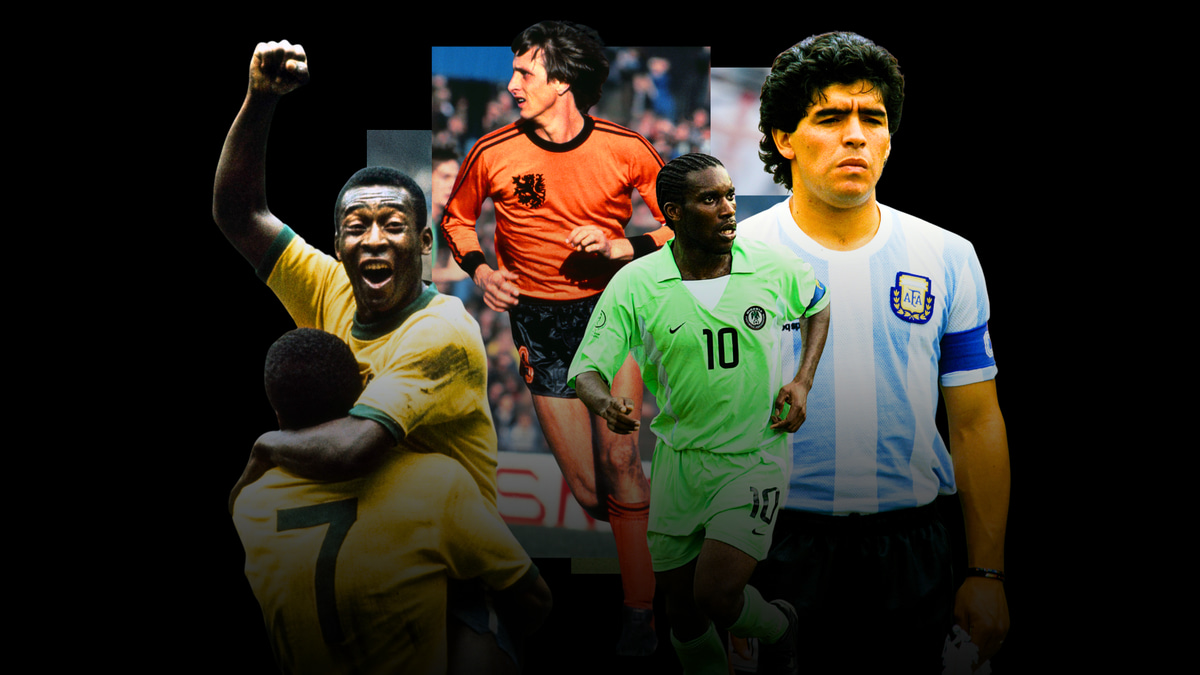
From the iconic stripes of Argentina, to the elegance of Italy, to Brazil's famous yellow and green, World Cup kits are more than just what the players wear — they’re symbols of national pride, footballing history, and unforgettable moments on the world stage. Over the last century, some kits have become legendary, immortalised by stunning goals, heartbreaking losses, and glorious triumphs.
In this countdown, we celebrate the best, boldest, and most memorable World Cup kits ever worn, from retro classics to modern masterpieces.
England (1966)
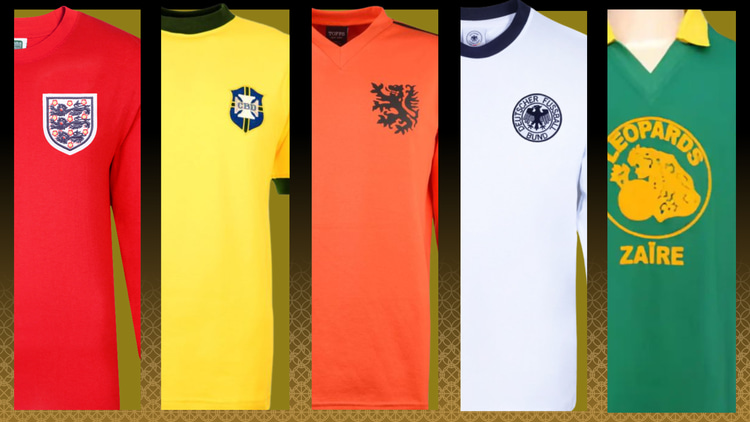
England’s first and only World Cup triumph came in their second strip, with reports indicating they were forced to wear their red away kit, despite being the host nation, after Sir Alf Ramsey lost a coin toss to West Germany.
It mattered little, however, as a hat-trick from Geoff Hurst and a strike from Martin Peters secured a historic 4-2 win after extra time at Wembley.
The kit, which was a simple all-red design with England’s crest on the top left, was designed by Umbro and while it was only worn in the 1966 final, it goes down as the most iconic shirt in Three Lions history.
Brazil (1970)
It’s not an exaggeration to say that this is perhaps THE football kit that historically represents the World Cup in what was arguably the tournament’s greatest moment, as the majestic Brazil side of 1970 won the World Cup in Mexico, led by the incomparable Pele.
While we had seen brilliant Brazil sides before, and Pele before, the 1970s allowed us to enjoy the famous yellow and green in glorious technicolour which became more widely available than in previous editions of the World Cup.
Think of seeing the back of the ‘10’ shirt as Pele nonchalantly passes into the path of Carlos Alberto to score what might be the greatest World Cup goal of all time.
Netherlands (1974)
"Always the bridesmaid, never the bride" is an idiom that perfectly encapsulates the Netherlands at the World Cup - and it all began in 1974.
'Total Football' was taking the world by storm. Rinus Michels’ star-studded team, spearheaded by Johan Cruyff, romped to the final, playing the most attractive football at the tournament, while wearing their distinctive orange kits. Notably, Cruyff wore a shirt with two stripes instead of the traditional three by Adidas, due to his sponsorship with Puma.
However, Oranje rested on their laurels after taking the lead in the second minute and ended up losing 2-1 to hosts West Germany in controversial fashion.
West Germany (1974)
West Germany sported a plain white kit with navy borders during their successful 1974 World Cup run in a tournament that also saw East Germany feature for the one and only time in their history before the nations were unified in 1990.
West Germany secured their second World Cup title after defeating the Netherlands 2-1 in the final, giving captain Franz Beckenbauer a historic moment to lift the trophy in the country’s bright white jersey that is still used even today.
Simple and efficient yet iconic – the perfect way to describe both West Germany’s kit and their performance on home soil in a victorious campaign.
Zaire (1974)
Zaire, now known as the Democratic Republic of Congo, made their one and only appearance in a World Cup in 1974, where they boasted a unique green jersey with yellow collars and sleeve tips, as well as a badge with ‘leopards’ printed on.
The kit was only seen three times as Zaire endured a difficult campaign filled with political turmoil, including a 9-0 defeat to Yugoslavia.
However, Zaire also attracted attention when Mwepu Ilunga charged out of the defensive wall and booted the ball away before Brazil could take a free kick in a scene often seen as an iconic World Cup moment by the African nation.
Italy (1978)
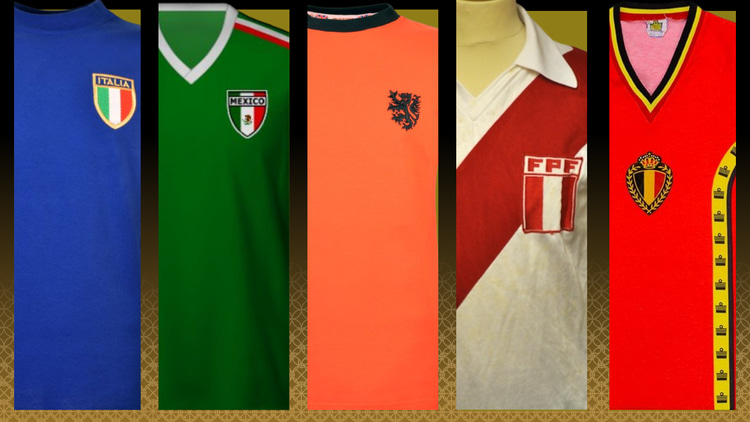
The simplicity of Italy’s 1978 kit makes it a real winner. There’s nothing fancy about the traditional Azzurri blue jersey, but that’s what makes it considered one of the purest examples of a classic kit design. It reflects the minimalist style of 1970s international jerseys, in that it’s completely plain with no stripes, patterns or brand logos. In fact, it was manufactured by Baila, whose logo only appeared inside the shirt.
The crew neck and ribbed cuffs are unlikely to ever make a comeback in modern shirt design, but that does not stop this kit from being an absolute classic.
Mexico (1978)
The 1978 World Cup was a flop for Mexico as they crashed out of the competition with three defeats from three games, with two goals scored and 12 conceded, yet their shirt from the tournament is still regarded as one of the best ever.
Mexico’s shirt was produced by Adidas and featured the traditional three stripes down the arms, with these coloured red and white, with the trim offsetting nicely against the deep green of the shirt. Nevertheless, it was branded by Levi’s in a distinct and unusual move.
Netherlands (1978)
After reaching the final in 1974, the Netherlands sought to go one better in the 1978 tournament in Argentina. However, they had to do so without talisman Cruyff.
Contrary to what was believed at the time - that he boycotted the tournament out of protest against the military dictatorship in Argentina - he actually refused to participate because he and his family had been the victims of a kidnapping attempt.
Despite the absence of Cruyff, the Netherlands yet again reached the final, this time under the stewardship of legendary Austrian manager Ernst Happel. Wearing a slightly altered version of their 1974 kits, the Dutch were yet again beaten by the hosts, losing 3-1 to Argentina.
Peru (1978)
Peru missed the 1974 edition, but they returned to the World Cup in 1978, and they were a team on a mission. Clad in their now-iconic white kit with a red sash, they finished top of a group that contained eventual finalists Netherlands, Scotland and Iran.
Attacker Teofilo Cubillas netted a brace against the Scots and a hat-trick versus Iran, ultimately finishing joint-second in the tournament’s Golden Boot race. Peru, however, ultimately met their match in the second group stage, where they were beaten by Brazil, Poland and Argentina.
Their 6-0 loss to hosts Argentina was overshadowed by match-fixing allegations, but overall, it was a tournament to be proud of for Peruvians.
Belgium (1982)
It was sports brand Admiral who arguably ushered in the era of football kits being made by outside brands for commercial purposes, as they pioneered developing replica kits to be purchased by Leeds fans in the 1970s.
By the 80s, such deals were everywhere but Admiral kept on evolving to produce one of the sharpest kits of the decade for Belgium at the 1982 World Cup.
In Spain, they successfully progressed through the first group stage but finished bottom of the second group stage behind Poland and the Soviet Union.
Argentina (1986)
One of the most iconic World Cup its of all time and it’s all due to one man - Diego Maradona.
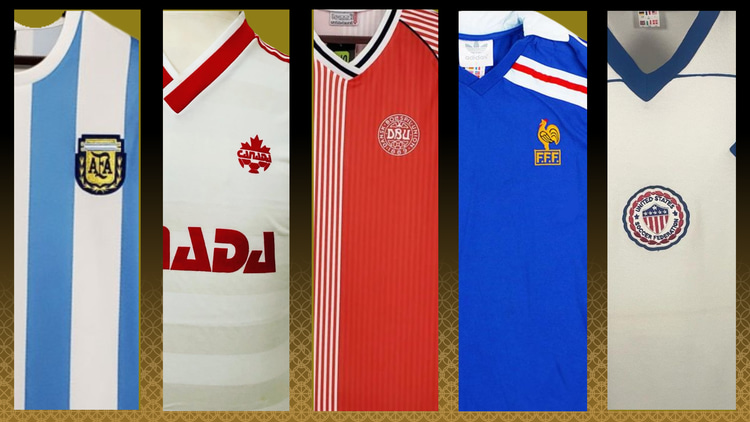
The vintage blue and white stripes of Argentina came alive when Diego donned the kit in ‘86 and in one game he managed to produce two of the most memorable tournament goals of all time. The first, the ‘Hand of God’ was infamous, while the second might just be the greatest solo goal ever scored.
Everyone wanted Le Coq Sportif gear after they saw Maradona wearing it, especially after Argentina won that tournament by defeating West Germany 3-2 in Mexico.
Canada (1986)
Canada qualified for their first-ever World Cup in 1986 and they produced an immense home kit to mark the occasion.
Designed by Adidas, the classic strip was a white jersey with a red collar and red trimmings, while Canada was spelled out on the front where a sponsor would usually be found in the modern game.
However, Canada were one of only two teams, alongside Iraq, to lose all three group stage matches and they finished bottom of Group C following defeats to France, Hungary and the Soviet Union.
Denmark (1986)
In 1986, Denmark unveiled one of the most iconic kits in football history and it remains a cult classic to this day. They also produced one of the most bizarre World Cup campaigns of all time while donning said jersey.
After qualifying for their first ever tournament, expectations were relatively low, but Denmark stunned the globe as they won all three group stage matches, beating Scotland, Uruguay and West Germany.
They then suffered a resounding 5-1 loss to Spain in the first knockout stage and their World Cup was over in a flash. The kit, however, lives on.
The pinstripe jersey was split down the middle and it featured two shades of red as Hummel revolutionised the football kit industry with a bold design that remains beloved to this day.
France (1986)
France’s kit for their triumphant 1984 European Championship campaign was superb and Adidas were soon faced with the unenviable task of producing a different design for the 1986 World Cup.
They decided to remove the stripes from the midriff and go for a simple blue base with a V-neck collar and white and red stripes on the sleeves. It went down a treat and remains a classic in French football history.
As for their performance on the pitch, France advanced to the semi-final stage before suffering a 2-0 defeat to West Germany. They then beat Belgium 4-2 after extra time in the third-place play-off match.
USA (1990)
The United States made their first World Cup appearance in 40 years during Italia 90 where they sported a white Adidas kit featuring blue designs across the sleeves and collar.
The kit was famously seen when the USA played hosts Italy in a game where they narrowly lost 1-0 and gained the respect of the international audience.
The Americans lost all three of their matches but they have not missed a World Cup since and, while their jersey has progressed over the following decades, the quirky 1990 design remains a unique product of its time.
Cameroon (1990)
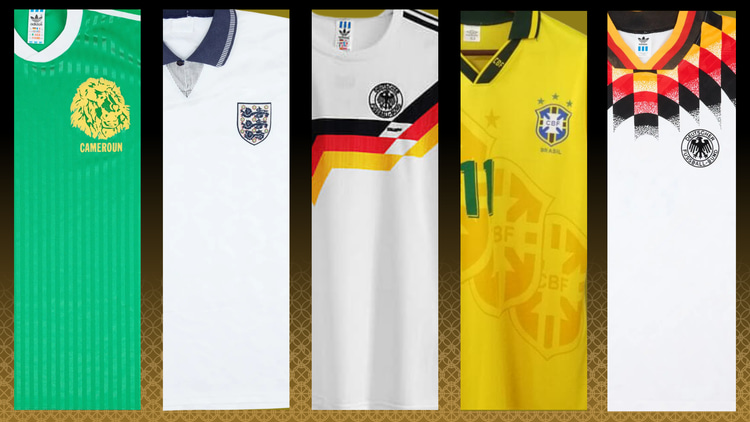
Another kit made famous by the exploits of one man, in this case Roger Milla of Cameroon.
The Indomitable Lions became everyone’s second-favourite team at Italia ‘90 as not only were they an impressive team, but they played with a smile.
Milla was key to this atmosphere as his dancing celebrations in the corner after scoring became a hit of the tournament. They impressively reached the quarter-finals, but were heartbreakingly eliminated by England after an extra-time goal from Gary Lineker.
England (1990)
While it didn’t result in World Cup glory like the 1966 away strip, England’s kit for Italia 1990 was also a thing of beauty.
Produced by Umbro, the classic white base featured a subtle geometric pattern, a dark blue collar and blue trimmings on the sleeves, and it remains a favoured retro shirt for all England fans to this day.
The Three Lions enjoyed their best World Cup campaign since 1966 at the tournament too as Gary Lineker and Paul Gascoigne helped to fire them to the semi-finals before an agonising penalty shootout defeat to eventual winners West Germany.
West Germany (1990)
Having previously sported plain white kits, the 1990 World Cup saw West Germany introduce a vibrant Adidas jersey with a horizontal zig-zag design of the flag’s colours across the chest.
The change may have proven lucky for the Germans as they won their third World Cup title in their final tournament before the nation was unified, making the shirt even more iconic for retro kit collectors given the historical context.
The jersey was considered radical at the time and was considered ‘too bold’ and ‘too colourful’ at the time, with 25-year-old designer Ina Franzmann claiming she wanted to come up with a design that ‘makes a kind of bang’.
Brazil (1994)
For many, Umbro is synonymous with England as it was formed in Cheshire in the 1920s. However, Brazil took the brand to a whole new level in 1994 with another yellow classic.
Brazil would go on to win the 1994 World Cup after beating Italy on penalties after THAT miss from Roberto Baggio.
But, the most famous moments from that tournament exploded into popular culture more than games or goals did. Yes, Romario, Nazinho and Bebeto doing the ‘baby’ celebration was actually in the blue away kit, but the overall offering from Brazil in 1994 was truly iconic.
Germany (1994)
The Adidas template shirt of 1994 worked particularly well for Germany, whose flag with three horizontal bands of black, red and yellow lent itself perfectly to the bold and very 1990s design of their kit.
Germany kits have been traditionally understated, largely consisting of a white jersey with only flashes of the flag’s colour. Here it was front and centre, impossible to miss. It made for a distinctive shirt that has gone down as a World Cup classic.
Unfortunately, their tournament did not go down quite so well as they were surprisingly beaten at the quarter-final stage by Bulgaria.
Ireland (1994)
Ireland opted away from an Adidas template kit at World Cup 1994 and were rewarded with one of their most memorable jerseys of all-time. Of course, the impression the shirt made was helped by the team’s famous 1-0 victory over Italy, in which Ray Houghton’s long-range strike gave Ireland a winning start to the tournament.
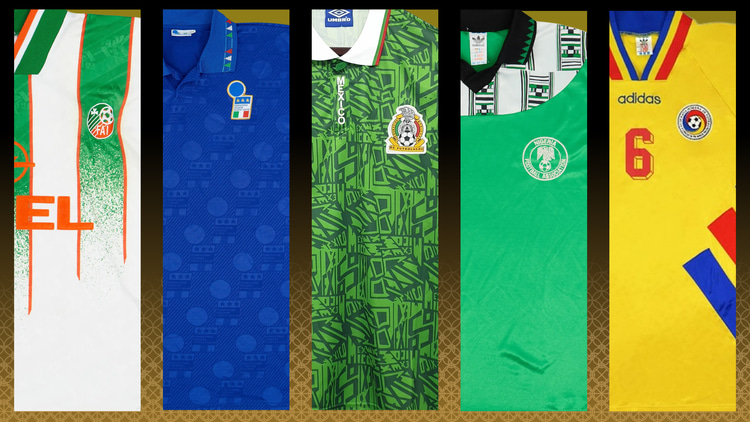
The Boys in Green were, of course, clad in their traditional emerald with a tonal pattern that showcased their logo in the middle of a moving football. The V-neck collar with an orange, white and green design helped stand out further.
Italy (1994)
Italy reached the final of the 1994 World Cup with an iconic shirt that was at once both innovative and traditional.
The Azzurri were clad in their traditional blue, which they wear as a tribute to the Royal House of Savoy, but there were distinctive aspects of this jersey that make it unmistakably from the 90s.
Firstly, the embossed logo of the Italian FA badge set in a diagonal pattern across the shirt. The triangles coloured red, white and green on the cuffs and collar, though, are what really set it apart.
Two more underappreciated aspect of this shirt are the number set and the collar.
Mexico (1994)
Mexico’s 1994 shirt is another 90s classic. It’s unashamedly loud and distinctive, setting the tone for what has followed from the North American nation.
It was a resplendently verdant kit, with Mexico’s traditional dark green interspersed with a brighter, more vivid colour in a geometric pattern. A close look shows that within the pattern, the word ‘Mexico’ is to be found all over the jersey.
On the collar, meanwhile, ‘Mexico’ is also printed vertically and visible when the sole button is undone.
There’s nice red piping on the arms to break up the overwhelming greenness, while the red and white on the collar helps to add another splash of colour.
Nigeria (1994)
Nigeria have become iconic for their brilliant World Cup kits, and it all began in the United States in 1994, when they entered the tournament for the first time. They suited up in a vibrant green strip with a traditional collar design on their way to becoming World Cup darlings.
The Super Eagles topped a group that contained Bulgaria, Argentina and fellow newcomers Greece. They resoundingly defeated the Bulgarians 3-0 - the biggest win of an African team at a World Cup finals - and Greece 2-0, while only narrowly losing to Argentina.
They took the lead against Italy in the round of 16 through Emmanuel Amunike, but late heroics from the legendary Roberto Baggio ultimately saw the eventual finalists prevail.
Romania (1994)
Romania arrived at the 1994 World Cup donning a striking, typical 90s-style kit made up of their national colours, and their performances certainly matched the vivacity of their outfit as they would go on to achieve their best-ever finish at a finals tournament.
Despite a 4-1 thumping by the Swiss, Romania topped Group A courtesy of wins against Colombia and their American hosts. In the round of 16, they defeated a Diego Maradona-less Argentina after the 1986 winner was sent home for having failed a drug test, which ended his international career.
Romania’s fairytale run came to an end in heartbreaking fashion in the quarters when they lost to Sweden on penalties after a 2-2 draw.
Spain (1994)
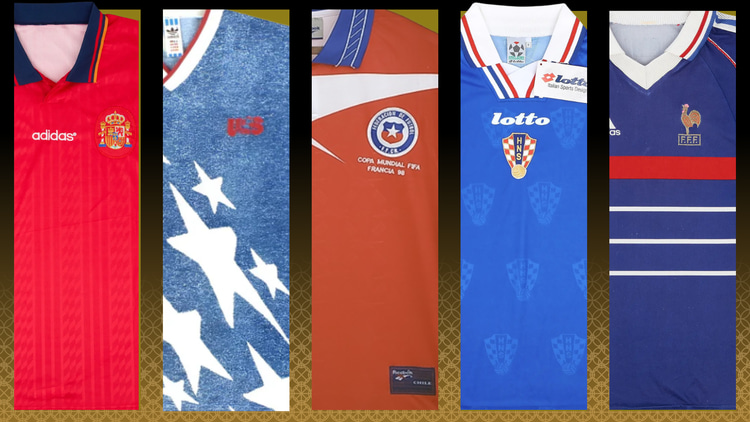
The 90s saw the rise of vibrant, geometric designs all across fashion and football kits were no exception, including Spain’s Adidas shirt worn at the 1994 World Cup in the USA.
The bright red shirt had yellow and blue diamonds going down the left side, with the same colours making up the collar, while the design featured a faint zig-zag throughout as Spain reached the quarter-finals of the tournament.
The design went on to inspire Spain’s 2018 jersey, which was a modern day take on the kit worn by stars such as Pep Guardiola and Luis Enrique.
USA (1994)
The United States, fresh off their first tournament in 40 years in 1990, were looking to return with a bang as hosts of the 1994 World Cup and their kit delivered on the message.
The away shirt, in particular drew attention with a grey design complimented by white stars coming from the left side, matched by a red trim across the sleeves and collar.
The 1994 World Cup was the most financially successful tournament in history and the quirky kits were a huge part of that, particularly in the US market and boasted by the home nation, who were knocked out by Brazil in the round of 16.
Chile (1998)
In their first World Cup appearance since 1982, Chile unveiled one of their best ever kits during the 1998 tournament.
The jersey was designed by Reebok and their famous red shirt was accompanied by two white diagonal stripes across the upper chest, a blue collar and blue cuffs, alongside World Cup text below their logo.
After drawing all three of their group stage games, Chile progressed to the knockout stages, although they suffered a 4-1 defeat to Brazil in the last-16 and weren’t seen at the tournament again until 2010.
Croatia (1998)
After gaining independence in 1991, Croatia qualified for their first ever World Cup tournament as a nation in 1998 and they stunned the globe with an eventual third-place finish.
They finished second in Group H, behind Argentina, and subsequently secured knockout wins over Romania and Germany before a 2-1 semi-final defeat to hosts France, who comfortably beat Brazil in the final.
Star striker Davor Suker won the Golden Boot award and Croatia’s home and away kits at the tournament were both extremely memorable. The away strip, in particular, was immense and it featured a blue base with the nation’s iconic red and white chequered pattern on each side.
France (1998)
After a third-place finish in 1986, France failed to qualify for the next two World Cups, before earning an automatic place at the 1998 tournament by virtue of being the host nation.
What followed was one of the most memorable World Cups in history, which ended with France lifting the trophy for the first time ever after a 3-0 victory over Brazil in the final.
Zinedine Zidane went into the tournament as one of the world’s most exciting midfielders and he fired Les Bleus to victory in one of the best kits of all time. Designed by Adidas, the kit had France’s iconic blue colour as its base, with one red stripe and three white stripes across the midriff, with tricolour cuffs and a V-neck collar. An iconic shirt befitting of champions.
Jamaica (1998)
Jamaica’s first – and so far only – trip to the World Cup finals at France 1998 yielded one of the classic football shirts and one that fitted the narrative of a fun-loving team from the island nation.
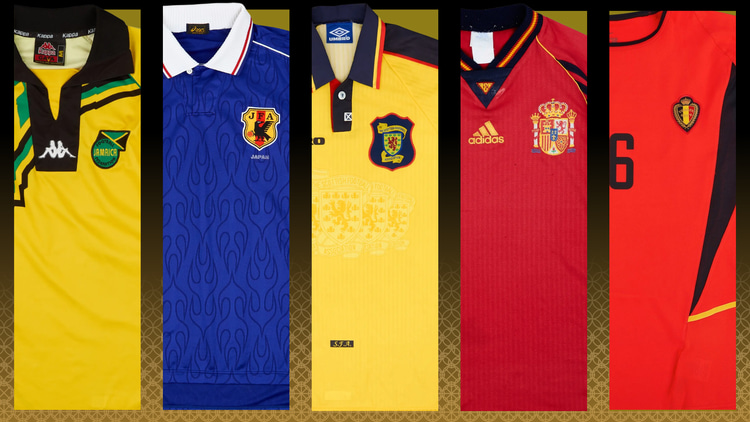
The kit was a bright, bright yellow colour with a unique green and black sash running down the right side of the jersey. This was meant to serve as an expression of Jamaican flair on the global stage.
It was a jersey designed to give the team an element of fun and confidence, and while Jamaica failed to make it through the group stage, they did at least cause an upset by beating Japan in their third and final match.
Japan (1998)
Japan’s first trip to the World Cup finals ended with three defeats in three games, yet the Samurai Blue won over football kit fanatics with their unique Asics design.
True to their traditions, Japan wore a deep blue kit that had dark blue flames embossed in the main design. On the arms, meanwhile, these were evident in red and white outlines in what was supposed to symbolise the energy and fighting spirit of the team.
The goalkeeper kit was even better. It was covered in red and gold flames, making it one of the most memorable keeper shirts ever worn.
Scotland (1998)
You may be forgiven for seeing Scotland’s away shirt during the 1998 World Cup and thinking it was from Belgium or Colombia, given the bright yellow colour with red and black trims.
While their blue jersey may perhaps be more iconic, Scotland wore their away kit once in their three matches across the tournament in a 1-1 draw with Norway.
Still, the Umbro kit is a true product of the loud and proud designs of its era, while the yellow colour scheme has continued to feature across Scottish away jerseys over the years – just perhaps not as bright and dominating as the 1998 edition.
Spain (1998)
Spain’s 1998 World Cup tournament was one to forget after they suffered a shock group stage exit, meaning their red home kit was only seen in two matches against Paraguay and Bulgaria.
The design was perhaps more muted compared to previous editions, with navy blue stripes being used on the sleeves and down the sides and it is not considered one of Spain’s more popular outfits.
Still, the kit formed part of the progression into the iconic red kit we see today from the Spaniards and the likes of Raul and Fernando Morientes had some goalscoring moments in the shortly-lived jersey.
Belgium (2002)
You can always count on Belgium to produce a lovely World Cup kit and they were part of the iconic range that Nike produced ahead of the 2002 edition of the tournament.
With it’s sharp red and black design, it’s hard to picture this particular kit without thinking of centre-forward Marc Wilmots who was in fine form in Japan and South Korea.
He scored in each of the first three games of the tournament and although Belgium were actually unlucky to be knocked out against Brazil at the round-of-16 stage, manager Phil Scolari would say post-tournament they were the toughest opponents the Selecao faced on the route to winning.
Brazil (2002)
Another belter from Brazil and another Nike belter from 2002. This strike is iconic because of the mesmerising striker that took hold of the tournament for the ultimate redemption arc - Ronaldo.
After being ill during the 1998 World Cup final and suffering from serious knee injuries thereafter, the 2002 World Cup was the stage Ronaldo Nazario needed to show the world he was still the very best in the business.
R9 scored eight goals in total in the tournament and two in the final against Germany.
And, he did it all with a dodgy haircut.
Cameroon (2002)
In 2002, Cameron won the African Cup of Nations with a never-before-seen Puma sleeveless kit which caused a bit of controversy upon its release.
Unfortunately for them, FIFA did not allow the players to take to the pitch without sleeves at the 2002 World Cup and so they were forced to improvise by adding sleeves late on. FIFA’s stance was that sleeveless shirts would not allow for a World Cup patch emblem to be added to the kit.
This squabbling did Cameroon no favours heading into the tournament and they were eliminated at the group stage behind Germany and the Republic of Ireland.
Uruguay (2002)
Uruguay wore a fairly basic kit at the 2002 World Cup, but it was made iconic by one specific goal. The strip itself mainly featured the country’s traditional sky blue colourway, with some white details and a large, more brightly coloured collar.
Uruguay’s performances at the tournament were nothing to write home about. Their opening game against Denmark ended in a 2-1, but Dario Rodriguez produced one of the most remarkable World Cup goals - a perfectly timed volley - in this match.
La Celeste would go on to draw 0-0 with struggling France and 3-3 with Senegal in a thrilling game. They exited the tournament after a third-placed group finish.
Nigeria (2002)
Nigeria qualified for their third successive World Cup in 2002, but the glory days of their first tournament in 1994 and the 1996 Olympics “Dream Team” were a distant memory. They didn’t offer much resistance in South Korea and Japan.
The Super Eagles lost to Argentina and Sweden before drawing 0-0 with England. They exited the tournament rock bottom of Group F with one point, having scored just one goal.
Although they struggled, at least they looked good while doing so, sporting a light green kit that was made iconic by Jay-Jay Okocha.
Portugal (2002)
2002 was Portugal’s first World Cup since 1986, but it was not one to remember, as this was still in the pre-Cristiano Ronaldo era. Their kit - an eye-catching mix of burgundy, yellow and green - was nice, at least.
Though they demolished Poland 4-0, they lost to hosts South Korea and the US in the group stage and thus did not advance to the knockout stage.
Their next World Cup in 2006 would be significantly more successful as they finished fourth.
South Korea (2002)
Simply put, it is hard to look at South Korea’s 2002 World Cup home kit and not feel a sense of joy given the country’s successful performance as co-hosts where they stole the hearts of neutrals.
The Koreans stunned the world by reaching the semi-finals of the competition, dumping out the likes of Spain and Italy in the process while boasting their plain white away kit.
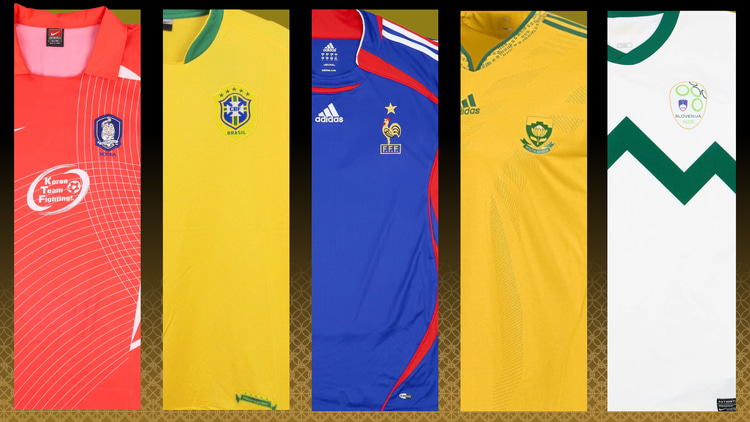
However, the red Nike home kit is just as iconic, if not due to its ‘Korea team fighting!’ logo written in English in the middle to give a reminder of the spirit displayed by the country in a historic tournament.
Brazil (2006)
2006 wasn’t a vintage year for kits but as always, Brazil delivered another cracking offering in the famous yellow. The collar was a bit polarising but it provided a unique change to the collars of the past.
On the pitch, the Selecao unfortunately toiled. Even if an extremely unfit Ronaldo broke Gerd Muller’s goalscoring record, Brazil didn’t impress in Germany.
Despite having talent like Ronaldo, Kaka, Adriano and Ronaldinho in their ranks, Brazil were not at their swashbuckling best and fell at the quarter-final stage to France thanks to a solitary goal from Thierry Henry.
France (2006)
France’s defence of their 1998 triumph was a complete disaster as they crashed out of the group stages in 2002, but they bounced back four years later with a runners-up finish.
Their defeat to Italy in the final was marred by Zidane’s infamous red card for a headbutt on Marco Materazzi, but their kit goes down as an all-time World Cup classic.
The blue home shirt was a modern design with a red pattern around both rip cages, while the away strip was sublime. It featured a white base with hints of blue and red and it remains a favourite of many football fans.
South Africa (2010)
Bafana Bafana! It is simply impossible to see South Africa’s home jersey for their 2010 World Cup tournament and not hear the sound of vuvuzelas and picture Siphiwe Tshabalala’s magnificent strike for the hosts in the opening match.
The golden yellow kit with green accents was on full display during the first tournament on African soil and the home nation put on a show in their first game against Mexico with a stunning goal.
South Africa were knocked out in the group stage so the kit was only seen for three matches but it still remains iconic to supporters for the memories across a unique tournament.
Slovenia (2010)
Slovenia were narrowly knocked out of the 2010 World Cup at the group stage due to a 1-0 loss against England, but their kit was spectacular.
They sported a simple white shirt that was cut across by a dark green zig-zag stripe. This was inspired by Mount Triglav, the highest peak in the mountainous country. It is an iconic symbol in Slovenia and often used in national team kits to evoke national price.
This was done particularly well by Nike. The clean design was offset by tasteful dark green trim and made for a visually pleasing shirt.
Australia (2014)
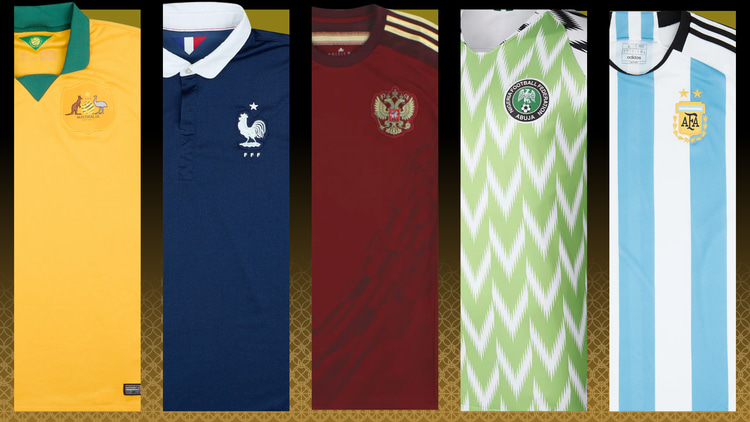
Australia are another nation that seem to consistency produce lovely kits and this one at least gave them a real moment to remember.
The Socceroos haven’t had much to shout about at the World Cup over the years but wearing this kit, Tim Cahill produced one of the most spectacular goals in the history of the competition.
With the ball coming over his head he keeps his eye on it all the way before crashing a first-time volley in off the crossbar.
Iconic.
France (2014)
After a dismal and highly chaotic 2010 World Cup, France fared slightly better in 2014 as they reached the quarter-finals before suffering a narrow 1-0 loss to eventual champions Germany.
Their kit was produced by Nike and it featured a dark shade of blue as the dominant colour, while the nation’s famous cockerel badge was modeled on the 1958 design.
The dark blue kit was inspired by the town of Nimes and France’s simple white away strip was also excellent.
Russia (2014)
Russia returned to the World Cup stage after a 12-year absence in 2014, and they certainly did so with a bang, at least as far as their kit was concerned. They donned a classy burgundy-gold strip that is easily among the nicest to have ever been worn at a finals tournament.
On the pitch, though, the Russians did not make much of an impact in Brazil. A 1-0 loss to Belgium was sandwiched between 1-1 draws with South Korea and Algeria.
Their failure to progress to the knockouts was a huge disappointment as they were not in a particularly strong group. They would have a much better time of it in 2018 on home soil, albeit in a controversial fashion.
Nigeria (2018)
Nigeria cemented their status as the kings of World Cup kits when they arrived in Russia in 2018, sporting an audacious green-white-black design that became an instant fan favourite. It is perhaps one of the most popular football strips ever created and received more than three million pre-orders.
However, Nigeria did not exactly manage to live up to the hype they had created with their kit. Drawn into a tough group, they failed to advance. The Super Eagles had to go up against eventual finalists Croatia, Argentina and Euro 2016 surprise package Iceland.
They managed to defeat Iceland but lost to Croatia and Argentina, thus only finishing third and having to depart again after just three games.
Argentina (2022)
Argentina’s 2022 World Cup jersey will forever be remembered as the kit that Lionel Messi lifted the trophy in.
No Argentina jersey is complete without the traditional sky blue and vertical stripes across the front and back, yet this time Adidas set this off against a black trim.
The number set was also in black and positioned in the centre of the front of the kit as well as on the back.
There was a subtle embossed pattern travelling diagonally down across the shirt, which helped to give it more depth.
Read more about:
FIFA Club World Cup