
-
Analysis
- 1 hour ago
How the Premier League changed the transfer market
Updated: 7 Jan 2026 08:31 CST |
8 min read

Analysis

The January transfer window is upon us, and it is worth setting the scene as to why the Premier League can consistently spend, while others merely barter.
The Premier League enters its 34th year in existence, and when it was born, Serie A was so clearly out in front in terms of stature, of culture, and of spending power, it’s worth remembering just quite how dominant they were.
In 1990/91, the top five transfers took place for a combined €43.9m and all five transferred to Serie A, with Juventus breaking the world record at the time for Roberto Baggio.
All figures are via FootballTransfers and their database, which you can access and bookmark here:
FootballTransfers: Transfer database
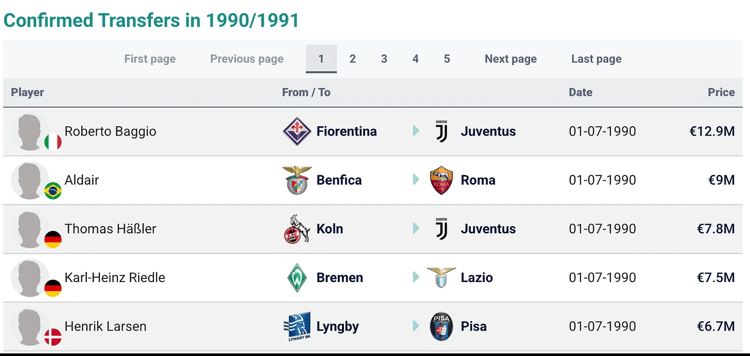
In 91/92, Serie A had four of the five biggest and in 92/93, eight of the top ten. Barcelona and Real Madrid soon get involved, before Serie A returned with a vengeance, spending gigantic sums around the turn of the millennium, the type of money they would struggle to spend now, let alone then.
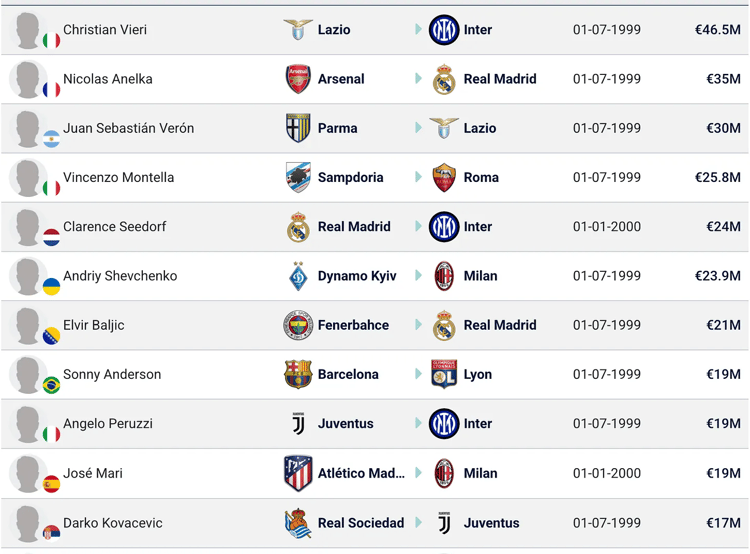
As you can see below, in 1999/00 Italy and Real Madrid dominate the spending. In Italy it was a broadly democratic spend, too; Inter, Juventus, Milan, Roma and Lazio all feature. Splashing crazy sums wasn’t part of the Premier League remit at this point, save for the odd Alan Shearer deal (1996).
Even for much of the 2000s, the transfer market remained a competitive, evenly-matched environment in which the power was distributed in multiple places, and generally, players had options. That is primarily because sources of income for clubs were competitively matched, with no real individual outliers beyond the chequebook of Florentino Perez and Real Madrid’s Galacticos.
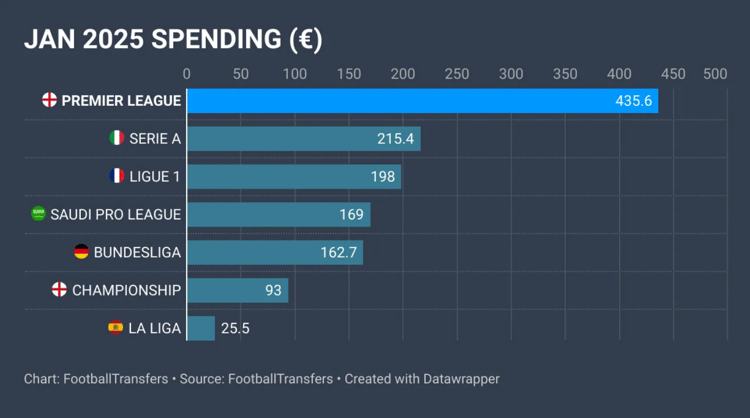
We all know that’s no longer the case. Real Madrid will always spend, Barcelona will always pretend they don’t still have crippling debt, and Bayern will always do their best to remain competitive. But elsewhere it is state-backed money, namely PSG and the Saudi Pro League, skewing things away from the only gig in town - the Premier League.
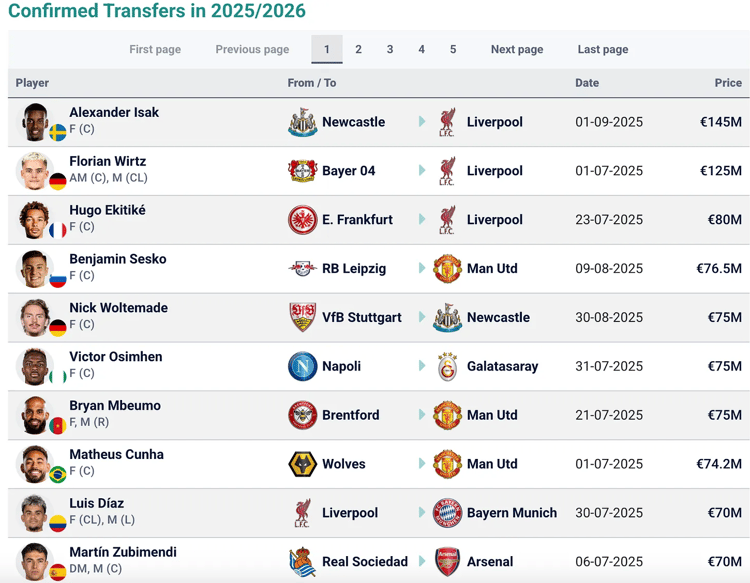
At one point, the Premier League begun marketing itself as the best league in the world, and others started believing it.
How did the EPL become so dominant?
Small pieces make up the large whole of why it became so popular, and here’s a few quite obvious markers, but a few less so.
1. Continental players - good ones - started playing there. Dennis Bergkamp and Ruud Gullit laid down the marker, and when Thierry Henry becomes the best player in the world there, circa 2004, the quality of the league and its international standing begun to be taken seriously.
2. There’s an advantage of a shared language for most of the world - English. English is unquestionably the world’s dominant football language and it makes things easier to understand and engage with. If you want to question this, La Liga’s international TV revenue easily exceeds Serie A or Bundesliga, two leagues where their language is only utilised domestically - though La Liga still have much work to do to catch up with the EPL’s commercialisation.
3. Manchester United, Liverpool and Arsenal have history you simply cannot manufacture or replace; it’s not like the EPL was going to market with completely new, unconnected assets. Teams like these were already in the consciousness, had featured some of the greatest players of all time, and were an easy sell for a burgeoning audience that, for the first time, were gaining access to international competitions that they had never seen before.
4. And that marketing strategy involved the teams, thus the now-famous Asian Tour was created. Not only were fans being exposed to these teams on TV for the very first time, they appreciated the fact they had taken the time to come play in front of them. Man Utd made £8m from their Asian Tour in 2025 alone - their first trip to Indonesia was as far back as 1975. There’s a level of long-term seed planting that the EPL has done so much better than anyone else.
5. Timing truly is everything. Around 2004 is when the international TV earnings potential opened up in earnest, and around then is when Manchester United’s stranglehold over the league had ended (at least initially). United won the league by 17 points in 99/00 and 10 in 00/01, but Arsenal became not only a challenger, rather the neutral’s team of choice. The fact that they were also the most cosmopolitan team ever assembled at the time helped.
6. And then Jose Mourinho arrived at Chelsea. It’s important to never underestimate the value of the box office individual and in Ferguson, Wenger, Mourinho and Liverpool’s Rafa Benitez, the league had four immensely powerful winners and also, bad losers, each with different personalities that would challenge each and every week.
Not only were fans being exposed to these teams on TV for the very first time, they appreciated the fact they had taken the time to come play in front of them.
- So while other leagues were continuing to focus on their domestic battles, the Premier League were miles ahead in their marketing efforts. They travelled. They competed in mini-tournaments. They partnered with local brands. Their footprint extended beyond Sharp Viewcam, McEwans Lager and the local sponsorships of the 90s, into pan-continental partnerships.
And the US was always the big target, one that they have taken on head on and are starting to gain ground. The 2012 NBC Sports deal which saw more Premier League, more of the time, is identified as a key breakthrough into a notoriously difficult-to-crack sports market controlled by the behemoth that is the NFL.
And it’s little discussed but patently true; the kick-off times are perfect to remain out of competition with the NFL and NBA. They are at American mornings, or lunchtimes. They are the perfect accompaniment to start the day, before their core sports begin. That is a time-difference luck-out that is simply a quirk of the globe.
BUT...
There is one key, undeniable, overarching reason why the Premier League has been successful; its revenue distribution model, which has allowed the weakest teams to be financial giants in comparison to other competitions.
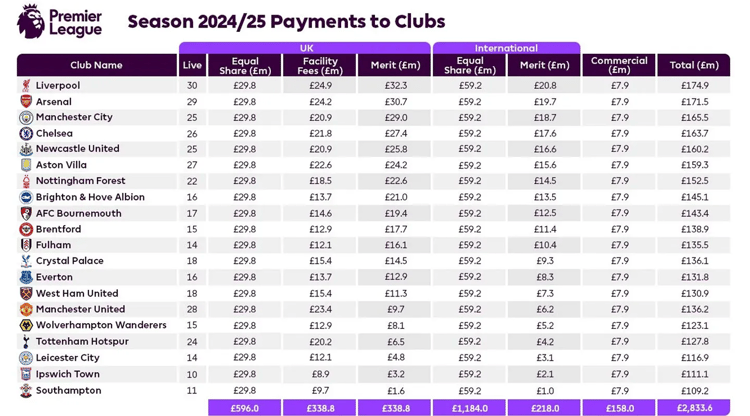
The Premier League remains the most equitable and yet simultaneously the most rewarding. There’s a equal share of both domestic and international TV revenue, while the facility fees are related to how often you’ve been chosen for a TV match. The rest is on merit - the higher you finish, the more you will get. Serie A and the Bundesliga work to a similar model, but the EPL’s simply delivers more across the board.
Comparing this to other leagues is where the disparity becomes apparent. Look, for example, at La Liga’s distribution for 2024/25:
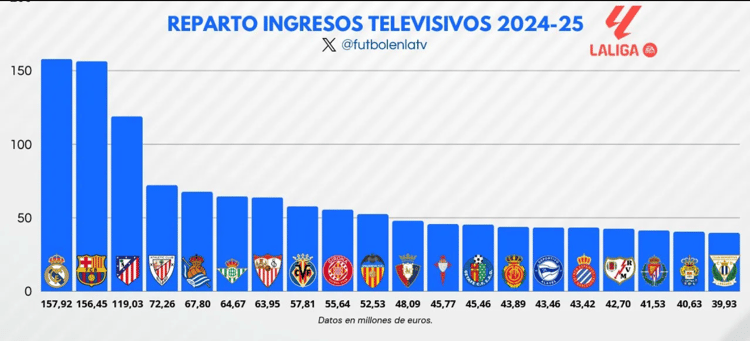
La Liga remains the most unfair and egregious split, ensuring nothing but the status quo, but also effectively ensuring half of the league are financially light years behind not only the top of their own league, but the bottom of the Premier League.
In fact, if you leave Real Madrid and Barcelona out of the equation, the team who finishes bottom of the Premier League earns more TV revenue than every other team in Europe, including Bayern, Juventus and Atletico Madrid. Of course these sides are regulars in Europe, which tops up their income and gives them a domestic competitive advantage. But based on the TV deals their respective leagues can drive alone, the disparity is clear.
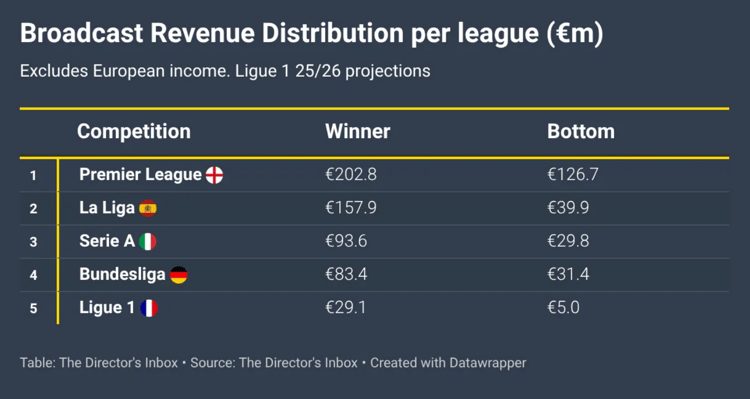
When we assess the landscape of European competition this season, we find six English clubs likely to reach the last 24 of the Champions League, while the leaders in the betting for the Europa League and the Conference League and both also English - Aston Villa, and Crystal Palace.
And with the new Squad Cost Ratio (SCR) that is coming in next season to replace Financial Fair Play, they will have more scope to spend more of this money they are generating, more of the time.
We hate to bang this particular revenue drum, but the gap is there for all to see. So when you see the Premier League spending again this January, remember. They can do it, and most other teams can’t.