
-
News
- 20 Sep 2026
The Golden Boy who changed football forever: How Diego Maradona became a god at Napoli
3 Mar 2026 03:00 CST |
7 min read
Analysis

Napoli signing Diego Maradona from Barcelona is one of the most important football transfers of all time.
At FootballTransfers, we determine the importance of a deal based on influence, legacy or the huge impact it had on a particular club or indeed the sport as a whole.
It could be because of a record-breaking or history-making transfer fee. It could be a transfer that broke down a social, cultural or racial barrier. It could be a move that transformed the fortunes of a team and led to a period of dominance. It could be a transfer that simply transcended the sport.
In the case of Maradona, he broke the world transfer record (for a second time) and changed the trajectory of Italian football by ushering in the most successful era in the history of Napoli.
Why did Napoli sign Diego Maradona?
When Diego Maradona arrived in Naples in July 1984, he was already a known commodity: he was a hot-headed but exceptionally talented playmaker.
Indeed, it was his temper that catalysed his move to Italy in the first place. Back in 1982, a 21-year-old Maradona was signed by Barcelona from Boca Juniors for a world-record £5 million fee despite coming off a disappointing World Cup with Argentina.
In Spain, Maradona was only able to show his prodigious talent in spurts. When he was on the pitch, he was almost unplayable. However, health issues plagued him, as did his enjoyment of Catalonian nightlife.
After suffering from hepatitis, he missed several months of action due to the notorious ankle-breaker from the Butcher of Bilbao, Andoni Goikoetxea, that threatened to prematurely end his career.
He ultimately recovered, but he wouldn’t stay at Barcelona for long. The 1984 Copa del Rey final proved to be his final game, as Maradona snapped after his side were beaten 1-0 by Athletic Club in Madrid.
Having had to endure taunts, xenophobic abuse and rough treatment for the entire match, Maradona was pushed over the edge by Miguel Sola after full-time and went rogue. Headbutts, punches and kicks ensued, resulting in a mass brawl in front of the Spanish king and 100,000 other spectators, with more than half of Spain’s population watching on TV.
As a result, Maradona’s position at Barcelona became untenable, and both parties agreed that it was best to part ways. The Argentine pushed for a transfer in the summer of 1984, leaving the Blaugrana after winning the 1983 Copa del Rey and Copa de la Liga and scoring 38 goals in 58 games.
The transfer
When the die was cast and Maradona was on his way out of Barcelona, it was expected that he would join another European giant. However, he did the opposite.
Struggling Serie A side Napoli, who had finished the 1983/84 season just one point above the relegation zone, shocked the world when they announced the signing of Maradona for a new record fee of £6.9m.
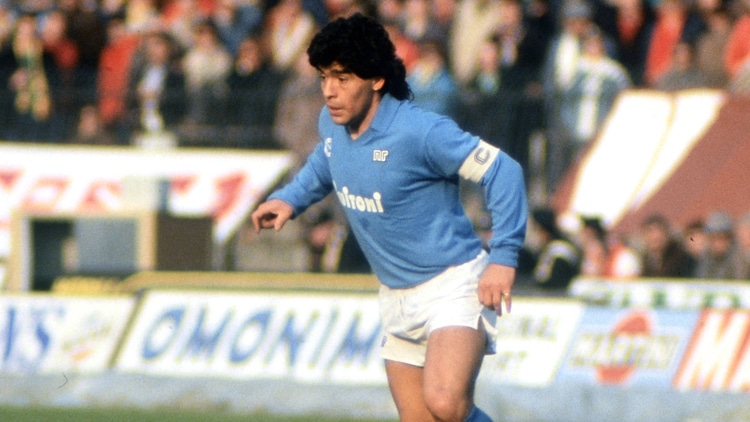
The deal was financed with the help of a local politician and a bank loan, and was only made possible for two reasons. For one, Serie A was becoming the place to be for superstars. It had begun attracting the biggest names in European football, so it was only natural for Maradona to move to the peninsula.
His options, though, were limited. Foreigner regulations were much more stringent back then, and despite his talent, few clubs were interested in shifting one of their stars to make way for an upstart who had consistently courted controversy.
The established powerhouses of Italian football - all located in the North or in Rome - already had their foreign spots filled with some of the most recognisable names in European football and were simply not interested in Maradona.
“I had no idea where I would go,” he later confessed. He needed money, and Napoli “were the only ones who made a [reasonable] offer.” He used the money he made from the transfer to clear his debts.
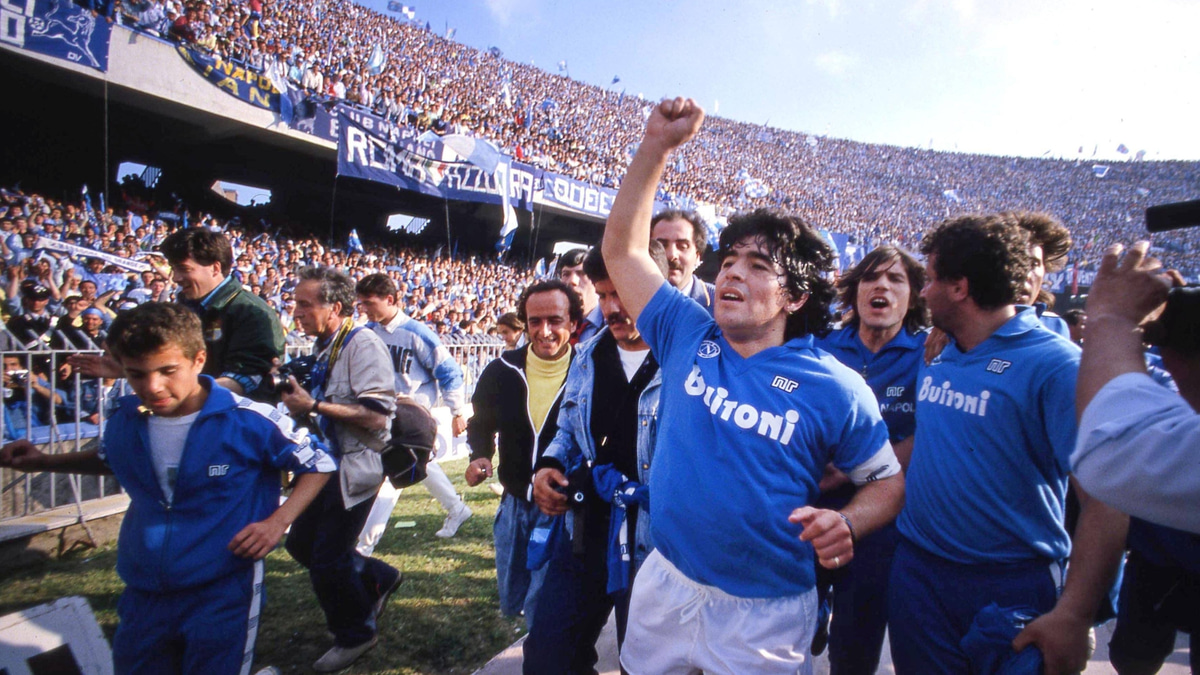
The Argentine was unveiled in front of 75,000 frenzied supporters at the club’s Stadio San Paolo on 5 July, and it quickly became clear that this was a match made in heaven.
Did the transfer work out?
Maradona felt at home in Naples. Hailing from a working-class family, he felt a connection to the downtrodden people of what was possibly the poorest city in Italy at the time. Discriminated against by the affluent, industrial North, the divide between the two parts of the country was at its most intense back then.
A team from the South had never won the Scudetto and, as mentioned, Napoli had battled against relegation before Maradona arrived. His transfer changed everything. He was hailed as the club’s saviour and certainly lived up to the billing.
60,000 season tickets were sold before his first campaign with the Parthenopei, but success didn’t come instantly. Napoli came eighth in 1984/85, but they were emboldened by developments in the North.
The established elite was faltering. Hellas Verona had upset the odds and won the Scudetto in 1985. This convinced Napoli that they could compete for silverware. By 1986, they were up to third.
The summer of that year proved to be a game-changer. Maradona led Argentina to World Cup glory, with his Hand of God and Goal of the Century going down in history. It was at the tournament in Mexico where the diminutive playmaker firmly established himself as one of the greatest players ever.
He carried his stunning form over into the new domestic season. Napoli’s ranks had been bolstered through smart and ambitious recruitment, and it quickly paid dividends. With 17 goals, Maradona catapulted his club to the top of Serie A to end the northern domination of Italian football. They followed that up by demolishing Atalanta 4-0 in the Coppa Italia to win the double.
Napoli entrenched themselves in the upper echelons of Serie A, finishing second behind the Milan clubs in the following two seasons. They did, however, win their first major European trophy by beating Stuttgart in the 1989 UEFA Cup final.
Maradona eventually fell out with club president Corrado Ferlaino, but he was still committed to the team, helping Napoli reclaim the Scudetto in 1990 and win the Supercoppa.
Legacy
His falling out with the president was a sign that his personal problems were increasingly getting the better of him. His cocaine use, which had already started during his time at Barcelona, turned into an addiction and became an almost daily routine at Napoli, eventually resulting in a 15-month ban that effectively ended his career with the club.
He also faced other accusations, such as siring an illegitimate son and having a connection with a Mafia clan, while his local popularity took a dent when Argentina knocked Italy out of the 1990 World Cup in Naples.
Although he left Napoli under a cloud in 1992, it didn’t diminish his status as the greatest player in club history and one of the greatest to ever play in Serie A. He was and still is to this day revered as a god in the city of Naples, almost on par with its patron saint, San Gennaro. Hundreds of murals around Naples are dedicated to their adopted son.
After brief stints at Sevilla, Newell’s Old Boys and Boca Juniors, he retired in 1997. His international career had already ended three years earlier when he failed a drug test at the 1994 World Cup in the US. He later became a coach and was named FIFA Player of the 20th Century, alongside Pele.
Although Serie A was already on its way to becoming the premier competition in European football, Maradona’s arrival accelerated the process massively. He elevated Napoli to a giant of the Italian game and helped break the stigma associated with teams from the South.
Maradona was Napoli’s Golden Boy and changed the landscape of Italian football forever. Without their talisman, the Partenopei had to wait 33 years for their next Scudetto. His shirt number was retired in 2000, and the San Paolo was renamed in his honour after his death in 2020. The name Maradona will forever be inextricably tied to Naples.
The FootballTransfers app
Check out FootballTransfers' new app for all of football's big storylines, transfer rumours and exclusive news in one convenient place directly on your mobile device.
The FootballTransfers app is available in the Apple App Store. Download here: