
-
News
- 1 hour ago
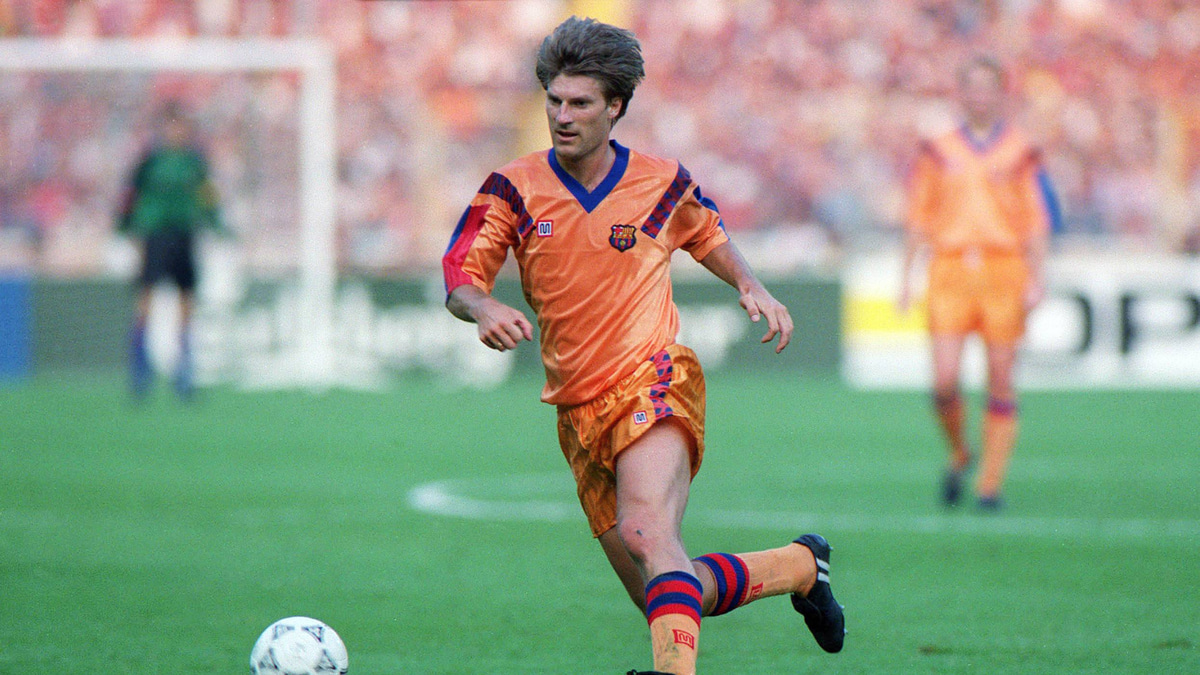
How Michael Laudrup defied his hero Johan Cruyff to ditch Barcelona for Real Madrid
Updated: 10 Feb 2026 07:55 CST |
4 min read
Analysis

Real Madrid signing Michael Laudrup is one of the most important football transfers of all time.
At FootballTransfers, we determine the importance of a deal based on influence, legacy or the huge impact it had on a particular club or indeed the sport as a whole.
It could be because of a record-breaking or history-making transfer fee. It could be a transfer that broke down a social, cultural or racial barrier. It could be a move that transformed the fortunes of a team and led to a period of dominance. It could be a transfer that simply transcended the sport.
In the case of Laudrup, he did the unthinkable years before Luis Figo in that he joined Real Madrid from arch-rivals Barcelona and the deal sent both clubs on very different paths until the end of the 1990s.
It's that aspect that sets him apart from Bernd Schuster, who left Barca for Madrid in 1988.
Why did Real Madrid buy Michael Laudrup?
Laudrup is considered to be one of the best attacking midfielders of all time and possibly the greatest player to ever emerge from Scandinavia.
Football is in his blood as his father, Finn Laudrup, was a professional player and manager while his brother, Brian, carved out a fabulous career of his own, featuring for giants like Bayern Munich, Milan, Chelsea and Rangers.
Laudrup had already enjoyed a fine career before even moving to Spain as he starred for KB, Brondby, Lazio and Juventus, winning Serie A with the Bianconeri in 1986.
He sought pastures new, however, and eventually made his way to Barcelona to be part of Johan Cruyff's 'Dream Team' that would go on to win the European Cup for the first time in the club's history in 1992.
“It was a completely different way of playing,” Laudrup told FourFourTwo about linking up with his childhood hero.
“Cruyff told me, 'Michael, you don’t need to drop so deep – I want you to play in the final 30 metres, otherwise you’ll get tired.'
"I had the freedom to express myself and we had a brilliant understanding as a team. I came from Italy, where it was important not to concede and many said the best result was a 1-0 win. Then I arrived somewhere that valued a 4-3 win over a 1-0. I really enjoyed the games and training.”
Under Cruyff at Barcelona, Laudrup won one European Cup, four La Liga titles, one Copa del Rey, one Supercup and one UEFA Supercup.
During his first few years at Barcelona, there was only allocated places in a squad for three foreign players. When a fourth, Romario, was added in 1993, things started to turn sour.
Laudrup, Romario, Ronald Koeman and Hristo Stoichkov rotated throughout the 1993-94 season as one player had to be left out of every single matchday squad.
For the 1994 European Cup final against Milan, which Barca lost 4-0, Laudrup was the player left out by Cruyff and that decision led to the relationship between the pair completely breaking after tensions had risen throughout the campaign.
After the match, Milan's manager Fabio Capello remarked: "Laudrup was the guy I feared but Cruyff left him out, and that was his mistake."
The transfer
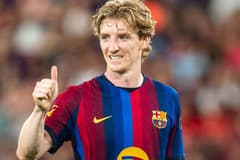
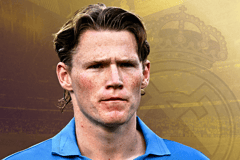
In 1994, Laudrup completed a hugely controversial move to Barca's arch rivals Real Madrid. Some speculated at the time that he did so in order to spite Cruyff, but he outright rejected those claims.
"People say I wanted to go to Real Madrid just to get revenge. I say revenge from what? I've had a perfect time; five fantastic years here [at Barcelona]," he said.
"I went to Madrid because they were so hungry to win, and they had four or five players who went to the World Cup. I said this would be perfect; new coach, new players, and hungry to win."
Did the transfer work out?
The Dane excelled for Madrid in his debut campaign and helped them win La Liga, ending former club Barca's four-year run of winning the title. He became the only player in Spanish history to win five consecutive league titles with two different clubs.
That title in 1995 would prove to be the only piece of silverware he would win with Real Madrid but he still became a darling of the fans.
In fact, unlike Luis Figo, he remains revered by both sets of Clasico fans despite crossing that divide.
Laudrup would go on to Vissel Kobe and Ajax before retiring in 1998.
Legacy
When asked years later why he doesn't receive the same treatment as Figo by the Barca fans, Laudrup responded to GOAL:
"I don't know, maybe we should ask the fans. When I returned two years ago I did not get a very good reception but when I finished as a player there was never a problem. I still go to the Camp Nou often. I always got well treated in Spain, both in the Camp Nou and the Santiago Bernabeu, but also in Bilbao and Seville. The truth is I do not know why they treat me so well in places where I did not play but this is what I'm most proud of."
Cruyff would only manage Barca for a couple more seasons before eventually retiring from club coaching and Madrid saw the opportunity to dominate again.
Though the Blaugrana won La Liga in 1998 and 1999, there was a 14-year gap between their first two European Cup/Champions League victories in 1992 and 2006.
In that period, Madrid won in 1998, 2000 and 2002.
It was only when Cruyff's disciple Pep Guardiola was appointed in 2008 that the true identity of Barca returned.
The FootballTransfers app
Check out FootballTransfers' new app for all of football's big storylines, transfer rumours and exclusive news in one convenient place directly on your mobile device.
The FootballTransfers app is available in the Apple App Store. Download here: