
-
News
- 11 hours ago
How Gianluca Vialli chose the Premier League to blaze a trail for an influx of foreign talent
Updated: 17 Feb 2026 07:59 CST |
5 min read
Analysis

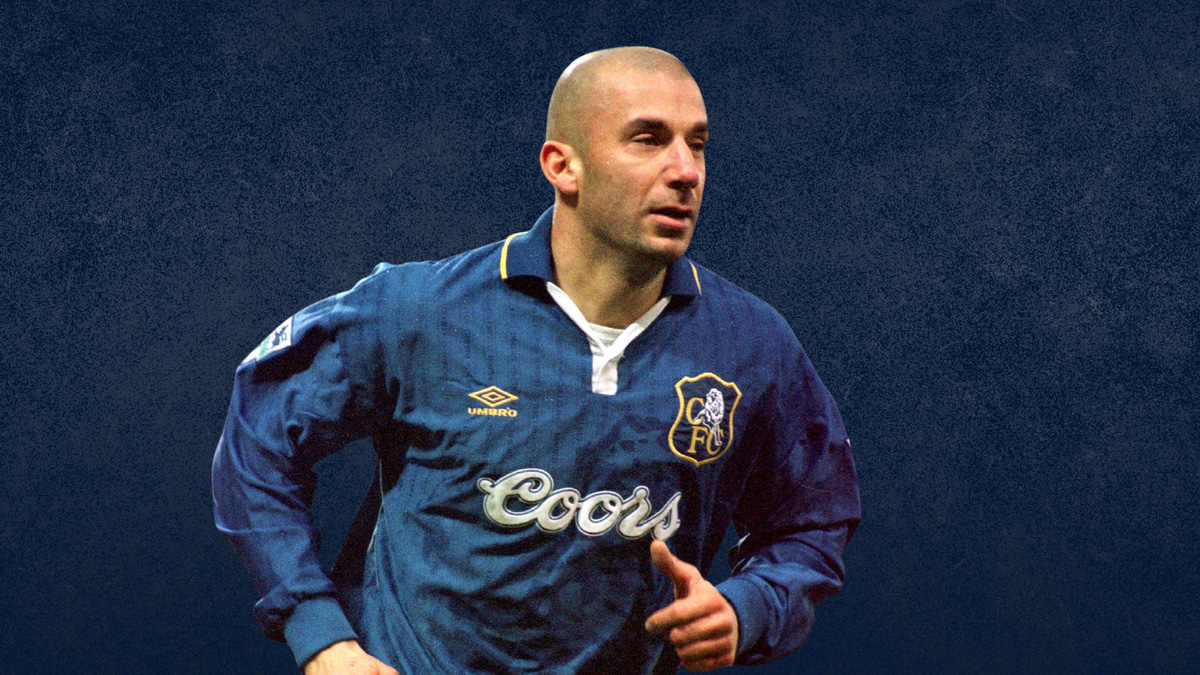
Chelsea signing Gianluca Vialli is one of the most important transfers of all time.
At FootballTransfers, we determine the importance of a deal based on influence, legacy or the huge impact it had on a particular club or indeed the sport as a whole.
It could be because of a record-breaking or history-making transfer fee. It could be a transfer that broke down a social, cultural or racial barrier. It could be a move that transformed the fortunes of a team and led to a period of dominance. It could be a transfer that simply transcended the sport.
In the case of Vialli, he chose to come to the Premier League at a time when it wasn't as dominant and popular as it is now, blazing a trail for a major foreign influx of talent in the years to come.
Why did Chelsea sign Gianluca Vialli?
After coming through the youth ranks of Cremonese and making a real impact on the first team, Vialli signed for Sampdoria in 1984 and he would eventually help the club win its first ever Serie A title in the 1990-91 campaign, while he also lifted three Coppa Italia titles during his time at the club.
His last match for Sampdoria was the 1992 European Cup final in which they lost 1-0 to Barcelona's 'Dream Team' under Johan Cruyff.
He subsequently became the most expensive footballer in history at the time following a £12.5 million switch to Juventus. Though he struggled with injuries in his first season with the Bianconeri, he was part of the side that won the UEFA Cup under Giovanni Trapattoni.
Vialli's strength and conditioning improved in his second season as he flourished under new boss Marcelo Lippi. In 1995, Juve won the Scudetto and the Italian Cup but just missed out on a treble after losing the UEFA Cup Final to domestic rivals, Parma.
He was eventually made club captain and captained the club to a Champions League victory in 1996, having already stated his desire to leave at the end of the season under the Bosman ruling.
The Transfer
In 1996, the newly-established English Premier League had only been running for four years as a replacement for the old First Division - it was far from the commercial and broadcasting juggernaut it is today.
It was, then, somewhat of a surprise that Vialli opted to sign for Chelsea, a club who at that point had not won the First Division since 1955. The Blues somehow convinced a true star of the game, fresh off a Champions League victory, to come to Stamford Bridge.
Prior to 1996, the Premier League was predominantly made up of British players but Chelsea catalysed a new trend for bringing in exotic foreigners. In the season Vialli joined, fellow Italians Gianfranco Zola and Roberto Di Matteo were acquired, as well as Frenchman Frank Lebouef.
Vialli's charm, talent and, well, coolness, meant he was the leader of the pack, while his grasp of the English language allowed him to settle quickly.
"Well, I was kind of shocked when I first arrived, the training facilities compared to what we had in Italy," he said on Graham Hunter's Big Interview podcast.
"The fact we had to train and leave the training ground by 1:00 because at 1:30 we had university students coming in and occupying our facilities. We couldn’t train twice a day, we had two days off a week, which was incredible. Even looking at some of the British players under the shower, and seeing them quite unfit. It was totally different, no need to spend the night before a match in the hotel.
"With the press, speaking to the press maybe one a month or less. The fans being extremely happy, no matter what as long as you give your very best. Results were important, but effort was more important. It was a shock for me."
Did the transfer work out?
Ruud Gullit was in charge of Chelsea at the time following Glenn Hoddle's decision to take over the England national team and the Dutchman made Vialli a primary target. The pair got on well to begin with but as the season progressed a feud gained momentum and Vialli was only given a few minutes off the bench as Chelsea won the FA Cup Final 2-0 against Middlesbrough.
Prior to the match, he said in a press conference: "I think my relationship with the players has been fantastic and my relationship with the fans is fantastic...with the manager there are some problems.
"But I want to forget them and think about the final. After the final we shall have a chat, I think.
"And then I will decide what is better for me and what is better for Chelsea.
"I don't know what Chelsea think at this moment. I hope they are happy with me. If they are I'd be happy to stay here.
"I can say I had some problems last week. But we have sorted them out, and now I am positive in thinking about playing football, in the final and the last matches in the Premier League."
Vialli ended up staying and not long into the 1997/98 campaign, he put in the best performance of his Chelsea, career, smashing in four goals in a 6-0 away win against Barnsley.
After four consecutive league defeats in February, Gullit was sacked and Vialli was appointed player-manager at the age of 33. As manager, he guided the club to League Cup and Cup Winners' Cup trophies.
Even though he regularly left himself out of matches, such as the aforementioned League Cup final, he finished the campaign as the club's top scorer.
He was also the youngest manager ever to win a UEFA competition.
Next season, he guided Chelsea to their highest league finish in 1970 (3rd) which enabled qualification to the Champions League for the first time. The next campaign, they reached the quarter-finals of that competition.
Vialli helped the Blues to further FA Cup glory in 2000 before losing his job five games into the 2000/01 season after high-profile spats with some players, including compatriot Zola.
He left a club legend and was adored by Chelsea fans until he sadly passed away from cancer in 2023 at the age of 58.
Legacy
Vialli's move was seismic for two very different reasons; one, alongside Edgar Davids he was one of the most high-profile players to take advantage of the newly-formed Bosman ruling. But secondly, he chose England at a time when it was miles behind Serie A in every aspect.
Vialli was a trailblazer in that respect, an internationally renowned talent choosing England over anywhere else. These days it's commonplace, but at the time the Premier League did not have the pull it now does; the arrival of players like Vialli opened the door for many others to follow.
The FootballTransfers app
Check out FootballTransfers' new app for all of football's big storylines, transfer rumours and exclusive news in one convenient place directly on your mobile device.
The FootballTransfers app is available in the Apple App Store. Download here:
Read more about:
Premier League
Chelsea